


School AI policy template: rules teachers will actually use
A school AI policy template with 11 sections, sample TK-8 language, and why each part matters, so teachers know what is allowed tomorrow.
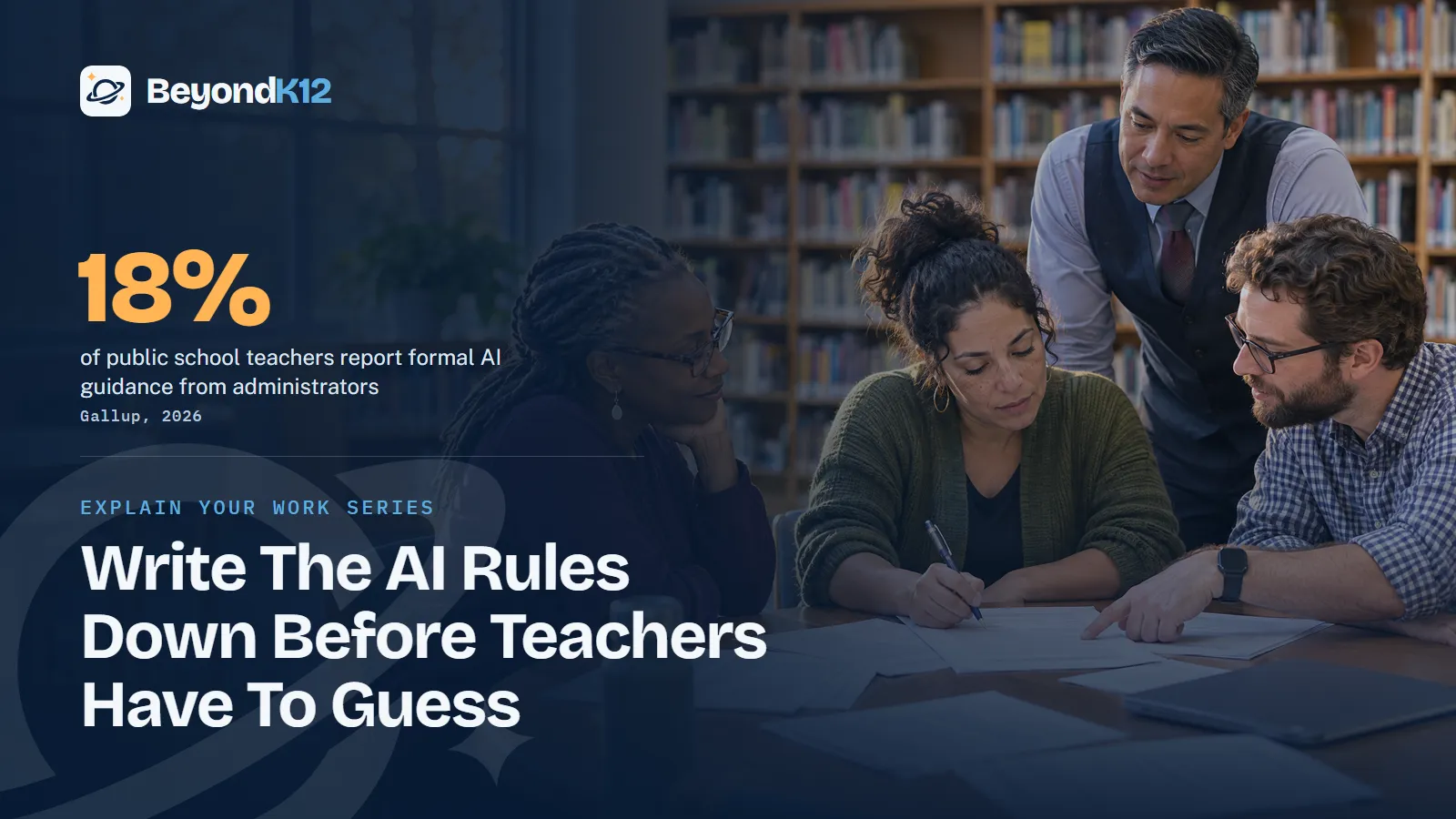
A school AI policy template teachers will actually use answers one question: what am I allowed to do tomorrow? Below is an 11-section outline you can copy, with a short note on why each section matters. An annotated example for a TK-8 school follows.
The need is real. Six in 10 public school teachers used AI for work in 2024-25, Gallup and the Walton Family Foundation found. In Gallup's 2026 follow-up survey, just 18% said they had received any formal AI guidance from administrators.
Why most teachers are still guessing about AI
Teachers are not short on opinions about AI. They are short on written answers. In Gallup's 2026 survey of public K-12 teachers, 48% had only informal guidance. Another 34% had none at all.
How much AI guidance teachers get
The gaps are widest where the stakes are highest. The same Gallup survey found 58% of teachers had no guidance on using AI for grading and feedback. For one-on-one instruction and tutoring, 69% had none.
RAND's 2025 research tells the same story from the principal's office. Under half of principals said their schools or districts have AI-use policies. Only about a third of teachers reported policies on AI and academic integrity.
Informal guidance is a hallway conversation. It changes with whoever you asked. A written policy gives every teacher the same answer, on the same day.
The school AI policy template: 11 sections to copy
Each row below is one section of the policy. Write it in plain words, with names and dates, not principles alone. Teachers act on lists.
| Section | What to write | Why it matters |
|---|---|---|
| 1. Purpose | Two sentences on why the school uses AI and what it protects. | The why settles gray areas the rules miss. |
| 2. Scope | Who it covers: staff, students, volunteers, vendors. Where: school devices, school accounts, homework. | Without scope, every rule invites "does this apply to me?" |
| 3. Approved uses | Named tasks and named tools staff may use now. | A teacher can act on a list by Monday. |
| 4. Prohibited uses | AI-only grading or high-stakes decisions, student data in prompts, unapproved tools with students. | A short no-list is easier to remember than a long yes-list. |
| 5. Student use by grade band | What students may do in TK-2, 3-5, and 6-8, in school-controlled tools. | A rule for an eighth grader is wrong for a kindergartner. |
| 6. Disclosure | How staff label AI-drafted materials and how students record which tools helped. | Disclosure turns hidden use into a conversation. |
| 7. Data privacy | No student names, grades, or records in prompts. Vendor review before any tool touches student data. | This is the section parents ask about first. |
| 8. Academic integrity | What counts as help, what counts as cheating, and what happens after a concern. | Clear lines protect students and teachers. |
| 9. Review and ownership | A named reviewer for each AI use and one owner for the policy. | Someone must be able to explain it to a parent or a board. |
| 10. Training | What every staff member learns, by when, and who teaches it. | A policy no one is trained on is a memo. |
| 11. Review date | A date on the first page and a mid-year check. | Tools change every semester. Stale rules lose trust. |
Keep the full policy to a few pages for the board. Then pull sections 3, 4, 5, and 6 onto one page for teachers. That page is the one they will actually use.
What an annotated example looks like
Here is sample language for the sections teachers ask about most. It is written for a TK-8 school. Replace the bracketed parts with your own tools and names.
Approved uses
Sample: Staff may use [approved tool] to draft lesson plans, rubrics, parent letters, and leveled reading passages. The staff member reviews and edits every draft before it reaches a student or family.
Why: This is human in the loop in two sentences. AI drafts and narrows. A qualified educator reviews, decides, and owns the result.
Student use by grade band
- TK-2: Students do not use AI tools directly. The teacher may demonstrate a tool, and the class talks about what it got right and wrong.
- Grades 3 to 5: Students use only school-controlled tools, in teacher-led activities, with the teacher present.
- Grades 6 to 8: Students may use approved, school-controlled tools for named tasks, such as brainstorming or feedback on a draft. They record each use.
Why: Pew Research Center found that 54% of U.S. teens ages 13 to 17 have used chatbots to get help with schoolwork. The policy decides whether they meet AI with a teacher beside them. Check each tool's terms for age limits, as the TeachAI toolkit recommends.
Disclosure
Sample: A student who uses AI on an assignment fills out a short disclosure. It names the tool, the request, what they kept, and what they changed. Every project ends with the student explaining what they made and why.
Why: Explanation is strong evidence of learning, and it is hard to fake. It is how we build every project in TechPlus AI, our TK-8 curriculum.
Academic integrity
Sample: An AI detector result is a question, not a verdict. The teacher talks with the student and asks them to explain their work before any consequence.
Why: RAND found that half of surveyed students worried about being falsely accused of using AI to cheat. A conversation protects the honest student and still surfaces the shortcut. We go deeper in why explaining the work beats catching cheaters.
Review and ownership
Sample: No AI tool grades a student or makes a placement, discipline, or support decision on its own. A named educator reviews and decides. [Assistant principal] owns this policy and reports to the board each spring.
Why: TeachAI's Agency principle says AI-supported decisions should "ultimately rely on human approval processes." Writing down a name makes that real.
If a teacher has to guess what is allowed, you do not have a policy. You have a rumor.Ernie Delgado, BeyondK12
Who has to adopt a school AI policy?
More schools every year. Ohio's House Bill 96 requires all Ohio school districts to adopt a formal AI policy by July 1, 2026. The state's model policy covers acceptable use, academic honesty, data privacy, curriculum, and evaluating third-party AI tools.
A 2024 Tennessee law requires districts and public charter schools to adopt AI policies, the AI for Education tracker reports. The same tracker counts 35 states and Puerto Rico with official K-12 AI guidance or policy as of August 2026.
CoSN's 2026 survey found 79% of districts report AI guidelines, up from 57% in 2025. The Ohio and Tennessee laws cover public schools. Private and Catholic schools may face no mandate, but a written policy still answers the questions parents ask.
How to write and adopt it in 30 days
- Collect the real questions. Ask five teachers what they wanted to do with AI this month but were not sure was allowed. Their answers become your approved and prohibited lists.
- Draft from the template. Fill in all 11 sections in one sitting. Leave nothing as "to be decided"; write your best rule and mark it for review.
- Test it with the five teachers. Give them the one-page summary and three scenarios. If two of them answer a scenario differently, rewrite that rule.
- Adopt and announce. Take it to your board or leadership team. Send families a plain-language summary of what students may and may not do.
- Train, then calendar the review. Walk every staff member through the one-pager before the policy takes effect. Our professional development sessions can help. Put the mid-year check on the calendar the same day.
One thing to do this week
Ask five teachers: what did you want to try with AI this month but were not sure was allowed? Write their answers down. You now have the first draft of sections 3 and 4.
This post is part of our Explain your work series. Each one asks leaders to show their reasoning the way we ask students to show theirs. A written AI policy is the school explaining its work.
If you want to see where your written rules stand, take the free AI Readiness Assessment. Eight questions give you a score out of 24 across Policy, People, Curriculum, Guardrails, and Funding. Look first at the Policy pillar, where your written rules show up.
Related reading: Why school leaders must consider human in the loop AI for future-ready strategies and The role of AI ethics and human judgment in protecting student data in schools.
Questions school leaders ask
What should a school AI policy include?
At minimum: purpose, scope, approved uses, prohibited uses, student use by grade band, disclosure, data privacy, academic integrity, review and ownership, training, and a review date. Ohio's 2025 model policy covers similar ground, including acceptable use, academic honesty, data privacy, and evaluating third-party AI tools.
Are schools required to have an AI policy?
Some are. Ohio's House Bill 96 requires all Ohio school districts to adopt a formal AI policy by July 1, 2026, and Tennessee's 2024 law requires districts and public charter schools to adopt one. Private schools should check their own state.
How long should a school AI policy be?
Short enough that a teacher will read it. Aim for a few pages for the board and a one-page summary for staff. Gallup's 2026 survey found 48% of public school teachers had only informal AI guidance, so a clear written page is already an improvement.
Should elementary students use AI tools?
Our position is that TK-2 students should not use AI tools directly; the teacher demonstrates and the class discusses. Grades 3 to 5 use only school-controlled tools in teacher-led activities. Grades 6 to 8 may use approved tools for named tasks and record each use.
How often should we update our AI policy?
Put a review date on the first page and revisit it at least once a year, with a short check at mid-year. Tools and state guidance change fast: the AI for Education tracker counted 35 states and Puerto Rico with official K-12 AI guidance or policy as of August 2026.
Sources
- Gallup and Walton Family Foundation, Most Teachers Receive No Formal Guidance on AI Use (May 2026) (opens in a new tab) (checked 2026-11-08)
- Gallup and Walton Family Foundation, three in ten teachers use AI weekly, saving six weeks a year (June 2025) (opens in a new tab) (checked 2026-11-08)
- RAND, AI Use in Schools Is Quickly Increasing but Guidance Lags Behind (2025, via KMPH) (opens in a new tab) (checked 2026-11-08)
- CoSN, U.S. State of EdTech 2026 (opens in a new tab) (checked 2026-11-08)
- AI for Education, state AI guidance for K-12 tracker (updated August 2026) (opens in a new tab) (checked 2026-11-08)
- Ohio Department of Education and Workforce, model AI policy release (December 2025) (opens in a new tab) (checked 2026-11-08)
- Pew Research Center, How teens use and view AI (February 2026) (opens in a new tab) (checked 2026-11-08)
- TeachAI, AI Guidance for Schools Toolkit principles (opens in a new tab) (checked 2026-11-08)

See where your school stands on AI, in five minutes
Eight questions. A score out of 24 across Policy, People, Curriculum, Guardrails, and Funding, with the three fixes that move it most. The report is yours whether or not you ever call us.