


Beyond Technology Education is now BeyondK12: what the change means for schools
Founded in 2001 as Beyond Technology Education, the company became BeyondK12 in September 2025. Why the move to AI readiness, and what schools can use now.
Updated with current data and sources. Originally published September 2, 2025.
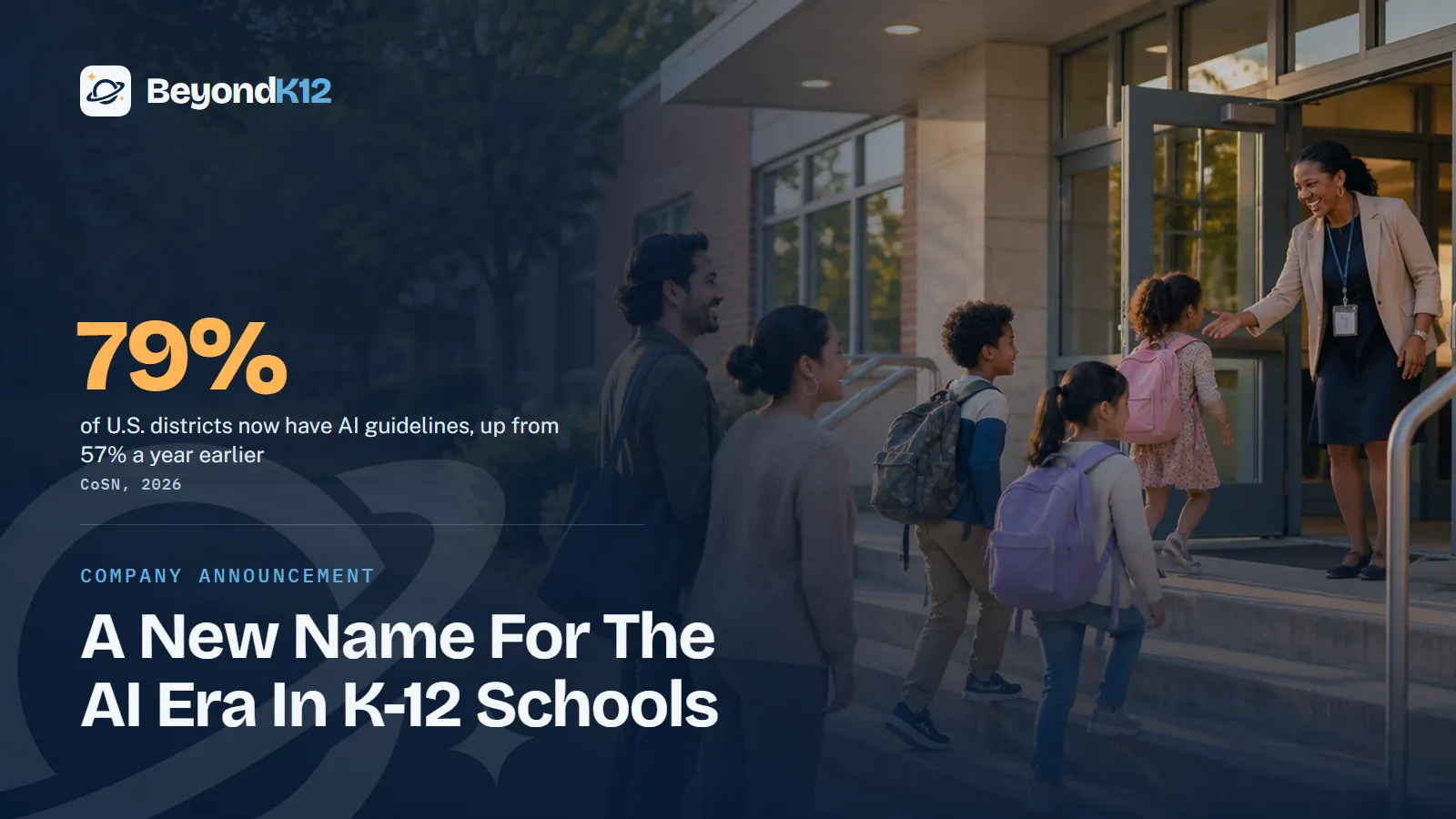
On September 2, 2025, Beyond Technology Education, founded in 2001 as a K-12 digital literacy company, became BeyondK12. The name changed because the job changed: school leaders stopped asking how to teach technology and started asking how to get their teachers, students, and systems ready for AI.
This post is the announcement, rewritten a year on with the context a school leader needs. It covers what the company did for two decades, why AI readiness is now the center of the work, what the September 2025 release promised and what those offers are called today, and how a school can start this week.
What the company was, and what BeyondK12 is
The company was founded in 2001 as Beyond Technology Education and spent more than two decades delivering digital literacy instruction and teacher training to K-12 schools, with a long history in Catholic, independent, and charter schools in California and beyond. The September 2025 release described it as a trusted K-12 digital literacy provider for over two decades, and that is a fair summary of the first chapter.
BeyondK12 keeps all of that and adds a second chapter. The release announced a sharpened focus on AI readiness: evaluating a school's technology, curriculum, and staff readiness for AI, then building a plan that aligns instruction, digital literacy, digital citizenship, and infrastructure with the realities of the AI era. The table below puts the two chapters side by side.
| Area | Then (founded in 2001 as Beyond Technology Education) | Now (BeyondK12, from September 2025) |
|---|---|---|
| Core question from schools | How do we teach students to use technology well? | How do we get teachers, students, and systems ready for AI? |
| Curriculum | K-12 digital literacy and digital citizenship | TechPlus AI: TK-8 digital literacy and AI literacy, every project ends with the student explaining the work |
| Leadership services | Technology planning and staff training | Free AI Readiness Assessment and the 90-Day AI Readiness Accelerator |
| Student programs | Technology electives | CEO Challenge and CEO Marketing entrepreneurship courses for middle and high school |
| Teacher support | Technology integration workshops | Professional development on responsible AI use, prompting, and classroom application |
| Funding help | Informal advice | A published funding guide mapping common federal and state sources to AI readiness work |
Why AI readiness, and why 2025
The timing was not a marketing decision. It followed what students were already doing. Pew Research Center's survey of U.S. teens, fielded in fall 2025, found that 64% use AI chatbots and 54% have used them for schoolwork. Some 59% of teens said AI-assisted cheating happens at least somewhat often at their school.
Adults were behind. The EdWeek Research Center found that 50% of teachers had attended at least one professional development session on AI by fall 2025, up from 42% a year earlier and 13% in 2023. Progress, but half of the profession had still never been trained, and most of the trained half had attended a single session. Gallup's 2026 survey put the leadership gap in sharper terms: 48% of teachers had only informal guidance on AI from administrators, and 34% had none at all.
Students moved first, schools are catching up
Meanwhile the policy layer moved fast. By August 2026, 35 states and Puerto Rico had published official K-12 AI guidance, according to the AI for Education tracker. CoSN's 2026 survey of roughly 600 district technology leaders found 64% of districts using AI in operations, up from 37% the year before. A school leader in 2025 could see this coming and had almost nowhere to turn for a plan that fit a single school's budget. That was the opening.
Districts moving on AI, 2025 to 2026
Our job is to give every school the knowledge, the tools, and the confidence to run its own AI strategy, with educators making the decisions.Ernie Delgado, BeyondK12
What the release announced, and what it is called today
The September 2025 release listed four items: a new identity, AI Audits for schools, customized AI Readiness Plans, and a free AI Tech Plan for schools ready to start. A year later those offers have settled into clearer shapes with clearer names.
The free AI Readiness Assessment
The AI Audit and the free AI Tech Plan became the AI Readiness Assessment: eight questions, five minutes, a score out of 24 across Policy, People, Curriculum, Guardrails, and Funding, and the three fixes that move the score most. It is free and the report belongs to the school.
The 90-Day AI Readiness Accelerator
The customized AI Readiness Plan became the 90-Day AI Readiness Accelerator: a guided program that takes a school from its assessment score to a board-ready AI policy, a staff training plan, a curriculum decision, and a funding map in one semester.
TechPlus AI
The digital literacy curriculum that built the company is now TechPlus AI, a TK-8 digital literacy and AI literacy curriculum. Every project ends with the student explaining what they made, why, which tools helped, and what they would change. That explanation is the one assessment AI cannot complete for a child.
CEO programs and professional development
The CEO Challenge and CEO Marketing entrepreneurship courses for middle and high school students continue, as does teacher professional development, now centered on responsible AI use, prompting, and classroom application. The funding guide maps the common federal and state sources that schools use to pay for this work.
2001
the company was founded in 2001 as Beyond Technology Education; it is now BeyondK12
BeyondK12 announcement, 2025
8
questions in the free AI Readiness Assessment, scored out of 24
BeyondK12
90
days in the AI Readiness Accelerator, one semester from score to board-ready plan
BeyondK12
12
states that require a computer science course to graduate; none yet require an AI course
Code.org and CSforALL, 2025
What stays the same
Three things did not change with the name. The first is the belief that a human makes the decision. AI narrows the work; a teacher, a counselor, or a principal owns the outcome. The second is the focus on the schools that get the least help: Catholic, independent, and charter schools without a district technology office. The third is the student explanation at the end of every project, which has been part of the curriculum since long before generative AI.
How a school starts with BeyondK12
- Take the assessment. One leader, eight questions, five minutes. You get a score out of 24 and a short report naming the three weakest areas. Do it before the next leadership meeting so the conversation starts with a number.
- Read the score as a team. Put the five areas on the agenda: Policy, People, Curriculum, Guardrails, Funding. Agree on which one would embarrass you if a parent asked about it tomorrow. That is the first fix.
- Choose your pace. If you have a technology lead with time, use the report and the funding guide to plan the semester yourself. If you do not, the 90-Day Accelerator supplies the templates, the training calendar, and the weekly check-ins.
- Put the curriculum decision on paper. Decide what TK-8 students will learn about digital literacy and AI this year, who teaches it, and how students will show their work. A curriculum with a student explanation built in answers the cheating question before it is asked.
- Tell families. One page, plain language: how the school uses AI, who reviews it, and what students are learning. Gallup's finding that most teachers lack formal guidance is also true of most parents; a school that explains itself first earns the benefit of the doubt.
Where to start this week
A rename is only news if the work behind it is useful. The useful part is this: a school leader can find out today, for free, how ready the school is for AI, and can have a plan a board will approve within a semester. That is what the company could not offer a few years ago and what BeyondK12, the name it carries now, was created to do.
Start with the free AI Readiness Assessment. Eight questions, a score out of 24 across Policy, People, Curriculum, Guardrails, and Funding, and the three fixes that matter most. The report is yours whether or not you ever call us.
Related reading: Top 3 markers to audit your school's AI readiness in one hour and What is an AI strategy in K-12 education?.
Questions school leaders ask
Is BeyondK12 the same company as Beyond Technology Education?
Yes. The company was founded in 2001 as Beyond Technology Education and announced the new name, BeyondK12, on September 2, 2025. Same founder, same team, same K-12 focus, with AI readiness added to digital literacy as the core work.
Why did the company change its name?
Because the job changed. For two decades the work was digital literacy curriculum and teacher training. By 2025 school leaders were asking how to prepare teachers, students, and systems for AI, and the new name signals that AI readiness is now the center of the work.
What happened to the AI Audit and the free AI Tech Plan from the announcement?
They became two current offers. The free AI Readiness Assessment is an eight-question self-assessment that scores a school out of 24 across Policy, People, Curriculum, Guardrails, and Funding. The 90-Day AI Readiness Accelerator is the guided program that turns that score into a board-ready plan.
Do existing digital literacy customers lose anything?
No. TechPlus AI, the TK-8 digital literacy and AI literacy curriculum, the CEO Challenge and CEO Marketing entrepreneurship courses, and teacher professional development all continue under BeyondK12.
How urgent is AI readiness for a small private or Catholic school?
Public districts are moving quickly: CoSN found 79% had AI guidelines in 2026, up from 57% the year before. Private schools are exempt from most state mandates but not from parent expectations, and the teacher-side gap is the same everywhere: Gallup found only 18% of teachers had formal AI guidance from their administrators in 2026.
Sources
- CoSN, U.S. State of EdTech 2026 (May 2026) (opens in a new tab) (checked 2026-11-05)
- EdSurge, Report: school IT officials worried about AI adoption, cybersecurity (June 2026) (opens in a new tab) (checked 2026-11-05)
- Gallup and Walton Family Foundation, most teachers receive no formal guidance on AI (May 2026) (opens in a new tab) (checked 2026-11-05)
- Pew Research Center, How teens use and view AI (February 2026) (opens in a new tab) (checked 2026-11-05)
- EdWeek Research Center, Teacher AI training is rising fast but still has a long way to go (November 2025) (opens in a new tab) (checked 2026-11-05)
- AI for Education, State AI guidance tracker (updated August 2026) (opens in a new tab) (checked 2026-11-05)
- K-12 Dive, Code.org and CSforALL 2025 State of AI + CS Education report (December 2025) (opens in a new tab) (checked 2026-11-05)

See where your school stands on AI, in five minutes
Eight questions. A score out of 24 across Policy, People, Curriculum, Guardrails, and Funding, with the three fixes that move it most. The report is yours whether or not you ever call us.