


AI cheating in schools: ask students to explain their work
The best answer to AI cheating in schools is not a detector. It is a routine where students show drafts, disclose AI help and explain their work.
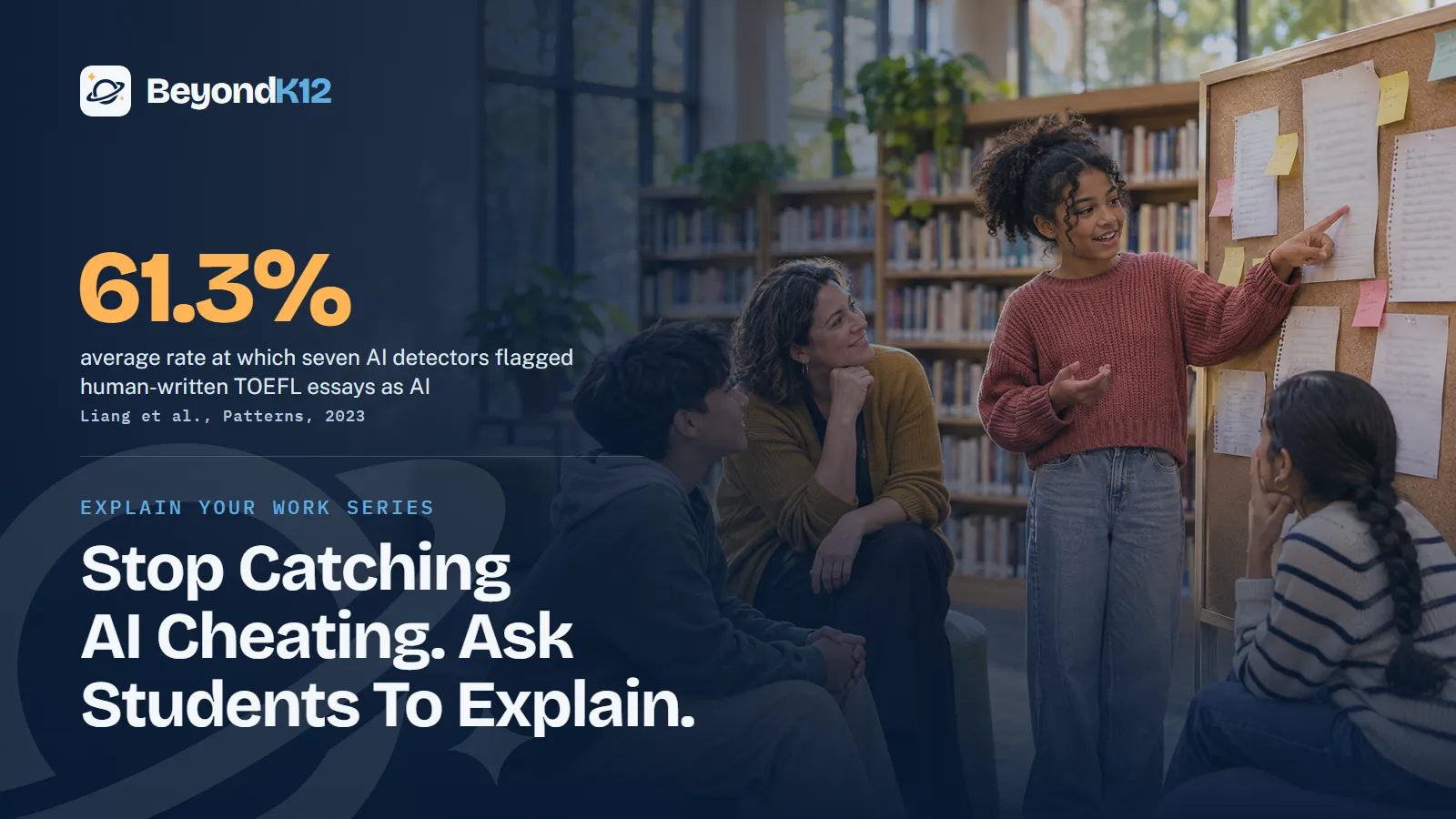
The best response to AI cheating in schools is not a better detector. It is a routine where students show drafts, disclose AI help and explain their work out loud.
A detector can only guess who wrote an essay. A student who can walk you through it has shown you what they learned.
This post is part of our Explain your work series. Its core idea is simple: explanation is evidence of learning that is hard for AI to fake. Below is the case against leaning on detectors, a routine to run tomorrow, and what to put in policy.
- AI disclosure record
- A short note attached to an assignment that lists each AI tool a student used, what they asked it, and what they kept, changed or rejected. It works like a citation for a book.
Why AI cheating in schools feels out of control
Teachers are not imagining the problem. In Carnegie Learning's State of AI in Education 2025, 78% of 656 K-12 educators were very or somewhat worried about AI cheating. The share who had experienced students cheating with AI rose from 53% in 2024 to 61% in 2025.
Schools have reached for software. In the Center for Democracy and Technology's 2025 report, 43% of 6th to 12th grade public school teachers regularly use an AI detection tool. Another 27% had tried one.
How often teachers use AI content detection tools
78%
of K-12 educators are very or somewhat worried about students cheating with AI.
Carnegie Learning, 2025
61%
of K-12 educators have experienced students cheating with AI, up from 53% in 2024.
Carnegie Learning, 2025
43%
of grade 6 to 12 public school teachers regularly use an AI detection tool.
Center for Democracy and Technology, 2025
15%
of teachers say school AI training covered how to respond to suspected AI misuse.
Center for Democracy and Technology, 2025
Put those last two numbers together. Teachers are using detection tools without much guidance on what to do next. CDT also heard from teachers whose students were accused of AI cheating that could not be proven.
Do AI detectors work well enough to accuse a student?
Not on their own, and some of the strongest evidence comes from the companies that build them. OpenAI withdrew its own AI text classifier in July 2023 over "its low rate of accuracy," Decrypt reported.
Independent research found a fairness problem.
A 2023 study in the journal Patterns tested seven widely used detectors. Stanford researchers ran 91 TOEFL essays by non-native English writers through them. The detectors wrongly flagged these human-written essays as AI 61.3% of the time on average. At least one detector flagged 97.8% of them.
Seven AI detectors on 91 human-written TOEFL essays
The same detectors classified essays by U.S. eighth graders accurately. Detectors have changed since 2023, and that study tested the versions available then. It still shows what a style guess can do to a student who writes plain English.
Vendors are more careful in their fine print than many schools are in practice.
Turnitin's chief product officer wrote in May 2023 about false positives. For documents with over 20% AI writing, its document-level false positive rate is less than 1%. Its sentence-level false positive rate is about 4%, and Turnitin marks scores under 20% as less reliable.
Turnitin also says it cannot remove the risk of false positives completely. It tells educators to use the score to start a conversation with the student.
Read those as vendor statements, not independent findings. Even taken at face value, they describe a tool that can open a conversation but cannot close a case.
What should count as proof a student learned something?
A detector score is a guess about a piece of text. An explanation is direct evidence about a student. A teacher who hears a student walk through their choices is grading thinking, the real point of the assignment.
| Question | Detector score | Explain your work routine |
|---|---|---|
| What does it check? | Whether the writing style looks machine-made | Whether the student understands what they turned in |
| Who decides? | Software, unless a teacher steps in | The teacher, with the student's drafts and log in hand |
| What happens when it is wrong? | An honest student carries an accusation | The teacher asks a follow-up question |
| What does the student learn? | How to avoid getting flagged | How to describe their process and disclose their tools |
| Student privacy | Student work goes to another vendor | Student work stays with the teacher and approved school tools |
| Works in TK to 2nd grade? | No | Yes, out loud, like show and tell |
This is how we build our TechPlus AI curriculum for TK through 8th grade. Every project ends with the student explaining what they made, why, which tools helped and what they would improve. A kindergartner does it out loud, and an eighth grader adds a written AI disclosure record.
The proof of learning is a student who can explain the work, not a score from a detector.Ernie Delgado, BeyondK12
This is not a softer standard. A student who pasted in a chatbot answer usually cannot explain why the third paragraph says what it says. A student who did the work almost always can, even if they are nervous.
A five-minute routine teachers can run tomorrow
This routine fits any written assignment or project. It costs a few minutes per student, and teachers do not need to run every step on every assignment.
- Put the AI rule on the assignment. State the allowed help in one line, such as "AI for brainstorming, not drafting." Students cannot follow a rule they never saw.
- Start the draft in class. Students begin the work during class, by hand or in a shared document with version history. Early drafts show how the thinking grew.
- Keep a process log. After each work session, students write a few lines: what they did, where they got stuck, what changed. It builds a record no detector can.
- Attach an AI disclosure record. Students list each tool, what they asked it, and what they kept, changed or rejected. Disclosure is a citation habit, not a confession.
- Hold a short explain conference. Ask three questions: How did you get here? Why this choice and not another? What would you improve? Rotate through the class over a unit, so a conference is routine, not an accusation.
- Decide as the teacher. If the explanation does not hold up, start with a redo and a conversation, then follow school policy. A detector score may prompt a conference. It never decides the case.
Scale it by age. In the early grades, the conference is the whole routine. By middle school, students can keep the log and the disclosure record on their own.
What school leaders should write into the AI policy
Teachers will run this routine with confidence only if the policy backs them up. Four lines do most of the work.
- No detector score alone decides an academic integrity case. A teacher conference and the student's process evidence come first.
- Student work goes only into approved tools. Essays can carry names, family details and health information. Pasting them into an unreviewed detector or chatbot is a privacy decision, not a grading shortcut.
- Every assignment states its AI rule, and students disclose AI help. Clear rules make honest use easy and dishonest use obvious.
- Teachers are trained on what to do when they suspect misuse. Short, practical professional development on the conference routine closes the gap CDT found.
Need a rewrite? See our guide to writing a school AI policy teachers will actually use.
One thing to do this week
Pick one assignment due in the next two weeks. Add a one-line AI rule, a short disclosure record and three conference questions. Run the conference with five students and see what you learn about their thinking.
Explaining work is a curriculum decision as much as a discipline one.
The free AI Readiness Assessment scores your school on Curriculum, Policy, People, Guardrails and Funding. It shows the three fixes that matter most. It takes five minutes, and the report is yours whether or not you ever call us.
Related reading: Building responsible AI use and human decision making in the classroom and The role of AI ethics and human judgment in protecting student data in schools.
Questions school leaders ask
Should our school use AI detectors to catch cheating?
If you use one at all, use it only to prompt a conversation. Turnitin said in May 2023 that it cannot remove the risk of false positives completely, and OpenAI withdrew its own AI text classifier in July 2023 for low accuracy. A detector score alone should never decide an academic integrity case.
Are AI detectors biased against English learners?
A 2023 Stanford study in the journal Patterns found that seven widely used detectors wrongly flagged human-written TOEFL essays as AI 61.3% of the time on average, while classifying U.S. eighth graders' essays accurately. Detectors have changed since then, but the study is a strong reason not to treat a score as proof.
How common is AI cheating in schools?
In Carnegie Learning's 2025 survey of 656 K-12 educators, 61% said they had experienced students cheating with AI, up from 53% in 2024, and 78% said they were very or somewhat worried about it.
What is an AI disclosure record?
A short note a student attaches to an assignment listing each AI tool they used, what they asked it, and what they kept, changed or rejected. It works like a citation. It tells the teacher where the help came from and gives the student something concrete to explain.
How long does an explain-your-work conference take?
Plan on three to five minutes per student, using three questions: how did you get here, why this choice and not another, and what would you improve. Teachers can rotate through a class over a unit instead of conferencing on every assignment.
Sources
- Carnegie Learning, The State of AI in Education 2025 (May 2025) (opens in a new tab) (checked 2026-11-08)
- Center for Democracy and Technology, Hand in Hand: Schools' Embrace of AI Connected to Increased Risks to Students (October 2025) (opens in a new tab) (checked 2026-11-08)
- Center for Democracy and Technology, survey research summary and methodology (October 2025) (opens in a new tab) (checked 2026-11-08)
- Liang, Yuksekgonul, Mao, Wu and Zou, GPT detectors are biased against non-native English writers, Patterns (July 2023) (opens in a new tab) (checked 2026-11-08)
- Turnitin, AI writing detection update from Turnitin's chief product officer (May 2023) (opens in a new tab) (checked 2026-11-08)
- Decrypt, OpenAI Quietly Shuts Down Its AI Detection Tool (July 24, 2023) (opens in a new tab) (checked 2026-11-08)

See where your school stands on AI, in five minutes
Eight questions. A score out of 24 across Policy, People, Curriculum, Guardrails, and Funding, with the three fixes that move it most. The report is yours whether or not you ever call us.