


AI tools for school administrators: build, buy, or skip
AI tools for school administrators: when to use what you already pay for, buy, build a small workflow, or skip. A decision table and five steps.
The best AI tools for school administrators are often the ones you already pay for. Decide problem by problem: use what you own, buy a new subscription, build a small workflow, or skip it. The order matters, because every new license adds cost, training, and a data agreement.
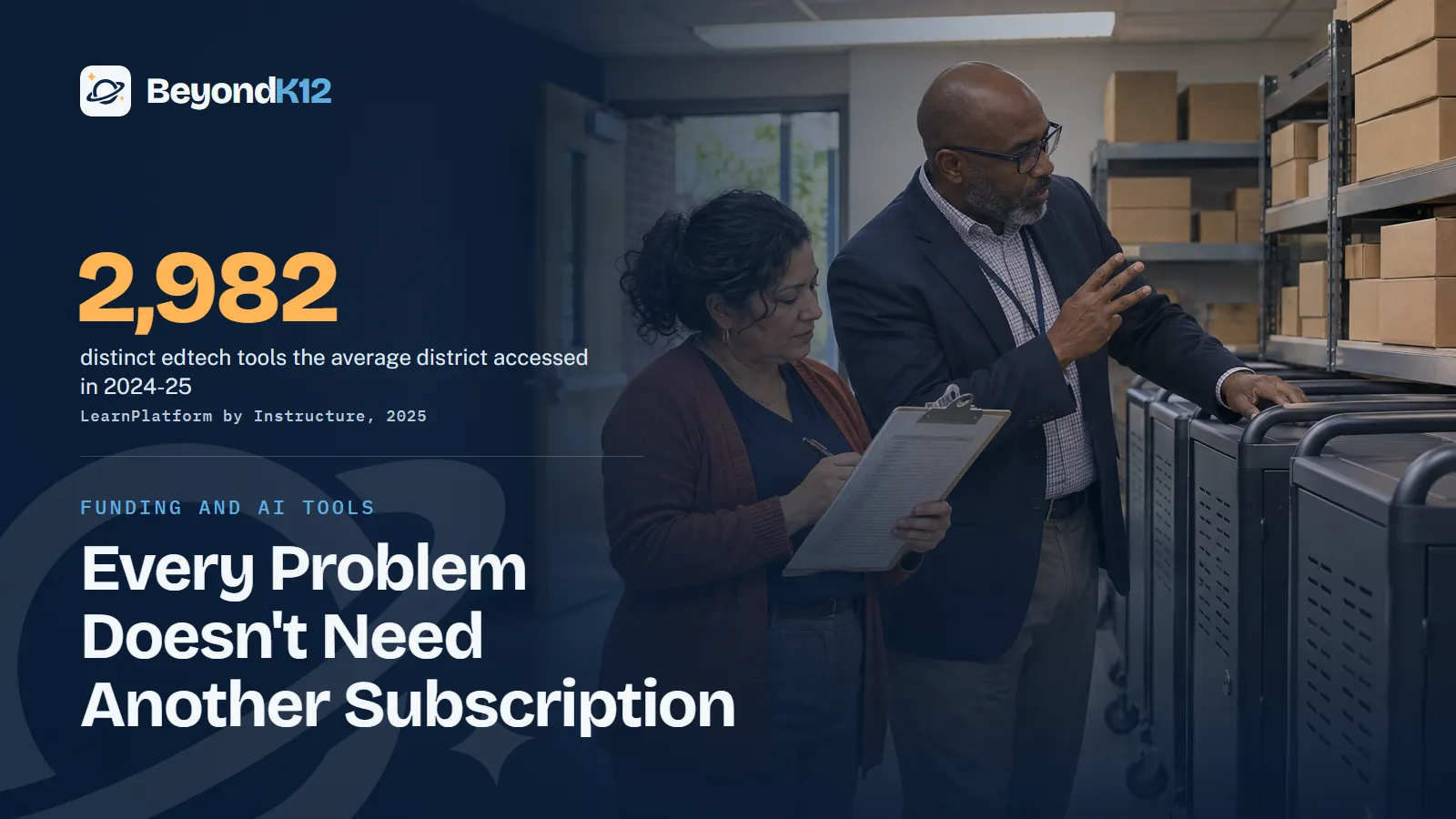
The tool count is already high. Instructure's 2025 EdTech Top 40 report found districts accessed an average of 2,982 distinct edtech tools in 2024-25, the most recent year it published a district count. The report counts tools accessed, not tools bought. Still, each one is a login, a data flow, and a question.
This post is part of our Explain your work series. The idea is simple. Every tool needs an owner who can explain what it does, what it costs, and whether it works.
Why is this the year to stop adding AI licenses?
Budget pressure has jumped for district leaders. In a spring 2026 RAND and CRPE survey, 54% of district leaders put budget shortages in their top three concerns. That was up from 33% in 2025, Education Week reported.
Two numbers shaping AI spending decisions
At the same time, AI features are showing up inside tools schools already license. In June 2025, Google made Gemini in Classroom free for educators on its Workspace for Education editions. Other vendors you already use may be adding AI features too.
That changes the first question. It is no longer which AI tool to buy. It is whether a tool you already pay for can do the job.
Which AI tools should school administrators buy, build, or skip?
Start from the problem, not the product. Pick one task that eats staff time, then run it through the questions below. You will often land on the cheapest answer: turn on a feature you already own.
| Question to ask | Buy when | Build when | Skip when |
|---|---|---|---|
| What is the problem, and how many staff hours does it cost? | Many staff lose real time to it every week | One office repeats the same steps every week | No one can name the hours, or it happens twice a year |
| Can a tool we already pay for do it? | Nothing you own comes close after a fair test | Your current suite does most of it with a simple automation | A current tool already does it well enough |
| Does it touch student data? | The vendor signs your student data privacy agreement | The workflow keeps student data out of AI prompts | The vendor will not sign, or the terms are vague |
| Who will own it? | A named owner will train staff and track use | A staff member has time to maintain it every month | No one has time, so it would sit unused |
| What happens when the AI is wrong? | Staff review every output, and the vendor explains how it works | Staff review every output, and the builder wrote down each step | It would make a decision about a student on its own |
Building does not mean writing software. For most schools, it means a small automation inside tools you own. Think of a form that feeds a draft, a reusable template, or a routed approval.
Our 90-Day AI Readiness Accelerator includes one working automation for this reason. A small build that one person can explain often beats a new license that nobody owns.
If no one can explain a tool to the board, the school should not be paying for it.Ernie Delgado, BeyondK12
What does an AI tool really cost a school?
The license is the number you see first. Total cost has five parts, and schools most often forget the last two.
- License. Per seat, per site, or per district, and what happens when enrollment changes.
- Training. Staff hours to learn the tool, plus stipends or substitutes if training happens outside the school day.
- Data agreements. The time to read the terms, negotiate, and sign a student data privacy agreement.
- Renewal. The price and terms in year two, and whether the contract renews on its own.
- Maintenance. For anything you build, the staff time each month to fix it when a form or a field changes.
A free feature still costs training time and a data review. A cheap build still costs the hours of the person who keeps it running. Count both before you compare options.
Federal funds may help, within limits. In July 2025, the U.S. Department of Education said AI uses can be allowable under existing federal education programs, Thompson Grants reported. They must align with each program's statutory and regulatory requirements and comply with privacy laws such as FERPA.
Read our funding guide before you write a tool into a grant. Plan for the renewal year, not only the first year.
Five steps to decide before the next renewal
- Inventory current subscriptions and who uses them. List every tool with AI features, its cost, its renewal date, and its active users. Check those tools for new AI features before you look at anything new.
- Name the problem and its time cost. Write the task in one sentence. Estimate the staff hours it takes each week. If you cannot estimate the hours, you are not ready to buy.
- Check data privacy terms and student-data agreements. Read the terms before any pilot, not after. Many districts use the Student Data Privacy Consortium's National Data Privacy Agreement, a standard contract for how student data is handled. Keep student data out of AI prompts entirely.
- Pilot with a named owner and an end date. One owner, a small group of users, one measure, and a date on the calendar. Staff review every AI output before it reaches a parent, a student, or a record.
- Decide to keep, fix, or stop. On the end date, compare the measure to the total cost. Then keep the tool, fix the setup, or stop it, and tell staff which and why.
Who owns an AI tool after it is turned on?
Guidance is now common in districts. CoSN's 2026 survey found that 79% of districts report having AI guidelines, up from 57% in 2025. Guidelines say what staff may do, and an owner says whether the tool is working.
Human in the loop applies to tools you buy and tools you build. The AI drafts, sorts, or recommends. A qualified educator reviews the output, makes the decision, and owns the outcome.
No AI tool should grade a student or make a placement, discipline, or support decision on its own. Write that rule into your policy before the first pilot starts. Our guide on how to write a school AI policy teachers will actually use shows where it fits.
Ownership also protects the budget. A tool with an owner gets reviewed at renewal. A tool without one renews by default, year after year.
One thing to do this week
Ask your business office for every software subscription that renews before next school year. Next to each one, write the owner's name and the problem it solves. Any line you cannot fill in is a tool to fix or stop.
Then see how your spending fits your wider AI plan. The free AI Readiness Assessment asks eight questions. It scores your school out of 24 across Policy, People, Curriculum, Guardrails, and Funding. Bring your Funding result to the next renewal conversation.
Related reading: Education grants: your guide to the funding you need for STEM and AI curriculum and The role of AI ethics and human judgment in protecting student data in schools.
Questions school leaders ask
What AI tools should school administrators try first?
Start with the AI features inside tools you already license. In June 2025, Google made Gemini in Classroom free of charge for educators on its Workspace for Education editions. Test what you own against a named problem before you buy anything new.
Should a school build its own AI tool?
Only a small one. For most schools, building means a simple automation inside tools you already own, such as a form that feeds a draft for staff to review. Build only when someone has time each month to maintain it.
Can federal funds pay for AI tools?
Sometimes. In July 2025, the U.S. Department of Education said AI uses can be allowable under existing federal education programs when they align with each program's statutory and regulatory requirements. Systems must comply with federal privacy laws, including FERPA. Check the program rules before you plan on it.
What should we check before an AI pilot?
Read the data privacy terms and confirm the vendor will sign your student data privacy agreement. Many districts use the Student Data Privacy Consortium's National Data Privacy Agreement. It is a standard contract for handling student data. Keep student data out of AI prompts entirely.
How do we know if our school is ready to spend on AI?
Take the free AI Readiness Assessment. Eight questions give you a score out of 24 across Policy, People, Curriculum, Guardrails, and Funding.
Sources
- LearnPlatform by Instructure, K-12 Edtech Engagement During the 2024-25 School Year (EdTech Top 40, June 2025) (opens in a new tab) (checked 2026-11-08)
- eSchool News, coverage of the 2024-25 EdTech Top 40 (July 2025) (opens in a new tab) (checked 2026-11-08)
- Instructure, press release on the eighth EdTech Top 40 report (June 30, 2025, via AI Journal) (opens in a new tab) (checked 2026-11-08)
- RAND and CRPE, Shrinking Budgets, Fewer Students (July 2026) (opens in a new tab) (checked 2026-11-08)
- Education Week, why superintendents' top concerns changed fast in 2026 (July 2026) (opens in a new tab) (checked 2026-11-08)
- CoSN, U.S. State of EdTech 2026 (opens in a new tab) (checked 2026-11-08)
- Google Workspace Updates, Gemini in Classroom for all Education editions (June 30, 2025) (opens in a new tab) (checked 2026-11-08)
- Thompson Grants, ED provides guidance on using grant funds for AI (July 2025) (opens in a new tab) (checked 2026-11-08)
- Student Data Privacy Consortium, National Data Privacy Agreement (opens in a new tab) (checked 2026-11-08)

See where your school stands on AI, in five minutes
Eight questions. A score out of 24 across Policy, People, Curriculum, Guardrails, and Funding, with the three fixes that move it most. The report is yours whether or not you ever call us.