
Why School Leaders Must Consider Human in the Loop AI for Future-Ready Strategies
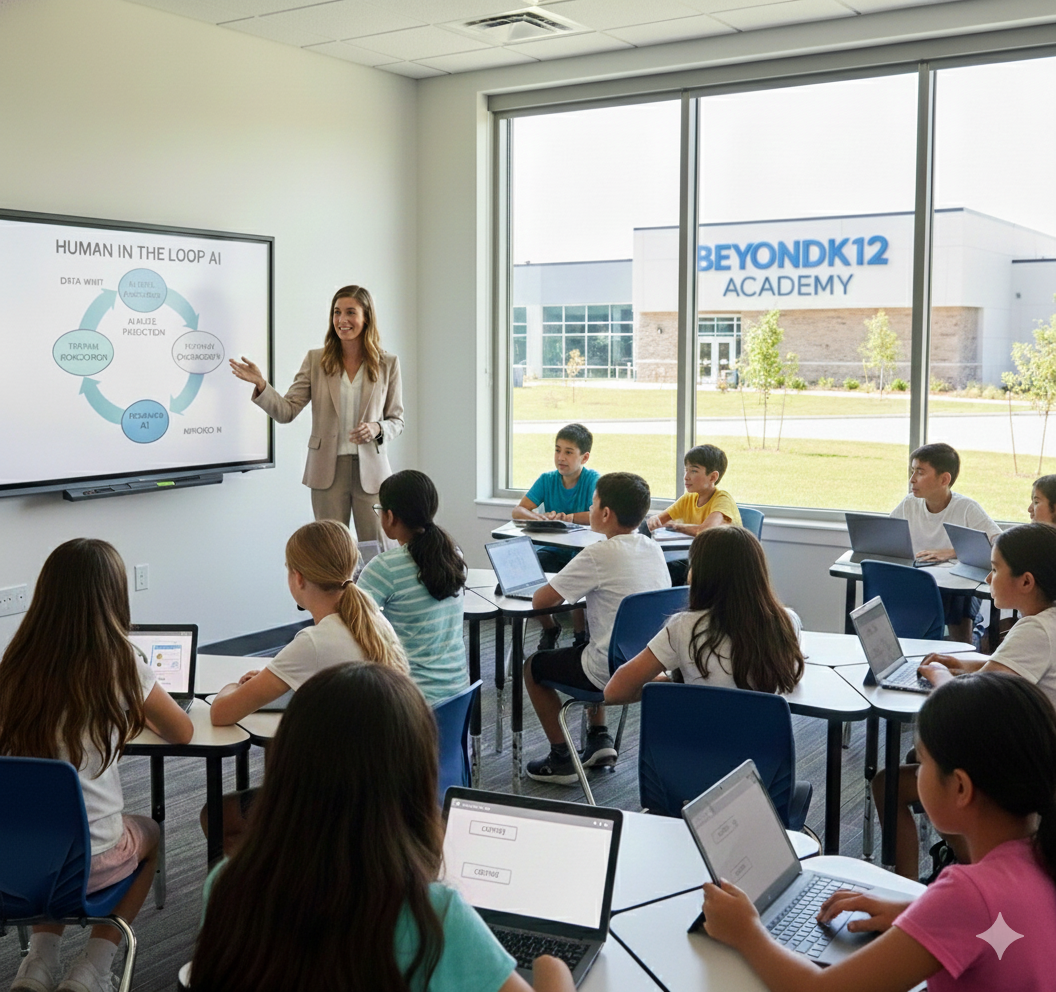
A teacher monitoring an AI-powered system while adjusting learning recommendations for students, demonstrating a human-in-the-loop AI model in K–12 education
Introduction: A Critical Moment for K-12 AI Strategy
Artificial intelligence is transforming industries everywhere, including K–12 education. Schools are using AI to improve instruction, automate tasks, support student needs, and personalize learning more effectively.
But one critical question remains:
How do we ensure AI in schools is ethical, equitable, safe, and aligned with human judgment?
The answer is Human in the Loop (HITL) AI—a model where educators guide, review, and approve AI-generated insights. This ensures student safety, academic integrity, and responsible technology use.
To explore a broader perspective, school leaders can review AI best practices for K-12 schools from BeyondK12:
https://www.beyondk12.com
Human in the Loop AI is the foundation for responsible, future-ready AI adoption in education.
What Is Human in the Loop AI?
Human in the Loop (HITL) AI means:
AI performs analysis or generates suggestions
Humans review, approve, correct, or refine those suggestions
Key Components of HITL AI
Human input – ensures ethical, accurate decisions
AI automation – handles repetitive data tasks
Review + feedback loop – humans validate outputs
Continuous improvement – AI learns from corrections
HITL blends AI efficiency with human-centered judgment.
Why HITL Matters for K-12 Leaders
As AI adoption accelerates, schools must address concerns about:
Algorithmic bias
Student data privacy
Over-automation
Misinterpreted student data
Transparency in decision-making
The U.S. Department of Education offers guidance in its Responsible AI in Education Framework.
Human in the Loop ensures:
Educators stay in control
AI supports—not replaces—teachers
Student fairness and privacy are protected
Decisions align with local school context
Trust and accountability remain central
AI + Human Intelligence: The Future of K-12
The future is augmented education, not automated education.
Imagine a school where:
AI flags when a student needs support
Teachers decide the next instructional step
AI drafts lesson plans
Teachers personalize lessons to student needs
AI tracks SEL or attendance patterns
Counselors intervene with empathy
Together, humans and AI create stronger outcomes, deeper relationships, and better learning environments.
Benefits of Human in the Loop AI in K-12 Schools
1. Better Personalization for Every Student
AI identifies learning patterns; teachers provide context, cultural understanding, and emotional insight.
This leads to:
Timely interventions
Personalized pathways
Equity and access
Higher engagement
See Brookings research on AI and personalized learning models.
2. Ethical and Safe AI Practices
HITL prevents:
Algorithmic mistakes
Biased decisions
Misuse of student data
Over-automation
This approach aligns with national K-12 AI safety standards.
Schools must build systems where AI enhances—not harms—student growth.
3. Teacher Empowerment
Human in the Loop AI strengthens teacher roles by:
Reducing workload
Supporting planning
Enhancing coaching
Offering actionable insights
Elevating teacher leadership
Teachers become AI-empowered learning designers.
4. Better Decision-Making for School Leaders
With HITL, AI provides insights for:
Staffing decisions
Scheduling
Intervention planning
Resource allocation
Climate improvement
Human judgment ensures decisions are culturally aligned and mission-driven.
5. Future-Ready Skills for Students
Students build:
AI literacy
Digital citizenship
Ethical tech understanding
Critical thinking
Problem-solving with intelligent systems
Education Week highlights how essential AI literacy is becoming:
https://www.edweek.org
How to Implement Human in the Loop AI in K-12 Districts
Step 1: Develop an AI Ethics & Governance Framework
Include:
AI use standards
Data privacy rules
Bias monitoring
Human review requirements
Family and community transparency
Step 2: Train Educators on AI Literacy
Training should include:
Responsible AI use
Prompting guidelines
Classroom application
Student data protection
Instructional augmentation
See future-ready digital learning strategies for K-12:
https://www.beyondk12.com
Step 3: Start With Low-Risk AI Tools
Begin with tools such as:
Lesson-drafting assistants
Student data dashboards
AI-supported grading
Communication templates
Always maintain human review.
Step 4: Monitor, Evaluate, Adjust
Ensure continuous oversight for:
Accuracy
Relevance
Ethical use
Cultural alignment
Why HITL Supports K-12 Values
Real Examples of HITL in Schools
Final Thoughts: Human-Centered AI Leads the Future
K-12 schools aren’t just preparing students for the future—they are shaping it. Human in the Loop AI helps districts build:
Ethical AI systems
Empowered educators
Stronger academic outcomes
Effective governance
Future-ready students
Key Takeaway:
AI + Human Expertise = Future-Ready Schools
Human-centered AI is not a trend—it is the foundation of responsible K-12 innovation.
How BeyondK12 Can Help
At BeyondK12, we specialize in helping schools navigate the complexities of emerging technologies. Our team provides training, strategic planning, and curriculum support tailored to your AI goals.
👉 Contact us to learn how we can build a sustainable and effective AI strategy for your school.
Ready to Build Your School’s AI Strategy?
Let BeyondK12 guide your journey.