


Using augmented intelligence (AI plus human) to personalize learning for every student
Augmented intelligence pairs AI analysis with teacher judgment to personalize learning: 2025-2026 tutoring evidence, the risks, and a one-semester plan.
Updated with current data and sources. Originally published January 31, 2026.
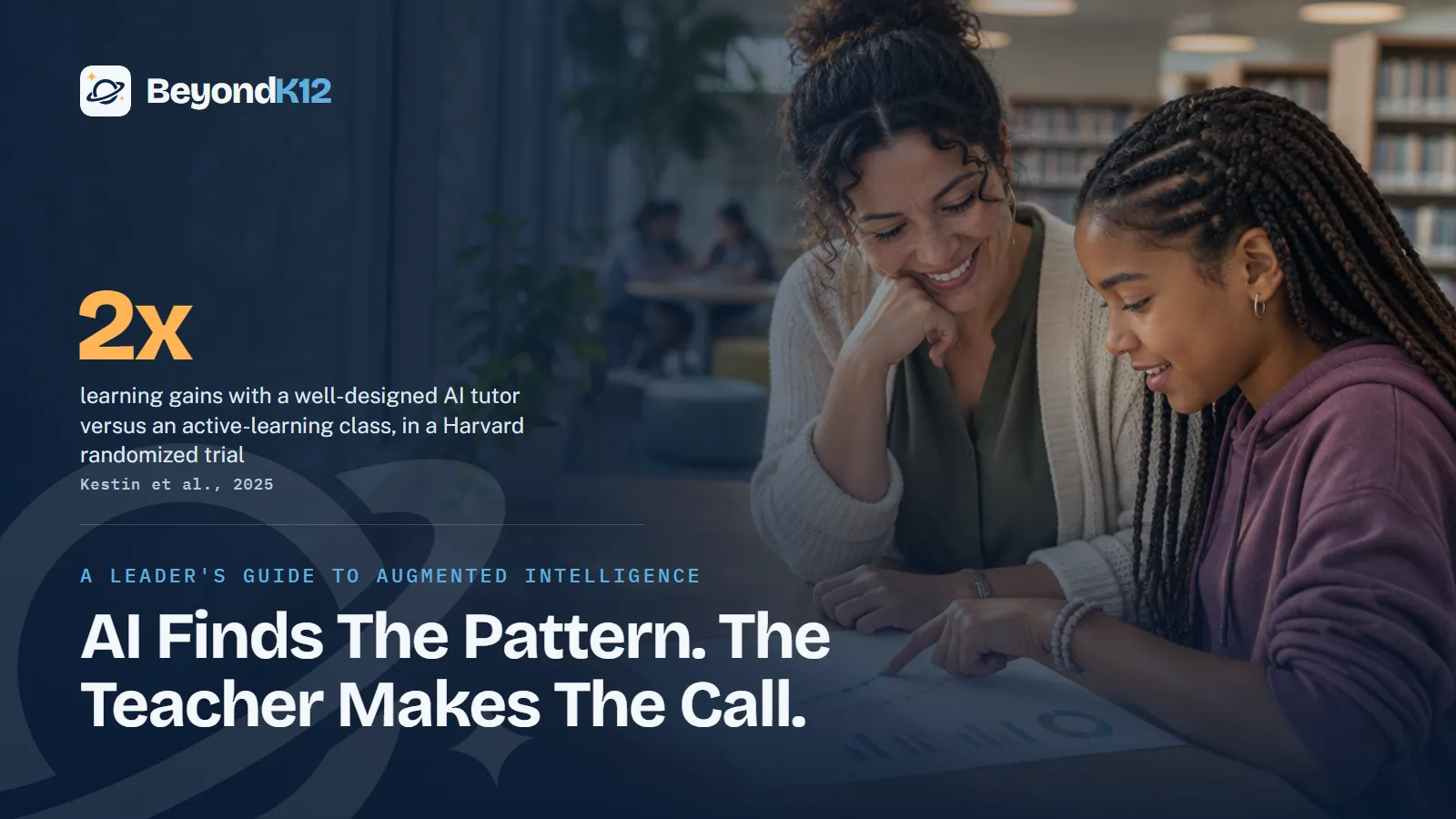
Augmented intelligence is the practice of pairing AI analysis with a teacher's judgment, so that the software finds the pattern and the educator decides what to do about it. It is the only version of AI personalization that has produced learning gains in controlled studies, and it is the version a school leader can defend to a board, a parent, and an accreditor.
The term matters because the alternative is automation: a tool that places a student, grades an essay, or writes a plan with no one checking. Every strong result in the 2025 and 2026 research came from the first model. Every well-documented failure came from the second. This guide covers what augmented intelligence is, what the evidence now shows, where it goes wrong, and how to build it in one semester.
- Augmented intelligence (AI plus human)
- A way of using AI in which the system analyzes student data, recommends next steps, and drafts materials, and a qualified educator reviews the output, adds the context the model cannot see, and makes the instructional decision. The AI widens what one teacher can notice. The teacher owns what happens next.
Why personalized learning now needs both the AI and the teacher
Students have already decided. In Pew Research Center's February 2026 survey of 1,458 U.S. teens, 64% said they use AI chatbots and 54% use them for schoolwork, most often to research a topic, solve a math problem, or edit their own writing. Teachers have followed: the EdWeek Research Center found 61% of teachers used AI in 2025, nearly double the 34% of 2023, and CoSN's 2026 survey found 79% of districts now report AI guidelines, up from 57% a year earlier.
The missing piece is the instruction that turns tools into personalization. When Gallup asked 2,069 public school teachers in early 2026 whether administrators had given them formal guidance on AI, 18% said yes. For the task closest to personalization, one-on-one instruction and tutoring, 69% had received no guidance at all. Schools have bought the AI. Most have not yet designed the human half.
Adoption is ahead of guidance, 2025 to 2026
What the 2025 and 2026 evidence says about AI tutoring
Three randomized trials now anchor the case for augmented intelligence. Read them together and one design choice appears in all of them: a human stayed in charge of the learning.
2x
learning gains from a research-based AI tutor compared with an active-learning class, 194 students.
Kestin et al., Scientific Reports, 2025
0.3 SD
gain after six weeks of teacher-supervised ChatGPT sessions in Nigeria, equal to 1.5 to 2 years of typical progress.
World Bank, 2025
4 pts
higher mastery when human math tutors had an AI assistant; 9 points for students of the lowest-rated tutors.
Stanford NSSA, Tutor CoPilot, 2025
5.9 hrs
saved per week by teachers who use AI weekly, about six weeks over a school year.
Gallup and Walton Family Foundation, 2025
The World Bank trial is the one to study if you lead a school with limited staff. Public secondary students in Edo State met twice a week for six weeks. A trained teacher opened each session with a curriculum topic, kept students on task, and taught them to spot the chatbot's mistakes. The result was a 0.3 standard deviation gain overall, and students who attended more sessions gained more. The authors are explicit that the effect belongs to the whole package: prompts, curriculum alignment, teacher support, and peers, not the software alone.
Stanford's Tutor CoPilot study makes the same point from the adult's side. More than 700 human tutors worked with about 1,000 elementary math students; half the tutors had an AI assistant suggesting what to say next. Students of the assisted tutors were 4 percentage points more likely to master the topic, and the weakest tutors improved most, by 9 points. The assistant cost about $20 per tutor per year. The AI did not teach the child. It made the human teaching the child better at it.
Where augmented intelligence personalizes learning in a school
Personalization is not one product. It is a dozen daily decisions about which student needs what next. Here is how the labor divides when the AI does the pattern work and a person makes the call.
| Personalization task | What the AI does | What the educator decides |
|---|---|---|
| Reading practice | Levels passages and recommends skill work from assessment data | The teacher picks the text, leads the discussion, and checks comprehension in person |
| Math intervention | Flags the specific skill gaps behind wrong answers | The teacher forms the small group and chooses the hands-on approach |
| Writing feedback | Marks mechanics and drafts comments against the rubric | The teacher coaches voice, argument, and clarity, and sets the grade |
| Early warning | Surfaces attendance, grade, and behavior patterns | A counselor talks to the student and the family before anything is recorded |
| IEP and 504 drafting | Summarizes progress data and drafts goal language | The special education teacher individualizes, verifies, and signs; the team is told AI was used |
| Tutoring | Explains, quizzes, and gives hints on demand | A teacher sets the scope, reviews the transcripts, and decides what to reteach |
| Student AI use | Helps a student research, outline, or revise | The student discloses the help and explains the work out loud |
The IEP row is where many schools are already past policy. The Center for Democracy and Technology found that 57% of special education teachers used AI for IEPs or 504 plans in the 2024-25 school year, up from 39% the year before, and 15% used it to write plans in full, according to Education Week's October 2025 report. Georgia's state guidance tells educators not to use AI for high-stakes purposes like IEPs. Both facts argue for the same thing: a written rule that AI may draft and a named person must individualize and sign.
Augmented intelligence is a teacher who can now see every student, not a machine that no longer needs to.Ernie Delgado, BeyondK12
What goes wrong when schools automate instead of augment
The risks of AI in schools are, almost without exception, the risks of removing the human. Common Sense Media's August 2026 survey found that 70% of teens now use AI for schoolwork, and that 63% of those users get an answer from the tool. A quarter use it as is. Only 27% said a teacher had ever talked with them about what AI is and how it works.
What AI-using teens do with an answer the tool gives them
Those numbers describe a student personalizing alone. The same survey found 39% of AI-using teens feel they miss out on learning when they use it for assignments, and 38% say they generate fewer of their own ideas. The fix is not a block: 44% of these students have had a tool blocked at school, and 59% of them switched to a personal device. The fix is a teacher who designs the task so that the AI help is disclosed and the student still has to explain the work.
Federal guidance already assumes the augmented model. The U.S. Department of Education's July 2025 letter to grantees says existing funds may support AI instructional materials, AI-enhanced high-impact tutoring, and training for educators, provided the use is educator-led, ethical, accessible, transparent, and protective of student data. It names hybrid tutoring that pairs human tutors with AI platforms as an allowable use. That is augmented intelligence written into the funding rules.
How to implement augmented intelligence in one semester
- Write the rule before the purchase. One sentence in the acceptable use policy: AI may analyze, draft, and recommend; a named educator reviews and decides before anything reaches a student, a family, or a record. Our 90-Day AI Readiness Accelerator includes policy templates a board can adopt in one meeting.
- Pick two low-risk, high-value uses. Lesson differentiation and feedback drafting are the places teachers already use AI most: Gallup found 37% use it at least monthly to prepare to teach and 28% to modify materials for student needs. Start there, with a reviewer named for each.
- Train the people, not the tool. Half of teachers had at least one AI professional development session in 2025, according to the EdWeek Research Center, up from 29% in 2024. Make yours about judgment: how to check an AI recommendation, when to override it, and how to talk to a student about their AI use. See our professional development options.
- Make students explain their work. Every AI-assisted assignment ends with the student saying, in their own words, what they made, what the tool did, and what they would change. It is the one assessment AI cannot fake and the habit the Common Sense data says students most need.
- Measure learning, not usage. Dashboards will tell you how many logins you had. Ask instead: did the intervention group close the gap, and did the teacher's review change the plan? Keep those notes. They are what your board and your funding plan will ask for.
Where to start this week
Augmented intelligence is not a product category. It is a decision that in your school the AI never gets the last word on a child, written down and trained for. The trials that produced real gains in 2025 and 2026 all made that decision first. Make it, pick two uses, and name the reviewers.
If you want to know how far your school is from that, the free AI Readiness Assessment takes five minutes and scores you out of 24 across Policy, People, Curriculum, Guardrails, and Funding, with the three fixes that matter most. The report is yours whether or not you ever call us.
Related reading: Why school leaders must consider human in the loop AI for future-ready strategies and How teachers personalize learning with AI week to week: differentiation, IEPs, and multilingual learners.
Questions school leaders ask
What is augmented intelligence in education?
Augmented intelligence is AI plus a human in charge. The software analyzes student work, spots patterns, and drafts materials or feedback; a teacher reviews the output, adds what the model cannot see about the child, and makes the decision. It is the opposite of automation, where the tool acts without review.
Does AI tutoring actually improve learning?
In controlled studies, yes, when it is designed well and a trained adult stays involved. A Harvard randomized trial published in Scientific Reports in 2025 found students learned about twice as much from a purpose-built AI tutor as from an active-learning class. A World Bank trial in Nigeria found a 0.3 standard deviation gain after six weeks of teacher-supervised ChatGPT sessions, equal to 1.5 to 2 years of typical progress.
Will AI replace teachers in personalized learning?
The evidence points the other way. In the Nigeria trial, teachers introduced each topic, kept students on task, and helped them catch AI errors. In Stanford's Tutor CoPilot study, human tutors with an AI assistant produced a 4 percentage point gain in student mastery, and 9 points for students of the lowest-rated tutors. The gains came from the pairing, not from the tool alone.
What is the biggest risk of AI personalization?
Automation without review. Common Sense Media's 2026 survey found 63% of teens who use AI for schoolwork get an answer from the tool, and 25% use it as is. RAND found half of students worry about being falsely accused of AI cheating. Both problems come from an AI acting without a teacher in the loop.
How do we know if our school is ready for augmented intelligence?
Take the free AI Readiness Assessment. Eight questions give you a score out of 24 across Policy, People, Curriculum, Guardrails, and Funding, and show the three fixes that would move the score most.
Sources
- Pew Research Center, How teens use and view AI (February 2026) (opens in a new tab) (checked 2026-11-05)
- Gallup and Walton Family Foundation, teachers receive no formal guidance on AI (May 2026) (opens in a new tab) (checked 2026-11-05)
- Gallup and Walton Family Foundation, three in ten teachers use AI weekly, saving six weeks a year (June 2025) (opens in a new tab) (checked 2026-11-05)
- EdWeek Research Center, more teachers are using AI in their classrooms (January 2026) (opens in a new tab) (checked 2026-11-05)
- CoSN, State of EdTech Leadership 2026 (opens in a new tab) (checked 2026-11-05)
- Common Sense Media, Teens in the AI Era: Schoolwork and Skills That Matter (August 2026) (opens in a new tab) (checked 2026-11-05)
- RAND, AI use in schools growing as policies lag (October 2025, via KMPH) (opens in a new tab) (checked 2026-11-05)
- Center for Democracy and Technology, Hand in Hand survey of teachers, students, and parents (October 2025) (opens in a new tab) (checked 2026-11-05)
- Kestin, Miller, Klales, Milbourne, and Ponti, AI tutoring outperforms in-class active learning, Scientific Reports (June 2025, via Stanford SCALE repository) (opens in a new tab) (checked 2026-11-05)
- Harvard Gazette, professor tailored AI tutor to physics course, engagement doubled (September 2024) (opens in a new tab) (checked 2026-11-05)
- World Bank, Addressing the learning crisis with generative AI: lessons from Edo State in Nigeria (June 2025) (opens in a new tab) (checked 2026-11-05)
- Stanford National Student Support Accelerator, Tutor CoPilot: A Human-AI Approach for Scaling Real-Time Expertise (2025) (opens in a new tab) (checked 2026-11-05)
- U.S. Department of Education, Dear Colleague Letter on using federal grant funds for AI (July 2025, via THE Journal) (opens in a new tab) (checked 2026-11-05)
- Education Week, teachers are using AI to help write IEPs, advocates have concerns (October 2025) (opens in a new tab) (checked 2026-11-05)

See where your school stands on AI, in five minutes
Eight questions. A score out of 24 across Policy, People, Curriculum, Guardrails, and Funding, with the three fixes that move it most. The report is yours whether or not you ever call us.