
Teaching Responsible Use of AI and Human Decision Making in the Classroom | BeyondK12
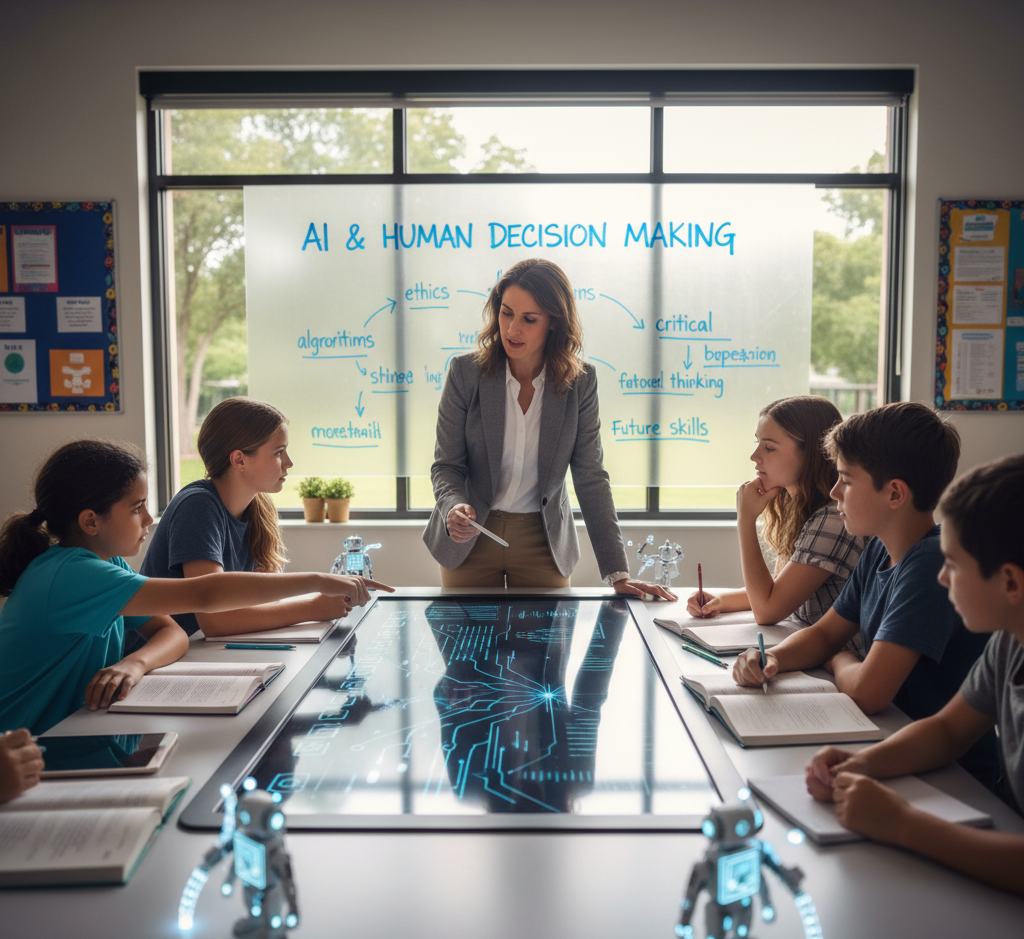
AI and Human Decision Making in the Classroom
In K-12 education today, artificial intelligence (AI) is increasingly embedded in tools that
support learning, assessment, feedback, and classroom management. Yet with this rise
comes a critical challenge: How do educators maintain meaningful human decision
making when AI is part of the instructional landscape?
The intersection of AI and human decision making matters because while AI offers
speed, scale, and data-based insights, it lacks moral reasoning, contextual judgment,
empathy, and ethical awareness—qualities that humans bring to education. The promise
lies not in replacing educators, but in a partnership: AI supports, and educators guide
decisions with integrity.
This blog explores how teachers and school leaders can teach responsible AI use and
human decision making in the classroom—from ethics and policy, to pedagogy and
student agency, to building professional capacity for balanced human-AI collaboration.
1. Understanding AI and Human Decision Making in K-12
Schools
What do we mean by “AI and human decision making”?
When an educator uses an AI tool (for example, an adaptive learning platform, or an AI-
driven analytics dashboard), there are decisions to be made:
● What insights from the AI will influence instruction?
● When will the teacher override or adjust the AI recommendation?
● How will student context, values, or well-being influence the choice?
Thus, “AI and human decision making” refers to:
1. AI generating data, suggestions or predictions
2. Human educators interpreting, contextualizing, and acting on those outputs
3. A feedback loop where human decisions help improve AI relevance and use
Research has shown that human-AI collaboration leads to better decision quality when
humans remain active and critical—not passive recipients. Taylor & Francis Online+1
Why this matters in K-12
● Students are more than data points; each learner is unique.
● Transparent and ethical decision making builds trust with students, families, and
communities.
● Blind reliance on AI risks losing human judgment, exacerbating bias, or reducing
student agency.
By explicitly teaching the interplay of AI and human decision making, schools can foster
students who not only use AI tools—but understand when, how, and why to override
them.
2. Ethical Principles & Policy Frameworks for AI and
Human Decision Making
Foundational Ethical Principles :
Teaching responsible AI use means grounding strategies in ethical principles. Schools
should emphasize:
● Human agency: AI supports, but does not replace, human decision making.
● Transparency: Students and educators understand how AI generated insights or
recommendations were produced.
● Equity & fairness: Tools must not disadvantage students based on background,
ability, or circumstance.
● Accountability: Humans (educators, administrators) retain responsibility for
decisions—even when AI is used.
The U.S. Department of Education’s AI and the Future of Teaching and Learning report
highlights the challenge of “Balancing human and computer decision-making” in its
recommendations. U.S. Department of Education
Policy & Governance in K-12
Districts and school leaders are increasingly building policy to govern how AI and
human decision making combine. For example:
● Clear guidelines on when AI suggestions may be used, and when human override
is required
● Data privacy, security, and student consent protocols
● Training and supports for teachers on decision-making workflows
● Monitoring and auditing AI tool outcomes to ensure equity
A recent roadmap from the Southern Regional Education Board (SREB) offers guidance
for schools adopting AI thoughtfully and responsibly. Southern Regional Education
Teaching students about these frameworks makes them more aware of responsible AI
use and reinforces the role of human judgment.
3. Pedagogical Strategies for Balancing AI and Human
Decision Making
Strategy A: Teacher-Led AI-Supported Tasks
Design tasks where AI handles data-heavy or routine work (such as generating candidate
feedback, tracking progress, or flagging patterns), while teachers lead the interpretation,
value judgments, and student-centered decisions.
This aligns with research on human-AI complementarity in schools: “AI supports human
teachers, but meaningful collaboration requires active teacher involvement.” arXiv
Strategy B: Decision Reflection Journals
Have both students and teachers maintain journals reflecting on AI recommendations
and their human decisions along the way. Example prompts for students:
● “The AI recommended I move to the next level—why did I stay and ask a teacher
instead?”
● “The AI flagged my behavior—how did the teacher interpret and decide what to do
next?”
This promotes metacognition about how human decisions differ or augment AI
suggestions.
Strategy C: AI Literacy + Decision Making
Pair lessons on how AI works (algorithms, data, bias, limitations) with decision-making
activities. For instance, students might evaluate when to trust an AI output and when to
ask a teacher. A study on K-12 AI literacy found that teachers’ ethical reasoning and
evaluation skills significantly impact how AI is used in decision-making. MDPI
Strategy D: Scaffold Explicit Human Judgement
Teachers should model a process:
1. Review AI recommendation
2. Consider student context, values, social-emotional factors
3. Decide (accept/modify/reject) the recommendation
4. Explain reasoning to students
By making human judgment explicit, students learn that AI isn’t infallible—and that
decision making is a human skill.
Strategy E: Student Agency & AI Use
Allow students choice about how much they rely on AI tools versus teacher guidance.
For example:
● “Would you like to use the AI recommendation this time, or ask the teacher first?”
This reinforces the principle that human decision making remains central, and AI is a support.
4. Professional Development: Building Capacity for
Human + AI Decision Making
Preparing Educators
Teachers need training not just on the technical use of AI tools, but on how to interpret
AI outputs, make ethical decisions, and teach students about decision making in AI-
augmented environments.
Professional development should include:
● AI literacy (how algorithms work, what they don’t do)
● Ethical use and oversight of AI
● Case studies of AI/human decision processes
● Workshops in decision-making frameworks
● Peer communities of practice for shared learning
Leadership’s Role
School leaders must cultivate a culture where human judgement is valued, not
overshadowed by tool adoption. Key leadership actions include:
● Time allocated for teacher reflection and decision-making discussions
● Recognition of teachers who model strong human-AI decision workflows
● Creation of oversight teams or ethics committees to monitor AI tool use
● Promoting transparency about how AI suggestions are used and overridden
Ongoing Feedback and Iteration
As AI tools evolve, so should decision-making practices. Continuous review of
outcomes, teacher reflections, and student feedback helps refine the process for human
+ AI decision making.
5. Addressing Common Challenges & Risks
Over-reliance on AI (Automation Bias)
One major risk is that educators or students may trust AI recommendations too heavily,
reducing critical thinking and human judgment. Automation bias occurs when automated
suggestions are favored even if wrong. Wikipedia
Mitigation strategies:
● Train both teachers and students to question AI outputs
● Build decision workflows that require human review of high-stakes decisions
● Use reflection prompts to surface when AI was overridden and why
Erosion of Human Judgment
If AI takes over too many decisions, students may perceive teachers as mere “validators”
of AI rather than mentors. To preserve human authority:
● Maintain teacher access to modify or reject AI suggestions
● Emphasize relational and ethical dimensions of decision making
● Highlight student-teacher dialogues where human context changed the outcome
Bias and Equity Concerns
AI systems can inherit bias from training data and perpetuate inequities if human
oversight is weak. Taylor & Francis Online
Mitigation:
● Regularly audit AI tools for bias and disparate impact
● Include diverse teacher voices in tool selection and decision frameworks
● Use AI as a flagging tool—but human judgement to decide interventions
Lack of Transparency
If AI recommendations are opaque (“black box”), neither teachers nor students can
understand how decisions are made. Transparency is essential for trust.
Mitigation:
● Choose AI tools with explainable logic
● Train educators to “read” AI outputs and explain them to students
● Encourage students to ask: “Why did the AI suggest that?”
Weak Governance & Policy
Without proper frameworks, schools may misuse AI tools in decision-making. Clear
policy is crucial. Oregon
Key policy components:
● AI use cases explicitly defined
● Roles for human decision-makers
● Data privacy and security standards
● Review and audit mechanisms
● Student and family engagement
6. Practical Steps to Teach Responsible AI and Human
Decision Making
1. Define your purpose and decision workflows Begin by defining how AI supports human decisions in
your classroom or school.
What types of decisions will AI suggest, and when will teacher judgement override?
2. Choose transparent, human-involved AI tools Select platforms that allow teacher review and provide
insight into how recommendations are generated.
3. Train students in decision-making with AI Include activities like “Will I accept the AI suggestion, or consult a
teacher?” and have students reflect on their reasoning.
4. Embed teacher decision-journals Have teachers log instances where they followed, modified, or rejected AI
suggestions—then examine outcomes and reasoning.
5. Establish policy & ethical frameworks Adopt district- or school-level policy framing AI use, human
decision making, student data rights, and equity safeguards.
6. Monitor, review, iterate Track student outcomes, teacher experiences, and decision workflows. Use data
and reflection to adjust processes and improve human + AI decision making.
7. The Future of AI and Human Decision Making in
Schools
As AI tools become more sophisticated, the role of human decision making becomes
both more critical and more complex. The future lies in Human + AI collaboration, where:
● AI handles data-heavy or routine tasks
● Teachers focus on creativity, relational and ethical decisions
● Students learn to use, question, and decide how to engage with AI tools
● Schools develop decision-making cultures that value human agency as much as
technological support
With thoughtful integration, AI won’t replace human decision making—it will amplify it. K-
12 students and teachers will emerge skilled not just at using AI tools, but at making
informed, ethical decisions in an AI-infused world.
Conclusion
Teaching responsible use of AI and human decision making is one of the most urgent
tasks facing K–12 educators today. As AI transforms how schools function, we must
ensure that technology enhances—not undermines—human judgment, student agency,
and relational teaching.
When AI tools are thoughtfully combined with clear decision-making frameworks,
professional development, and ethical policy, classrooms become more inclusive,
adaptive, and student-centered. The key is not surrendering decisions to machines, but
empowering humans to decide with richer context, deeper values, and broader impact.
By embracing the balance of AI and human decision making, educators prepare students
not just to use tools—but to lead, decide wisely, and collaborate in an evolving
technological landscape.
✨Get your FREE AI Technology Plan here!
🤝Join me on LinkedIn to get my updates on AI and Digital Literacy News for K‑12