
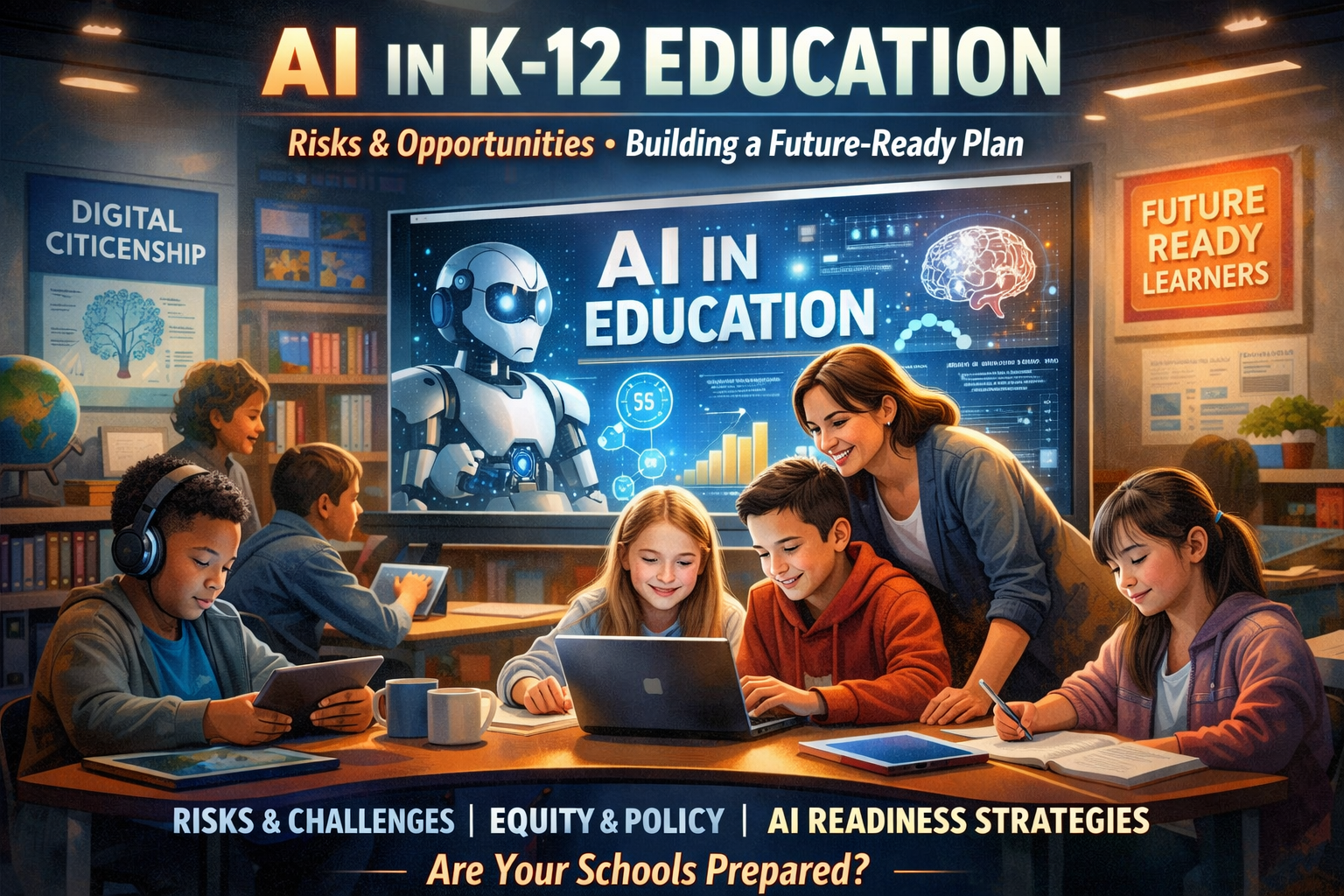
AI‑generated image created with OpenAI’s DALL·E
Artificial intelligence (AI) has rapidly become one of the most discussed — and debated — technologies in education today. Once a futuristic buzzword, generative AI tools like ChatGPT are now deeply woven into students’ daily lives and classrooms. But while the potential of AI to transform learning is enormous, new research suggests the risks may currently outweigh the benefits — unless schools take intentional, strategic action.
This presents a defining moment for school leaders. We must not merely react to AI — we must lead with strategy, equity, and pedagogy. That means understanding not just the dangers and opportunities AI presents, but also building the systems, policies, and capacity that make it a true educational asset.
📌 What the Latest Report Reveals
A sweeping global report — highlighted in NPR’s coverage — reviewed hundreds of international studies and consulted educators, students, parents, and technology experts from around the world. Its verdict is stark: the risks of generative AI in classrooms currently outweigh the benefits, especially where implementation is haphazard or absent of strategic guidance. Here’s what the research uncovered:
⚠️ Risks That Should Give Educators Pause
1. Cognitive Development Concerns
The report warns that over‑reliance on AI can stunt foundational cognitive development. When students allow AI to generate answers without engaging deeply with content, they risk bypassing essential critical thinking and problem‑solving processes that are the core of meaningful learning.
2. Emotional and Social Well‑Being Challenges
AI chatbots that constantly affirm user beliefs can create unrealistic social interaction patterns for students. Relationships, conflict resolution, empathy, and resilience — all forged in real human interaction — can suffer if AI becomes a primary emotional partner.
3. Equity and Access Gaps
While AI tools can both support and extend learning, not all schools or students have equal access. Wealthier districts tend to secure more accurate, advanced tools, while underfunded schools settle for unreliable free versions. This threatens to widen educational inequities rather than close them.
👍 Where AI Can Support Teaching and Learning
Despite significant concerns, the research also acknowledges positive roles for AI — but only when deployed with thoughtful oversight.
🎓 Support for Teachers
AI can help with time‑consuming administrative tasks:
Drafting communications (newsletters, parent emails)
Translations for diverse learners
Generating practice materials, quizzes, rubrics
Organizing lesson planning data
This can give teachers up to six more hours per week — invaluable time that can be refocused on instruction, intervention, and relationship‑building.
📚 Personalized Learning
When used as a supplement — not as a replacement — AI can support:
Differentiated reading level adjustments
Language acquisition reinforcement
Feedback loops that assist drafting and revision
Tailored supports for students with learning challenges
But the key is purpose, not novelty. AI must be integrated into sound pedagogy — not used as a shortcut.
🧠 Why This Matters for School Leaders
The NPR‑covered findings aren’t just academic — they hit at the heart of what school leadership must do in the rapidly evolving education landscape:
🎯 AI Cannot Be Treated as an “Add‑On”
AI isn’t like past classroom tech waves that came and went. Its capabilities affect:
How students learn
How teachers practice
What skills future graduates will need
Today’s digital natives think differently than previous generations. They automate tasks, multitask constantly, and use AI tools outside of school hours. Schools must respond with intentional curricula, policies, and leadership — not random adoption or blanket bans.
👩🏫 Professional Development Is Still Lagging
Even as AI becomes more prevalent, many teachers report limited training on how to teach with AI — not just regulate it. According to related education reporting, less than half of teachers have received substantial AI training while most students are already using AI tools.
This disconnect is one of the biggest obstacles to effective, safe, and equitable AI integration.
📜 Policy Is Needed — But It’s Not There Yet
Federal guidance and regulation related to AI in schools is minimal. School districts are left to each craft their own policies — often without federal guardrails or shared standards. This can create patchwork protections and inconsistencies in student safety, privacy, ethical use, and educational value.
🛠 What School Leaders Should Be Doing
The research clearly points to the necessity of strategic leadership around AI — not ad‑hoc decisions. Here’s what that looks like in practice:
✅ 1. Create an AI Vision Aligned to Learning Goals
Start with pedagogy, not tools. Ask:
What skills do we want every graduate to master in an AI‑infused world?
How should AI support — not replace — teacher expertise?
What outcomes are we aiming for?
Schools that begin with intentional learning outcomes will avoid the trap of novelty over substance.
✅ 2. Invest in Teacher AI Readiness
AI professional learning shouldn’t be optional.
Teachers need support to:
Understand AI capabilities and limitations
Embed tools into instruction that enhance learning
Maintain accountability, academic integrity, and critical thinking
Manage student use during class and at home
Without this foundation, districts risk chaos — or worse, misuse and mistrust.
✅ 3. Establish Policies Grounded in Student Safety and Equity
Policy should define:
Acceptable AI tool use by students and staff
Data privacy protections
Accessibility and equity across learner populations
Evaluation frameworks for AI platforms
These policies should be crafted collaboratively with educators, families, and students to ensure real‑world alignment.
✅ 4. Teach With AI, Not Against It
Outdated bans are not solutions. Instead of saying “AI is not allowed,” the new approach must be:
Teach students how to think with AI, not simply use AI to shortcut thinking.
This is a skills mandate: critical thinking, ethical decision‑making, digital literacy, evaluation of sources, and human‑AI collaboration.
✅ 5. Strategic AI Planning Is Non‑Negotiable
Every school and district needs a coherent AI plan — one that moves beyond tool procurement to long‑range readiness.
That plan should include:
Goals for AI literacy at every grade level
Professional development pathways
Tech infrastructure alignment
Data governance frameworks
Evaluation and feedback mechanisms
Equity assurance strategies
This is where organizations like BeyondK12 make a measurable difference: guiding schools to create actionable, education‑centred AI strategic plans that align technology with learning goals.
🧭 The Real Future of AI in Education
AI won’t go away — and it shouldn’t. But the way we adopt it will determine whether it enhances learning or erodes it.
We must shift from reactive policy and one‑off tool implementations to:
🔥 Proactive readiness
🔍 Pedagogically grounded strategies
🤝 Equity‑centric planning
📊 Clear assessment and feedback loops
AI isn’t merely a classroom tool — it’s now part of the ecosystem in which tomorrow’s citizens will live, work, and lead.
From AI to Digital Citizenship: NGTP is Our 9‑Stage Roadmap for K‑12 Success
The Next Generation Technology Plan (NGTP) Model is a future‑ready framework that helps schools align technology, curriculum, and staff development to prepare students for the world of work. It identifies gaps, modernizes outdated tech plans, integrates AI, digital literacy, character development, and digital citizenship, and builds a step‑by‑step roadmap across nine stages—ensuring schools stay innovative, efficient, and prepared for tomorrow’s challenges.
🧠 Conclusion
The NPR‑highlighted research is a wake‑up call: the promise of AI in schools is real — but the risks are real too. Without leadership, strategy, and capacity building, schools can inadvertently harm student development and widen inequities.
School leaders cannot afford to be passive on AI. They must be equipped with strategic frameworks, professional development models, equity safeguards, and policies that prioritize learning outcomes while harnessing AI’s power for good.
AI readiness is not optional — it’s imperative.
✨Get your FREE AI Technology Plan here!
🤝Join me on LinkedIn to get my updates on AI and Digital Literacy News for K‑12