


Top federal grants to help K-12 schools fund technology costs in 2026
The federal programs that can fund K-12 technology in late 2026: what E-Rate, Title IV-A, Title II-A, and Perkins V allow, and where FY2027 stands.
Updated with current data and sources. Originally published April 15, 2014.
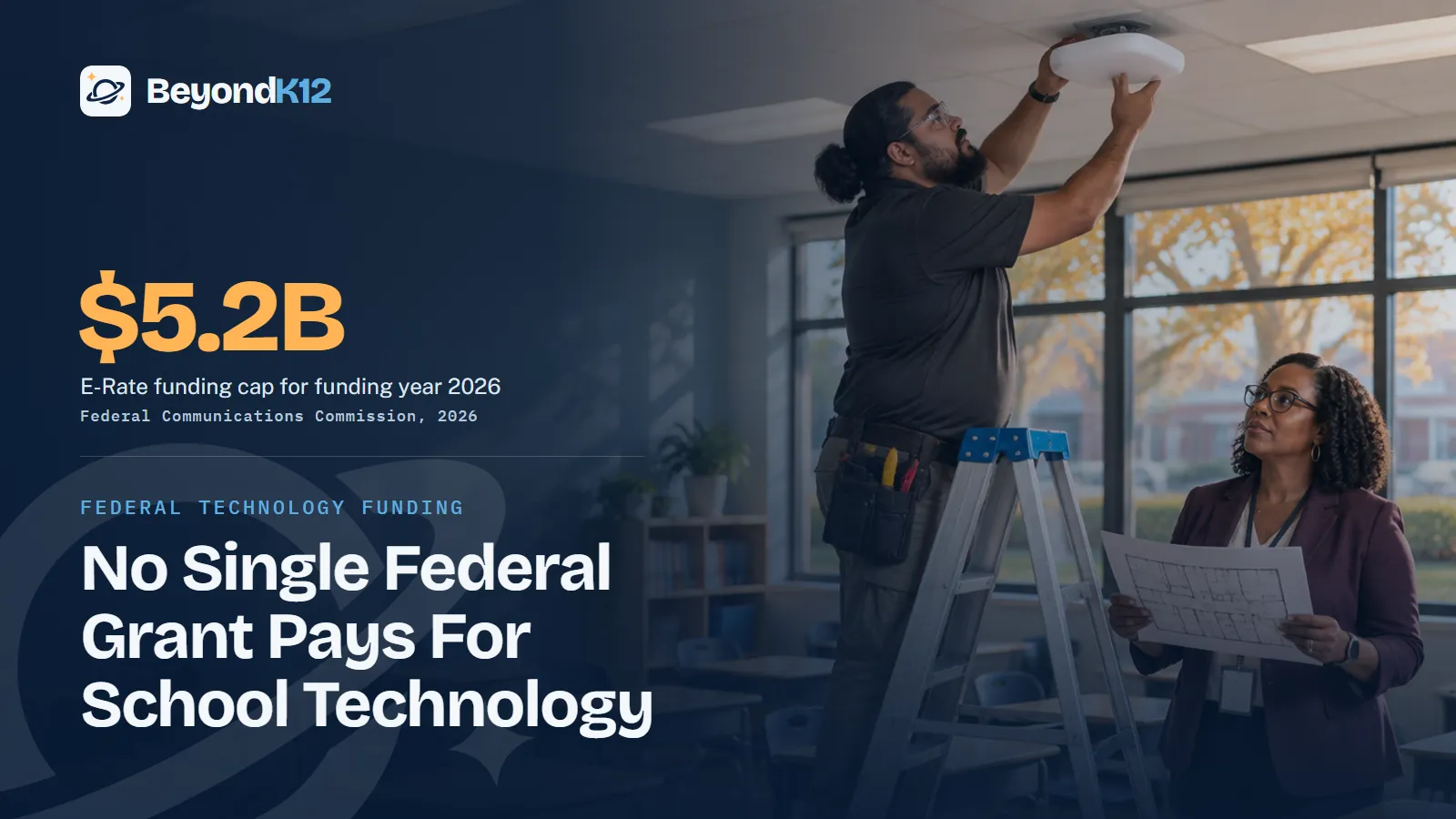
The main federal sources for K-12 technology in late 2026 are E-Rate for connectivity, Title IV-A and Title II-A for technology use and training, Perkins V for career programs, and rural education funds. No single federal grant pays for school technology, and none of these is a promise: every dollar depends on your eligibility, your state, and a federal budget that is not settled for FY2027.
When I first wrote about this in 2014, I pointed schools to two programs: E-Rate and Enhancing Education Through Technology. One of them is gone, and the other has changed a great deal. The point that opened that post still stands. Having a plan does not mean you have the money to carry it out, and implementation costs can run well past a technology budget.
Which federal programs pay for school technology in 2026?
Think of federal technology funding as a set of separate programs, each with its own purpose. E-Rate is a discount, not a grant. Title II-A, Title IV-A, and career and technical education funds are formula money that reaches schools through states and districts. A school does not win those by writing a clever application.
Federal programs that can support school technology, FY2026 (billions of dollars)
The Committee for Education Funding's table of the final FY2026 bill shows Title II-A at $2.19 billion and Title IV-A at $1.38 billion. Title I-A and IDEA state grants are far larger, but they serve their own purposes, and technology has to fit those purposes. Our education grants guide covers how they apply to STEM and AI.
$3.515B
estimated E-Rate demand for funding year 2026, below the cap.
Federal Communications Commission, 2026
20% to 90%
range of E-Rate discounts, with Category Two topping out at 85% for schools.
USAC discount matrix
$201.57
Category Two budget per student for the FY2026-2030 cycle.
USAC
15%
most Title IV-A funds a district may use to purchase technology infrastructure.
20 U.S.C. 7119
What happened to Enhancing Education Through Technology?
It ended. THE Journal reported in April 2011 that funding was eliminated for the program in the fiscal year 2011 appropriations bill, and it described the program as the only dedicated federal funding for technology in education. If an old list still names this grant, the list is out of date.
That matters for how you plan. You will not find one federal technology application to fill out. You have to work out which program allows each purchase.
What does E-Rate pay for now?
E-Rate discounts connectivity for eligible schools and libraries. The FCC sets the rules, and the Universal Service Administrative Company (USAC) runs the program. Your discount depends on your share of students eligible for the National School Lunch Program and on whether you are urban or rural, according to USAC.
- Category One: broadband and internet access. USAC says these services cannot include charges for content or end-user devices.
- Category Two: equipment such as routers, switches, wireless access points, and cabling inside the building. The funding floor is $30,175 for the FY2026-2030 cycle, according to USAC.
- Private schools: USAC excludes for-profit schools and schools with endowments exceeding $50 million, so a non-profit private or Catholic school under that line may be able to apply directly.
For funding year 2026, the FCC's Wireline Competition Bureau found enough money to fully fund eligible requests, with USAC projecting $600 million in unused funds from prior years on top of the cap. That finding covers one year. It says nothing about the next one.
The program is also changing. The FCC says it has rolled back support for off-campus Wi-Fi hotspots and school bus Wi-Fi. AASA reports that a new bidding portal will change how districts manage E-Rate starting with Program Year 2028. The FCC's Cybersecurity Pilot Program, with up to $200 million in support, is limited to participants the FCC selected, and the application windows USAC lists have closed.
Which federal funds can buy devices, software, and training?
Start with what you want to buy, then look for the program that allows it. This table shows starting points, not approvals. Your state's reading is the one that counts.
| What you want to buy | Where to look first | Limit to check |
|---|---|---|
| Internet access and building Wi-Fi | E-Rate Category One and Category Two | Competitive bidding, and your five-year Category Two budget |
| Devices, software, and infrastructure | Title IV-A, effective use of technology | The 15% limit in 20 U.S.C. 7119 |
| AI tools and learning materials | Title I and Title IV-A, as Ohio lists them | Must fit the program's purpose and your approved plan |
| Teacher training and coaching | Title II-A and Title IV-A | Washington excludes hardware and software licenses under Title II-A |
| Career program equipment | Perkins V local funds | Technology must align with business and industry needs |
| Assistive technology | IDEA | Tied to what a student's program requires under 34 CFR 300.105 |
| Rural district priorities | SRSA and RLIS rural funds | North Dakota's guide says they must supplement, not supplant, other funds |
| Rural distance learning equipment | USDA Distance Learning and Telemedicine | Competitive, with a 15% match; the FY2026 round closed June 30, 2026 |
The USDA program is a reminder that federal money does not all sit at the Department of Education. Its FY2026 guide lists requests from $50,000 to $750,000. For how to search beyond these programs, see 4 ways to find the technology funding your K-12 school needs.
There is no federal technology grant waiting for you, only programs whose rules your plan has to fit.Ernie Delgado, BeyondK12
What is uncertain for FY2027?
The practical response is plain. Commit the money you have to work you can finish, and do not build a position, a license, or a multi-year contract on a federal line that is still in dispute.
How do you match a technology need to a federal program?
- Name the purchase and the need. Write one sentence for each item: what it is, who uses it, and which learning goal it serves. Vague requests stall at every review.
- Find who holds the money. For Title funds, that is your district's federal programs director. For E-Rate, it is whoever files your forms. Private schools should ask the district about equitable services and answer its consultation invitation.
- Check the rule, then the state's reading. Read the program's allowable uses and your state's guidance, and get the answer in writing. Our funding guide shows how schools pay for AI readiness.
- Watch the calendar. The FY2026 E-Rate window ran January 21 to April 1, 2026, according to USAC. Confirm the next dates with USAC instead of assuming they repeat.
- Plan the year after. Show what happens if a source shrinks, and what moves into your own budget.
Where to start this week
List your next three technology purchases and put one federal program beside each. Then take that list to your federal programs director or E-Rate contact and ask what is allowable and what is still uncommitted. Nothing here is a promise of funding, so treat your state agency and USAC as the final word.
If you are not sure which need comes first, the free AI Readiness Assessment takes eight questions and scores your school out of 24 across Policy, People, Curriculum, Guardrails, and Funding.
Related reading: Education grants: a guide to funding STEM and AI curriculum and support and 9 ways to spend your end of year funds: what use it or lose it really means.
Questions school leaders ask
Is there a federal grant just for school technology?
Not one that covers a whole technology plan. THE Journal described Enhancing Education Through Technology as the only dedicated federal funding for technology in education, and its funding ended in the fiscal year 2011 appropriations bill. Technology money now comes through E-Rate and through programs with broader purposes, such as Title IV-A and Perkins V.
Does E-Rate pay for Chromebooks?
No. USAC says Category One services cannot include charges for content or end-user devices, and Category Two covers equipment such as routers, switches, wireless access points, and cabling. Look to other funds for student devices, within their limits.
Can a Catholic or private school apply for E-Rate?
It may be able to. USAC defines an eligible school as a non-profit institutional day or residential school as determined under state law, and it excludes for-profit schools and schools with endowments exceeding $50 million. This differs from Title funds, which reach private schools through district-provided equitable services.
Can Title IV-A buy devices?
Sometimes, within a limit. Federal law at 20 U.S.C. 7119 says a district may not use more than 15 percent of funds for purchasing technology infrastructure as described in that section. States read the rule in their own guidance, so ask your federal programs director before you plan around it.
Will federal technology funding change in FY2027?
It may. The Congressional Research Service reported in September 2026 that full-year funding had not been enacted and that a continuing resolution runs through December 11, 2026. A House committee bill would eliminate Title II-A, and the FCC is reviewing E-Rate. Treat any FY2027 amount as unconfirmed.
Sources
- Federal Communications Commission, E-Rate and RHC programs' inflation-based caps for funding year 2026, DA 26-291 (March 2026) (opens in a new tab) (checked 2026-11-05)
- Federal Communications Commission, Bureau directs USAC to fully fund eligible E-Rate requests, DA 26-460 (May 2026) (opens in a new tab) (checked 2026-11-05)
- Federal Communications Commission, FCC to review E-Rate program (June 2026) (opens in a new tab) (checked 2026-11-05)
- Committee for Education Funding, final FY 2026 funding table (January 2026) (opens in a new tab) (checked 2026-11-05)
- USAC, E-Rate eligible services overview (opens in a new tab) (checked 2026-11-05)
- USAC, E-Rate discount matrix (opens in a new tab) (checked 2026-11-05)
- USAC, Calculating discounts (opens in a new tab) (checked 2026-11-05)
- USAC, E-Rate Category Two budgets (opens in a new tab) (checked 2026-11-05)
- USAC, School and library eligibility (opens in a new tab) (checked 2026-11-05)
- USAC, Funding Year 2026 filing window (opens in a new tab) (checked 2026-11-05)
- USAC, Cybersecurity Pilot Program (updated October 2026) (opens in a new tab) (checked 2026-11-05)
- AASA, FCC finalizes new E-Rate bidding portal (2026) (opens in a new tab) (checked 2026-11-05)
- THE Journal, Groups call for reinstatement of federal ed tech program (April 2011) (opens in a new tab) (checked 2026-11-05)
- U.S. Code, 20 U.S.C. 7119, Activities to support the effective use of technology (Title IV-A) (opens in a new tab) (checked 2026-11-05)
- U.S. Code, 20 U.S.C. 2355, Local uses of funds (Perkins V) (opens in a new tab) (checked 2026-11-05)
- Code of Federal Regulations, 34 CFR 300.105, Assistive technology (opens in a new tab) (checked 2026-11-05)
- Washington OSPI, Title II, Part A allowability (December 2025) (opens in a new tab) (checked 2026-11-05)
- Ohio Department of Education and Workforce, AI in Ohio's education: funding (opens in a new tab) (checked 2026-11-05)
- North Dakota Department of Public Instruction, Quick guide to using SRSA and RLIS funds (2025) (opens in a new tab) (checked 2026-11-05)
- USDA Rural Utilities Service, FY2026 Distance Learning and Telemedicine application guide (opens in a new tab) (checked 2026-11-05)
- Massachusetts Department of Elementary and Secondary Education, Private school equitable services under ESSA (opens in a new tab) (checked 2026-11-05)
- Congressional Research Service, Status of FY2027 Labor, HHS, and Education appropriations (September 2026) (opens in a new tab) (checked 2026-11-05)
- Association of California School Administrators, Federal report: good news, bad news on federal funding (July 2026) (opens in a new tab) (checked 2026-11-05)
- Education Week, The Education Department will send more of its programs to other agencies (February 2026) (opens in a new tab) (checked 2026-11-05)

See where your school stands on AI, in five minutes
Eight questions. A score out of 24 across Policy, People, Curriculum, Guardrails, and Funding, with the three fixes that move it most. The report is yours whether or not you ever call us.