


Creating flow in teenagers with classroom and mobile computing: what the evidence says now
Flow theory, current student engagement data, and phone policy research: how classroom and mobile computing help teenagers focus, and how they break it.
Updated with current data and sources. Originally published December 5, 2014.
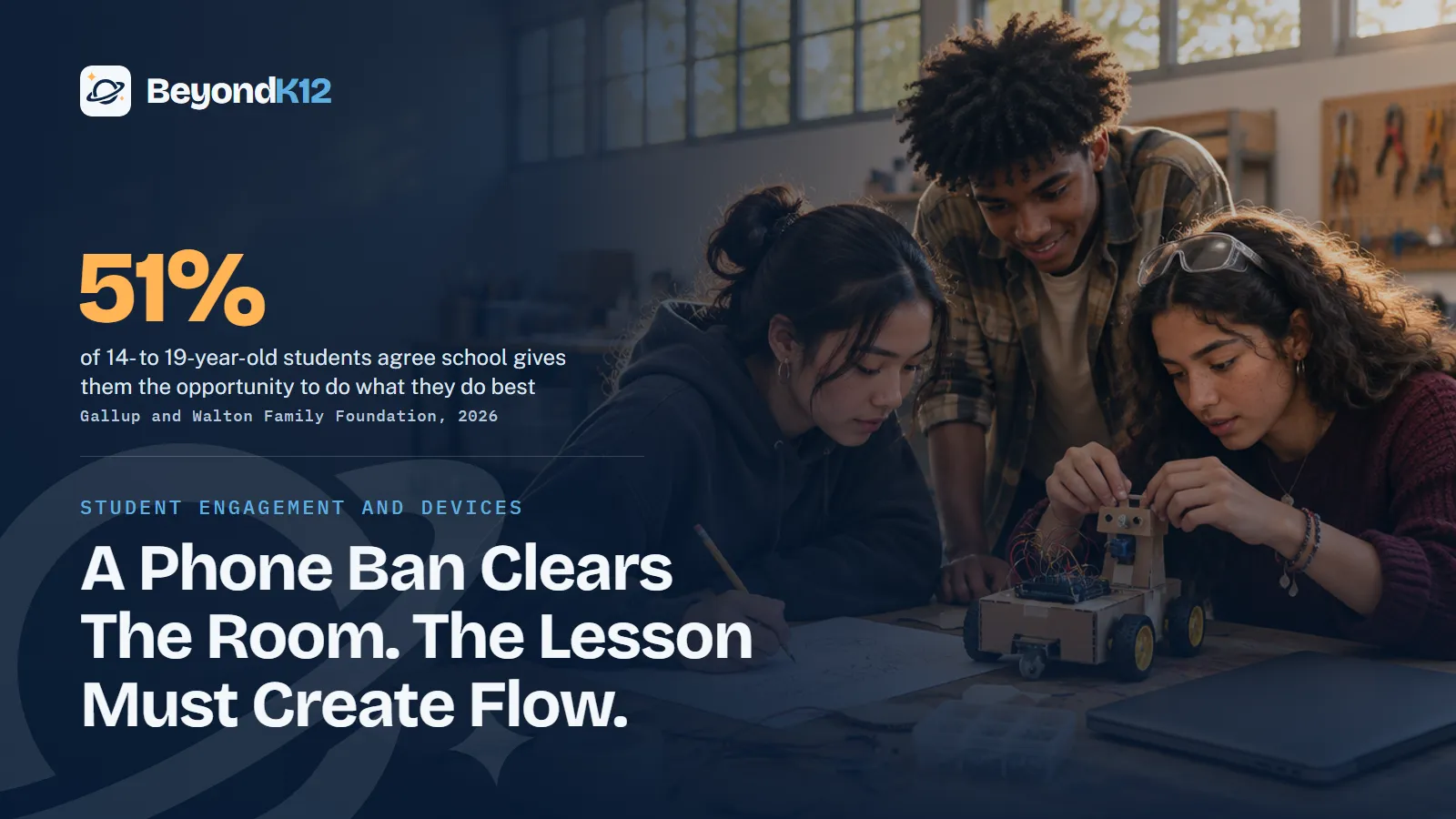
Flow is the state of being so engrossed in work that everything else drops away. Classroom and mobile computing can help teenagers reach it when a lesson gives them real challenge, choice, and feedback, and can break it when a device pulls their attention somewhere else.
- Flow
- The state in which we are so engrossed in doing something that we forget everything else, as described by psychologist Mihaly Csikszentmihalyi. It needs a balance between the challenge and the person's skills, a clear goal, and ongoing feedback.
Why did we start asking about flow?
This post began as a guest piece, reposted with permission from the CSI Blog. Our guest blogger sensed skepticism about using more classroom and mobile computing at school, and wrote that "we tend to get the value of technology for our personal use, but why don't we allow students the same level of use as they try to do their work?"
The answer our guest blogger gave was that we struggle to teach differently than we were taught. "We are moving from a culture of teacher delivery to a culture of guided exploration/collaboration and we must engage students in the learning process."
That argument came with a warning about students who fit badly in highly verbal classrooms: "We can and should do better for kids who are square pegs and don't fit our standard round holes." It also came with one administrator's line about schools with more technology than they use: "It's like we have a Learjet that we only drive to church and back."
When do teenagers experience flow?
Teenagers tend to find it where they have chosen to be. In a study of talented teenagers published in the early 1990s, Csikszentmihalyi and his colleagues reported that although some students felt challenged in class, most found their highest degree of engagement in extracurricular activities. Concentration rose in sports and music, and the students were eager there because participation was voluntary.
Class time can get there too. In a 2003 study, David Shernoff, Csikszentmihalyi, and colleagues had high school students rate their experience at various points in the school day. Students were more engaged during individual work and group work than during lectures or videos, and most engaged when an activity felt under their own control and relevant to their lives.
Flow also goes with better results. A 2023 meta-analysis of 13 studies and 3,253 students found that students with high learning flow levels tend to have better academic performance. Its authors say that conclusion needs more high-quality research, and 11 of the 13 studies came from South Korea or China.
How engaged are students now?
Engagement is better than it was, and far from finished. Gallup and the Walton Family Foundation surveyed 1,758 students ages 14 to 19 in 2026. Just over half (51%) agree that school gives them the opportunity to do what they do best, up from 37% in 2023. Still, more than four in 10 middle and high school students report that school usually does not feel interesting or seem to be a good fit for their talents.
What students say about school (2026)
Engagement pays off beyond the classroom. Gallup found that 81% of students with 10 or more engaging experiences at school feel prepared for the future, compared with 27% of students with three or fewer.
A phone rule removes a distraction, but only the lesson can give a teenager something worth concentrating on.Ernie Delgado, BeyondK12
How do devices help or break focus?
PISA 2025, released in September 2026, points both ways. Across OECD countries, moderate use of digital devices for learning is associated with stronger science performance, while excessive use and digital distraction are associated with weaker outcomes. These are associations from a survey and test of 15-year-olds, not proof of cause.
Distraction spreads beyond the student holding the device. The OECD says more than one in four students reported that classmates were distracted by digital devices in most or every science lesson. Students surrounded by distracted classmates performed less well, were less engaged in learning, and felt less connected to their school.
| What flow needs | How a device can help | How a device can break it |
|---|---|---|
| A challenge that fits the student's skill | Work that adjusts in difficulty, or a project with room to go further | Every student clicking through the same worksheet on a screen |
| A clear goal | A product the student is building, such as a model, a video, or a program | Open tabs and no stated purpose |
| Ongoing feedback | Running code, testing a design, teacher comments in a shared draft | Notifications that replace feedback with interruptions |
| Choice and relevance | Students pick the topic, the tool, or the audience | A tool chosen for the student with no connection to their goals |
| Unbroken time | Files that let work continue across class periods | Leisure use during class, by the student or a neighbor |
What does phone policy research say?
Bans change phone use. They have not yet been shown to change much else on average. A national 2026 NBER working paper looked at schools that adopted lockable pouches.
61% to 13%
Teacher-reported share of students using phones in class for personal reasons, before and after pouches.
NBER Working Paper 35132, 2026
30%
Rough decline in GPS pings on campus during school hours by the third year after adoption.
NBER Working Paper 35132, 2026
- Test scores: average effects were consistently close to zero, with modest gains in high schools and small losses in middle schools.
- Attention: the study found no clear evidence of improvements in self-reported classroom attention, and pre-trends limit what its authors can conclude.
- Discipline and well-being: incidents rose in the first year, then faded, and estimated well-being effects appeared to recover and turn positive in later years.
A Florida working paper on one large urban district found scores about 2-3 percentiles higher in the second year of a ban, along with fewer unexcused absences and a short-term rise in suspensions, especially among Black students. In England, a 2025 Lancet Regional Health Europe study of 1,227 adolescents in 30 secondary schools found no evidence that restrictive policies were associated with better mental wellbeing. It was a cross-sectional study, so it shows association rather than cause.
Read together, the research supports a limited claim. A strict phone rule reduces phone use in class. It does not, by itself, produce concentration, interest, and enjoyment. That part is lesson design.
How do you design for flow this year?
- Separate the two jobs. Decide your phone rule and your lesson design in different meetings. Plan for a discipline bump in the first year, since both studies saw one.
- Pick one course and one unit. Rebuild it around a product students make, with a real audience and a choice of topic or tool.
- Set the challenge on purpose. Give each student a starting point and a stretch goal, because flow depends on fitting the challenge to the skill.
- Move feedback inside the work. Use checkpoints, peer review, and teacher comments while students are still building, not only at the end.
- End with an explanation. Ask each student to explain what they made and why. In our TechPlus AI curriculum, every project ends this way.
What does this have to do with nurturing faith?
Our guest blogger wrote with faith in view, and saw more at stake than test scores. "I suggest that a deadening education is an education that tends to discourage faith," the piece said. "When we don't acknowledge that students are uniquely created and learn in different ways, then we disrespect them as persons and cause them to feel somehow inferior."
The piece ended on a hope that schools were not fulfilling "Neil Postman's analysis that many children begin formal education as question marks and leave as periods." Any school, religious or not, can ask the same question about its own students.
Where to start this week
Walk three classrooms with the checklist above and write down what you see. Pick the one condition that shows up least, and make it the focus of your next staff meeting. If teachers need time and coaching to rebuild a unit, see our professional development options.
If your school is also deciding how AI fits into this work, the free AI Readiness Assessment takes eight questions and scores you out of 24 across Policy, People, Curriculum, Guardrails, and Funding.
Related reading: Why every student needs a technology class in their curriculum today and 5 top ways technology benefits project-based learning in the age of AI.
Questions school leaders ask
What is flow in the classroom?
Flow is the state of being so engrossed in an activity that everything else drops away. Mihaly Csikszentmihalyi's research says it needs a balance between the challenge and the person's skills, a clear goal, and ongoing feedback. In a classroom it shows up as concentration, interest, and enjoyment at the same time.
Do school cellphone bans improve test scores?
The evidence is mixed. A 2026 NBER working paper on lockable pouches found average test score effects consistently close to zero, with modest gains in high schools and small losses in middle schools. A Florida study found scores about 2-3 percentiles higher in the second year of a ban in one large district. Both are working papers.
Do school phone bans help students pay attention?
Not clearly, so far. The 2026 national study found no clear evidence of improvements in self-reported classroom attention, and its authors caution that pre-trends limit what can be concluded. Teachers did report far less phone use in class.
Do laptops and tablets help or hurt focus?
It depends on how they are used. The OECD reports that moderate use of digital devices for learning is associated with stronger science performance in PISA 2025, while excessive use and digital distraction are associated with weaker outcomes. These are associations, not proof of cause.
How can a principal tell if a class is in flow?
Look for students working on a goal they can name, at a difficulty that stretches them, with feedback arriving during the work. Then ask a student to explain what they are doing and why. The walkthrough checklist below is a quick way to start.
Sources
- Greater Good Science Center, Can schools help students find flow? (2012) (opens in a new tab) (checked 2026-11-05)
- University of Chicago Chronicle, on Talented Teenagers by Csikszentmihalyi, Rathunde, and Whalen (February 1994) (opens in a new tab) (checked 2026-11-05)
- Frontiers in Psychology, Relationship between learning flow and academic performance among students: a systematic evaluation and meta-analysis (2023) (opens in a new tab) (checked 2026-11-05)
- Gallup and Walton Family Foundation, Engaged students more confident in their post-high school future (2026) (opens in a new tab) (checked 2026-11-05)
- National Center for Education Statistics, More than half of public school leaders say cell phones hurt academic performance (February 2025) (opens in a new tab) (checked 2026-11-05)
- Ballotpedia, State policies on cellphone use in K-12 public schools (October 2026) (opens in a new tab) (checked 2026-11-05)
- OECD press release on PISA 2025, via Education News Canada (September 2026) (opens in a new tab) (checked 2026-11-05)
- Education International, on the PISA 2025 report (2026) (opens in a new tab) (checked 2026-11-05)
- Information Age, Australian Computer Society, on PISA 2025 device use (2026) (opens in a new tab) (checked 2026-11-05)
- Allcott, Baron, Dee, Duckworth, Gentzkow, and Jacob, The effects of school phone bans: national evidence from lockable pouches, NBER Working Paper 35132 (2026) (opens in a new tab) (checked 2026-11-05)
- Full text of the same working paper, Stanford University (opens in a new tab) (checked 2026-11-05)
- Figlio and Ozek, The impact of cellphone bans in schools on student outcomes: evidence from Florida, NBER Working Paper 34388 (opens in a new tab) (checked 2026-11-05)
- Good Morning America, on the Florida cellphone ban study (2025) (opens in a new tab) (checked 2026-11-05)
- Goodyear et al., School phone policies and their association with mental wellbeing, phone use, and social media use (SMART Schools), The Lancet Regional Health Europe (2025) (opens in a new tab) (checked 2026-11-05)
- Wikiquote, Neil Postman, on Teaching as a Subversive Activity (1969) (opens in a new tab) (checked 2026-11-05)

See where your school stands on AI, in five minutes
Eight questions. A score out of 24 across Policy, People, Curriculum, Guardrails, and Funding, with the three fixes that move it most. The report is yours whether or not you ever call us.