


Computer Science Week ideas: from the Hour of Code to the Hour of AI
Computer Science Week ideas for 2026: theme days, free Hour of AI activities from CodeAI, family events, and a simple plan for running the week.
Updated with current data and sources. Originally published November 16, 2023.
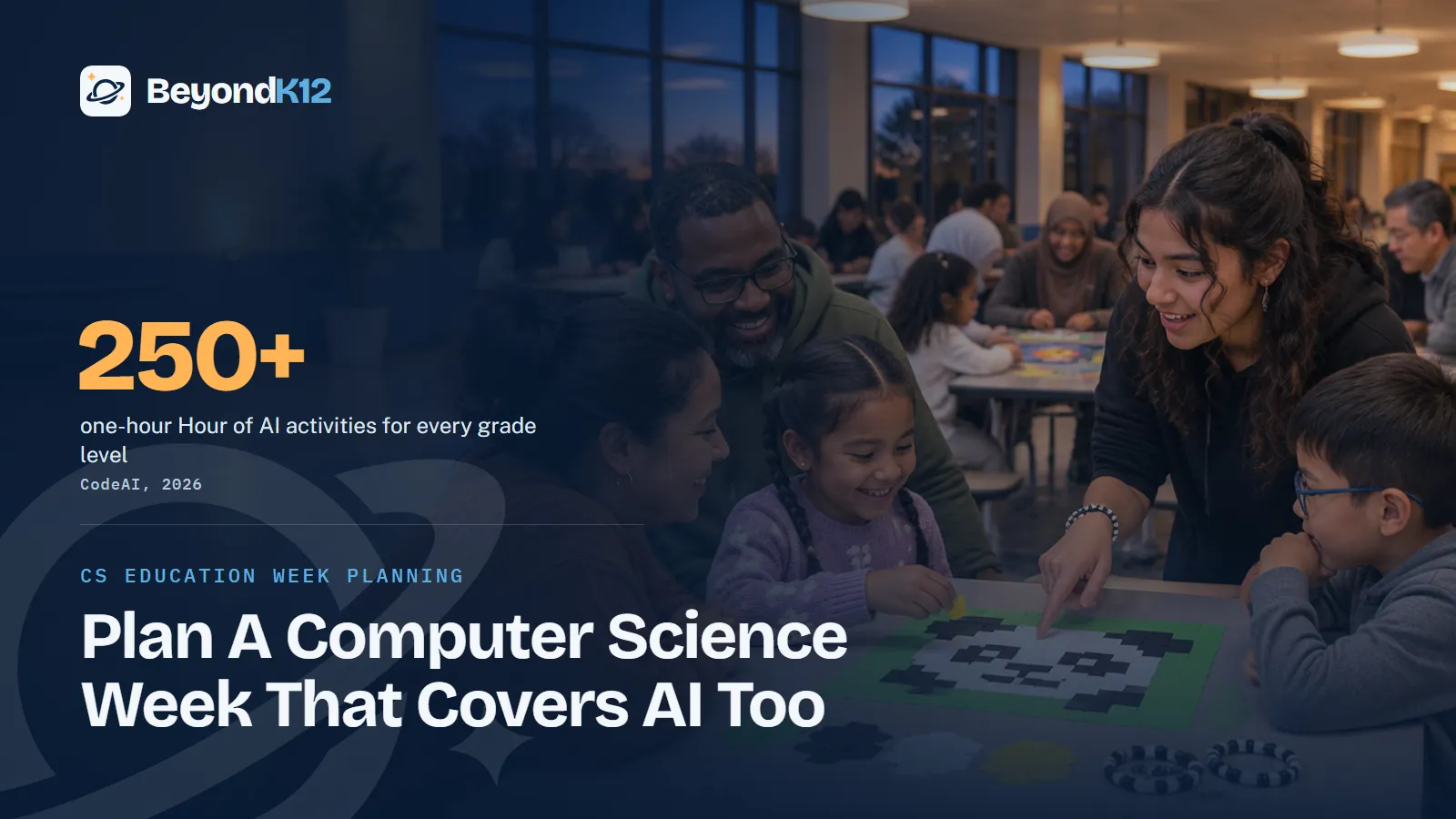
The best Computer Science Week ideas in 2026 mix theme days students can wear, one hands-on coding or AI hour in every class, and something families can do at home. The Hour of Code is now the Hour of AI, so one free event can now cover both coding and AI.
When is Computer Science Education Week in 2026?
CSTA's CSEdWeek site lists December 7 to 13, 2026. CodeAI's Hour of AI guide lists December 7 to 11, the school days of that same week. December 9 is Grace Hopper's birthday, which makes it a natural day for your main event.
Three dates are worth putting on your calendar now. CodeAI says its new activities launch on November 16. CSTA will host a preview on November 18 and a kickoff summit on December 5, with local watch parties run by CSTA chapters, and it will close the week with a session on December 9 called AI in Your Classroom. CSTA says every event is virtual and free with a free CSTA account.
December does not work for every school. The Hour of AI guide says the event works any time of year, so move it if testing, concerts, or Advent plans crowd the calendar.
What does CodeAI offer schools in 2026?
CodeAI, formerly Code.org, lists more than 250 one-hour activities on its Hour of AI page. The Hour of AI site calls them free and says no AI or coding experience is needed. These are good first picks.
- Mix & Move with AI (grades 2 to 12): students design a dancer, mix music, and choreograph a routine. It carries on the dance party idea I recommended in 2023.
- AI for Oceans (grades 3 to 12): students train a machine learning model to identify sea creatures and trash, and they explore training data and bias.
- Dance Party: AI Edition (grades 3 to 8): students learn AI concepts while they build a virtual dance party.
- Music Lab: Jam Session (grades 2 to 12): students remix tracks and practice coding basics such as sequencing.
- Intro to Web Lab (grades 8 to 12): students build webpages and practice using AI thoughtfully in the design process.
Partners add more. The Hour of AI site lists a Minecraft Education activity that shows why AI needs human oversight, AI Quests from Google, a hands-on LEGO Education activity on machine learning models, and Scratch Foundation's face sensing activity. Older coding activities remain on the site under Hour of Code, so a school that only wants coding can have it.
For the rest of the year, CodeAI announced two free courses in June 2026: AI Discoveries, a full-year course for grades 6 to 8, and AI Foundations: Designing and Building with AI, a high school semester. Both need a free CodeAI account. The Hour of AI teacher toolkit includes a step-by-step plan, slides, family and administrator handouts, and certificates, and teachers can request a volunteer when they sign up.
Eight theme day ideas that teach something
Dress-up days cost almost nothing, and they get students talking in the hallway before a single lesson starts. Pick three or four for the week, or run all of them across a longer celebration.
| Theme day | What students do | What it teaches |
|---|---|---|
| Pixel Day | Wear pixelated designs or make pixel art badges | How digital images are formed |
| Code Is Poetry | Wear shirts with programming languages or coding quotes | Coding languages, and that code can be creative |
| Historical Programmers | Dress as Ada Lovelace, Alan Turing, Grace Hopper, and others | The pioneers of computer science |
| Future Tech | Dress as future technology workers or devices | The future of technology and innovation |
| Binary Day | Wear black and white for 0s and 1s | The binary number system |
| Robot Day | Dress as robots or wear robotic designs | Robotics and automation |
| Webmaster Wednesday | Dress as favorite websites or web ideas, such as cookies, browsers, or HTML tags | The basics of web development and the internet |
| Gaming Gear | Wear favorite game clothing or dress as game characters | How games are programmed |
Any of these can carry an AI question. On Future Tech day, ask what job a person should always keep. On Pixel Day, ask how a computer tells a cat from a dog in a photo. Short questions like these turn a costume into a conversation.
Which classroom activities fit each grade band?
- Grades K to 2: a no-device activity from the Hour of AI list, a simple Caesar cipher, or black and white binary patterns.
- Grades 3 to 5: AI for Oceans, then a class talk about what the model got wrong and why.
- Grades 6 to 8: Dance Party: AI Edition or a digital escape room built around the week's vocabulary.
- Grades 9 to 12: Intro to Web Lab, or have older students lead an hour for younger buddies.
End every activity the same way: ask each student to explain what they made and how the tool helped. That is how every project ends in our TechPlus AI curriculum, and it works just as well after a one-hour activity.
How can families join in?
- Promote the week with a banner at pickup and dropoff, on social media, and in the school newsletter.
- Share ideas for how the whole family can code together. Turn off the TV and code.
- Host a family or school-wide dance party with Mix & Move with AI or Dance Party: AI Edition.
- Have families animate their names in Scratch, which is free for everyone.
- Encourage students to teach family members and friends to code.
- Show staff and administrators coding, and post it everywhere.
- Ask families to post pictures of their coding and tag your school, and follow your photo permission rules when you repost.
One week in December can open a bigger conversation
Access stopped growing. The 2025 State of AI + CS Education report found that 60% of U.S. public high schools offered foundational computer science in 2024-25, the same as the year before.
Public high schools offering foundational computer science
60%
of public high schools offered foundational computer science in 2024-25, unchanged from the prior year.
State of AI + CS Education, 2025
6.1%
of high school students took foundational computer science in 2024-25, in the 42 states with data.
State of AI + CS Education, 2025
34%
of computer science participants in 2024-25 were young women.
State of AI + CS Education, 2025
16%
of high school leaders say all their students are learning about AI in school.
CodeAI, 2026
The same report says schools with fewer than 500 students face the greatest difficulty offering and sustaining computer science courses. If your school is that small, you may not have a computer science teacher, which is exactly why a week that any teacher can run matters.
One great week will not replace a computer science plan, but it can show your community why you need one.Ernie Delgado, BeyondK12
How does a school plan the week?
- Name one organizer. The Hour of AI guide notes that one person can sign up for a whole school and share the guide with everyone. Give that person planning time, not just the title.
- Choose one activity per grade band. Pick from the list above after the new activities arrive on November 16. Include a no-device option if your carts or labs are booked.
- Try it before students do. Run the activity, read the teacher notes, and check whether it needs student accounts. Treat AI activities like any other tool under your acceptable use policy.
- Tell families what is coming. Send the theme days, the December 9 event, and one thing to try at home, using the toolkit's family handout.
- Ask what comes next. Use part of the next staff meeting to talk about what students asked and where the school should teach this all year.
Where to start this week
Open your calendar and block December 7 to 11. Name your organizer, sign up at the Hour of AI site, and pick three theme days before the new activities arrive.
Then use the week to ask a harder question: does your school teach AI and computer science the rest of the year? The free AI Readiness Assessment takes five minutes and scores you across Policy, People, Curriculum, Guardrails, and Funding, so you walk out of December knowing what to fix first.
Related reading: Why computer science matters in K-12 education and Exploring computer science: a guide for future innovators.
Questions school leaders ask
When is Computer Science Education Week in 2026?
CSTA's CSEdWeek site lists December 7 to 13, 2026. CodeAI's Hour of AI guide lists December 7 to 11, the Monday through Friday of that same week. December 9 is Grace Hopper's birthday. The guide says an Hour of AI works any time of year, so a school can move it around testing or concerts.
Is the Hour of Code still happening?
The Hour of Code is now the Hour of AI, and hourofcode.com redirects to hourofai.org. The Hour of AI site still lists Hour of Code activities, so a school can run a pure coding hour if that fits its students better.
Do teachers need coding or AI experience to run an Hour of AI?
No. The Hour of AI site says no AI or coding experience is required and that every activity walks you through it. It also says activities are available for any devices or none at all, so a school with limited technology can still take part.
What does CodeAI offer schools beyond one hour?
Two free courses announced in June 2026. AI Discoveries is a full-year course for grades 6 to 8, and AI Foundations: Designing and Building with AI is a high school semester. Both need a free CodeAI account, and CodeAI says neither requires a computer science background to teach.
What should we check before students use an AI activity?
Try the activity yourself, read the teacher notes, and check whether it asks students to create an account or enter personal details. Then run it past your acceptable use policy and vendor review, the same as any other tool. If your school has no written AI policy, write that first.
Sources
- CSTA, CSEdWeek 2026 site (dates and events) (opens in a new tab) (checked 2026-11-05)
- Hour of AI, How-to guide (2026) (opens in a new tab) (checked 2026-11-05)
- Hour of AI, home page and activity list (2026) (opens in a new tab) (checked 2026-11-05)
- CodeAI, The Hour of AI (2026) (opens in a new tab) (checked 2026-11-05)
- CodeAI, Code.org is now CodeAI, press release (June 2026) (opens in a new tab) (checked 2026-11-05)
- CodeAI, AI Discoveries and AI Foundations release (June 2026) (opens in a new tab) (checked 2026-11-05)
- Code.org and partners, 2025 State of AI + CS Education (opens in a new tab) (checked 2026-11-05)
- K-12 Dive, Most states still don't tie AI literacy and computer science together (2025) (opens in a new tab) (checked 2026-11-05)
- THE Journal, Code.org reinvents Hour of Code as Hour of AI (October 2025) (opens in a new tab) (checked 2026-11-05)
- Scratch Foundation, Scratch is free for everyone (opens in a new tab) (checked 2026-11-05)
- Pew Research Center, How teens use and view AI (February 2026) (opens in a new tab) (checked 2026-11-05)

See where your school stands on AI, in five minutes
Eight questions. A score out of 24 across Policy, People, Curriculum, Guardrails, and Funding, with the three fixes that move it most. The report is yours whether or not you ever call us.