


Why computer science matters in K-12 education
Why computer science matters in K-12: state requirements, equity gaps, earnings research, AI literacy, and how a small school adds CS without a CS teacher.
Updated with current data and sources. Originally published April 22, 2025.
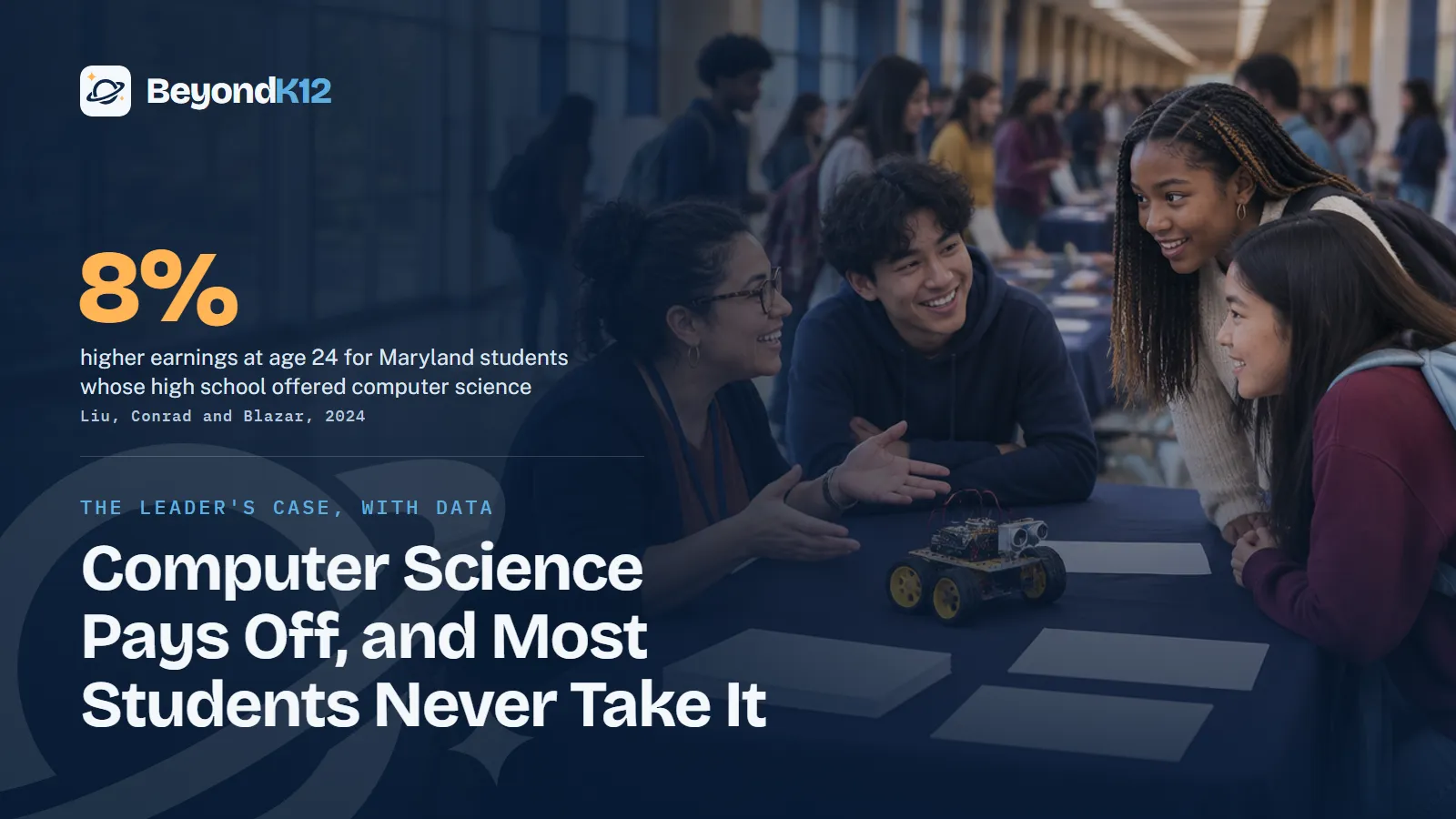
Computer science matters in K-12 education because it teaches students how the systems shaping their lives work, and the strongest research links access to it with higher early-career earnings for all students. Yet Code.org reports that only 60% of public high schools offered it in 2024-25 and only 6.1% of students took it, so the case for leaders now rests on access, participation, and AI.
- Computer science in K-12
- The study of how computing works: computational thinking, algorithms, programming, data, and the ethical use of technology. Coding is one part of it. The goal is to teach students how to think through a problem, not only how to use a tool.
Where state computer science requirements stand
Twelve states now require a computer science course to graduate, according to Code.org's 2025 State of AI + CS Education report and Education Week: Alabama, Arkansas, Indiana, Louisiana, Nebraska, Nevada, North Carolina, North Dakota, Rhode Island, South Carolina, Tennessee, and West Virginia. West Virginia was the only state to adopt one in 2025. North Carolina's rule reaches students entering high school in 2026-27, according to Government Technology. A step below that, Brookings reported that 30 states required all high schools to offer computer science as of 2023, up from four in 2017.
The requirement states are pulling ahead. In Code.org's comparison, 76% of their high schools offered foundational computer science in 2024-25, compared with 58% elsewhere. Code.org also shows their participation rising to 10.4% while it slipped to 5.3% in other states.
States with a CS graduation requirement lead on access and participation, 2024-25
That comparison shows a pattern, not proof of cause, because states that pass requirements may differ in other ways. Still, the direction is clear. Catholic and independent schools are often outside these state rules, but families comparing schools will notice the course catalog anyway.
Access has stalled and the participation gaps are wide
60%
of public high schools offered foundational CS in 2024-25, unchanged from the year before.
Code.org, 2025
6.1%
of high school students took foundational CS in 2024-25, down from 6.4%.
Code.org, 2025
34%
of CS participants in 2024-25 were young women.
Code.org, 2025
38%
of CS enrollment was low-income students, who are 53% of all students.
Code.org 2024, via Education Week
Keep the 6.1% in context. It is a yearly rate, and Education Week notes that the rate would reach 25% if every student took one course during four years of high school. Code.org shows access growing from 47% in 2019-20, but it has held at 60% for two years. Code.org also says small schools, with fewer than 500 students, face the greatest difficulty offering and sustaining the subject.
Opening a course does not fill it fairly. In the Maryland study, a new offering raised course-taking far more for some groups than others, and the top 25% of students by prior math achievement gained almost three times as much as the bottom 25%.
Rise in CS course-taking (percentage points) when a Maryland high school offered CS
North Carolina shows how long this can last. A study summarized by Duke found that CS enrollment rose from 3% in 2005 to 7.1% in 2015, with male students enrolling at nearly twice the rate of female students across all cohorts. The summary concludes that expanding access alone is not enough. A leader who adds a course without a recruitment plan may simply serve the students who were already headed there.
What the research says about outcomes
The original claim behind many CS programs is that students who take it do better in college and at work. Here is what holds up, from strongest to most limited.
| Study | What it found | How much weight to give it |
|---|---|---|
| Liu, Conrad and Blazar (Maryland, 2024) | Taking a CS course raised the chance of declaring a CS major by 10 points and earning a CS degree by 5 points. High schools offering CS raised employment by 2.6 points and earnings at age 24 by about 8%. | High. Causal design that compares cohorts in the same school before and after CS arrived. One state, early career only. |
| Same study, subgroups | Earnings gains of 10 to 14% for students who are female, low income, or Black. | High for the direction. These groups also took the course at lower rates. |
| Bruno (North Carolina, 2025) | Graduate degrees and specific licenses were not strong predictors of AP CS results. Teaching experience was linked to higher exam participation and scores. | Moderate. AP courses only, one state. |
| West Coast Analytics (two districts, 2020) | AP CS Principles students were 12% more likely to enroll in college than matched peers. | Low to moderate. Early findings on nearly 60,000 students, shared by Code.org. Matching is not causal proof. |
One detail matters for a budget conversation. The authors tie the 8% earnings result to attending a high school that offers computer science, and they note that it covers all students, not only those who pursue CS in college or work. Some summaries describe it as the effect of one course. The authors' own wording is more useful to a leader, because offering the course is the decision you control.
Computer science earns its place on the schedule because it changes what students can do in any field, not because every child should become a programmer.Ernie Delgado, BeyondK12
Computer science and AI literacy are converging
Code.org renamed its annual report in 2025 because the two subjects are merging in practice, and it states the position directly: AI does not replace computer science, it depends on it. State policy has not caught up. Code.org's 2025 report finds that of the 34 states it counted with AI guidance at the time, only 17 clarify that CS is fundamental to AI. In the same report, four states emphasize AI in their CS standards, five fund AI and CS professional development, and none requires both AI and CS for graduation.
Teachers are moving anyway. In CSTA's survey of 2,882 CS teachers, 70% already teach AI content, 81% believe AI belongs in foundational CS, and only 42% feel equipped to teach it. CSTA also reports that 85% spend less than five hours on AI across the school year. The willingness is there. The time and training are not.
A leader should not treat these as two budget lines. CSTA and TeachAI point to early research showing that people who understand computing concepts use AI tools more effectively. That makes CS the base layer of AI literacy, and it means one well-planned course can serve both goals. West Virginia's new requirement will also allow at least one foundational AI course to count.
How a small school can add computer science without a CS teacher
Most CS teachers were not hired as CS specialists. CSTA reports that 81% did not enter CS classrooms with a computer science or technical background, 85% chose to teach it, and only 42% are full-time CS teachers. Duke's summary of Bruno's research concludes that veteran teachers can effectively staff new CS courses and that broad certification mandates may slow expansion. Check your state's licensing rules, then use the following plan.
- Find the willing veteran. Look for a strong, curious teacher in any subject. Classroom experience is the qualification the research supports.
- Start with one course or one grade band. Pick a single point in the schedule where every student will pass through. In TK-8, that can be a scheduled class using a curriculum such as TechPlus AI.
- Protect the training time. CSTA found that almost half of elementary CS teachers had fewer than 11 hours of professional development in a year. Budget more, and plan professional development before the course starts.
- Connect the teacher to a community. Half of CS teachers have no CS colleague at their school, according to CSTA. Join a CSTA chapter or partner with a nearby school.
- Recruit on purpose. Ask counselors to invite girls, low-income students, and English learners by name. If the course is an elective, the Maryland data shows who is less likely to arrive alone.
- Report the roster. Show the board who enrolled against who attends the school, every year.
Where to start this week
Pull two numbers: how many students took a computer science course last year, and whether that group looks like your school. Then look up your state's page in the Code.org report and find the teacher you would ask first. That is enough to open the conversation with your leadership team.
Computer science sits inside your wider readiness for AI. The free AI Readiness Assessment gives you a score out of 24 across Policy, People, Curriculum, Guardrails, and Funding, with the three fixes that matter most.
Related reading: Exploring computer science: a guide for future innovators and Why every student needs a technology class in their curriculum today.
Questions school leaders ask
Does computer science really improve student outcomes?
The best evidence says yes for early-career outcomes. A Maryland study by Liu, Conrad, and Blazar found that high schools offering CS raised earnings at age 24 by about 8% and employment by 2.6 percentage points. It is one state and one age, so treat it as strong evidence rather than a guarantee.
Do students who take computer science go to college more often?
The evidence is thinner here. Early findings from a West Coast Analytics study, published by Code.org in 2020, found AP CS Principles students in two large districts 12% more likely to enroll in college than similar peers. That is a matched comparison shared by a course provider, not a causal result, so use it with care.
How many states require computer science to graduate?
Twelve as of Code.org's 2025 report: Alabama, Arkansas, Indiana, Louisiana, Nebraska, Nevada, North Carolina, North Dakota, Rhode Island, South Carolina, Tennessee, and West Virginia. Brookings reported that 30 states required all high schools to offer CS as of 2023. No state requires both AI and CS for graduation.
Is computer science still worth teaching now that AI writes code?
Yes, because the case was never only about programmers. Maryland's earnings gains covered all students, and CSTA and TeachAI point to early research showing that people who understand computing concepts use AI tools more effectively. The course should change to include AI, and 81% of CS teachers told CSTA that AI belongs in foundational CS.
Can a small school offer computer science without a CS teacher?
Yes. CSTA reports that 81% of CS teachers did not enter the classroom with a technical background and that 85% chose to teach CS. Pick a willing veteran teacher, start with one course or grade band, and protect time for professional learning.
Sources
- Code.org and CSforALL, 2025 State of AI + CS Education, full report (December 2025) (opens in a new tab) (checked 2026-11-05)
- Code.org Advocacy Coalition, State of AI + CS Education report page (opens in a new tab) (checked 2026-11-05)
- Code.org and CSforALL, New report: AI + computer science are the foundation for U.S. K-12 readiness (December 2025) (opens in a new tab) (checked 2026-11-05)
- Education Week, How to get more students into computer science classes in the age of AI (December 2025) (opens in a new tab) (checked 2026-11-05)
- K-12 Dive, Most states still don't tie AI literacy and computer science together (December 2025) (opens in a new tab) (checked 2026-11-05)
- Education Week, One change that can get more girls, students of color taking computer science (October 2024) (opens in a new tab) (checked 2026-11-05)
- Liu, Conrad and Blazar, Computer Science for All? The impact of high school computer science courses on college majors and earnings, IZA Discussion Paper 16758 (2024) (opens in a new tab) (checked 2026-11-05)
- Brookings, High school computer science impacts college majors and increases earnings (May 2024) (opens in a new tab) (checked 2026-11-05)
- University of Maryland, research brief on Maryland's CS for All policy (opens in a new tab) (checked 2026-11-05)
- University of Maryland College of Education, One computer science course in high school can boost future earnings (May 2025) (opens in a new tab) (checked 2026-11-05)
- Code.org, Study: computer science students much more likely to enroll in college (April 2020) (opens in a new tab) (checked 2026-11-05)
- Duke Center for Child and Family Policy, summary of Bruno, Who teaches high school computer science and does it matter? (2025) (opens in a new tab) (checked 2026-11-05)
- Duke Center for Child and Family Policy, summary of Kim, Who takes computer science in high school? (2025) (opens in a new tab) (checked 2026-11-05)
- CSTA, Kapor Foundation, and AiiCE, The 2025 Computer Science Teacher Landscape (opens in a new tab) (checked 2026-11-05)
- CSTA, The 2025 CS Teacher Landscape: insights into a profession facing isolation, AI uncertainty, and exhaustion (March 2026) (opens in a new tab) (checked 2026-11-05)
- CSTA and TeachAI, New guidance on computer science education in an age of AI (July 2024) (opens in a new tab) (checked 2026-11-05)
- Federal Reserve Bank of New York, The Labor Market for Recent College Graduates (March 2026, via VnExpress) (opens in a new tab) (checked 2026-11-05)
- Government Technology, North Carolina to require computer science for high schoolers (opens in a new tab) (checked 2026-11-05)

See where your school stands on AI, in five minutes
Eight questions. A score out of 24 across Policy, People, Curriculum, Guardrails, and Funding, with the three fixes that move it most. The report is yours whether or not you ever call us.