


Why is a coding program for middle school important?
Why grades 6 to 8 are the window for coding: identity research, the gender gap, access data, what a good program looks like, and what parents will ask.
Updated with current data and sources. Originally published April 5, 2024.
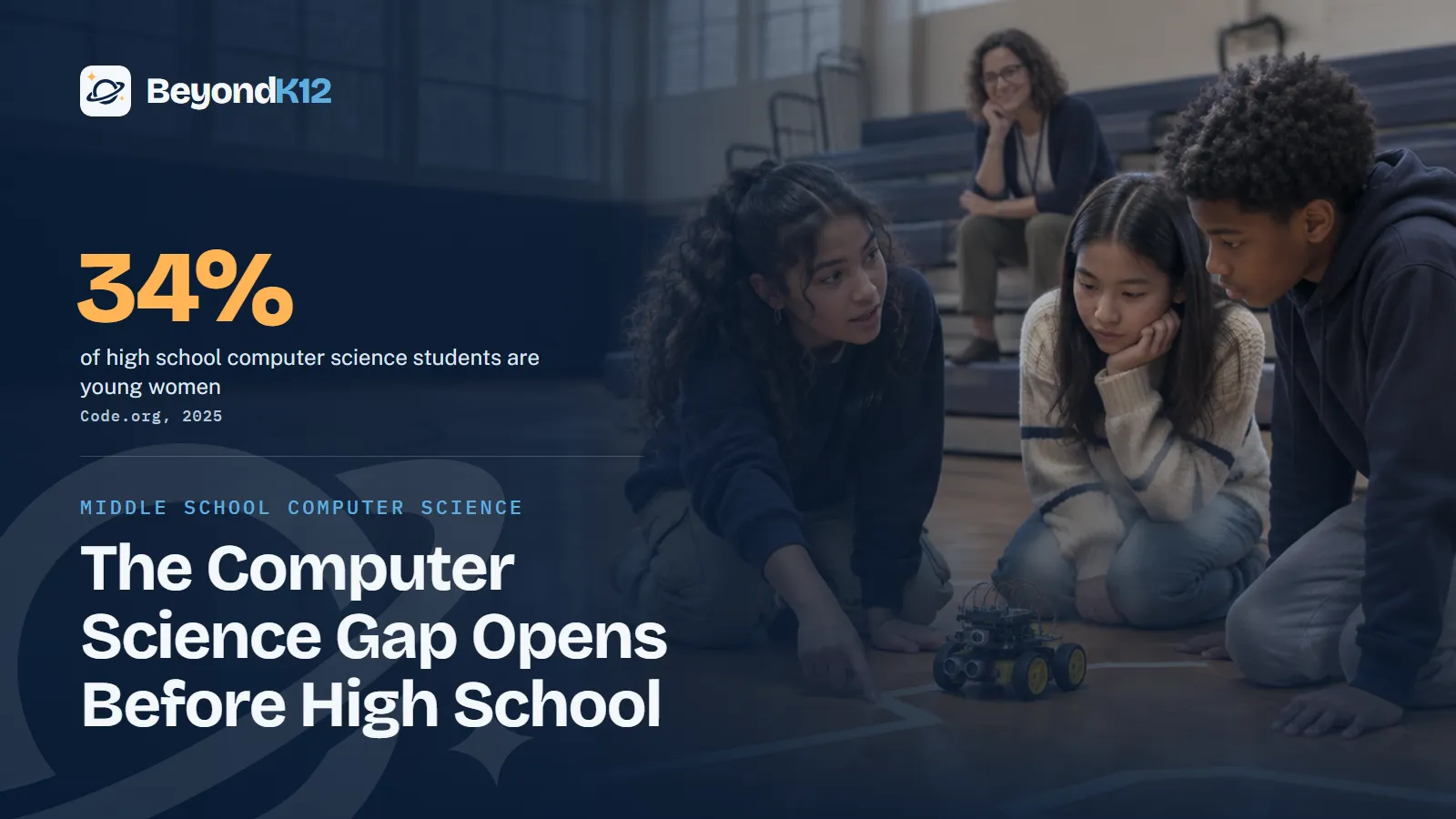
A coding program matters in middle school because grades 6 to 8 are when students decide whether computing is for them, and that decision follows them into high school. In a 2025 Rutgers study of 5,505 students, taking computer science in middle school was the strongest academic predictor of taking it in ninth grade.
Why are grades 6 to 8 the window for coding?
Early adolescence is when students sort subjects into "for me" and "not for me." The 2025 Rutgers study by Amiel and Blitz, which followed students across eight districts in one northeastern state, calls the move from eighth to ninth grade a pivotal point and argues for making CS part of the middle school curriculum in formats that reach all students, not only those who opt in.
Older research points the same way. A 2011 study reported by Education Week found that sparking interest was a more promising route to STEM degrees than pushing advanced high school courses or higher achievement. Interest comes first, and it forms before high school electives do.
Middle school also suits the work itself. Students this age can handle real logic, and they care about making something other people will use. A good course has them practice:
- Breaking a big problem into small ones, the core of computational thinking.
- Spotting patterns and writing steps, which is what an algorithm is.
- Making something original, because code is a creative medium as much as a technical one.
- Failing safely, since a bug is information and not a grade.
- Seeing real use, through games, websites, robots, and apps that someone can try.
One caution belongs here. A 2024 study of New York City students found that taking CS in middle school did not raise the likelihood that Black girls chose high schools offering CS or took a CS course in their first year. The same study found that Black girls were less likely to get CS instruction in middle school and less likely to feel they belong in the subject. A course on the schedule is necessary, and it is not sufficient.
Where does the gender gap in computer science open?
It shows up in confidence and interest long before enrollment. The most recent national survey we found that asks these questions by gender is Google and Gallup's 2020 study of students in grades 7 to 12. Boys were twice as likely as girls to be interested in learning CS, and nearly three times as likely to say they would pursue a career in it.
Grades 7 to 12: the gap in interest and confidence
Left alone, the gap does not close itself. Rutgers tracked seven public high schools over six years and found girls' CS participation at about 7% in 2023-24, where it had started, while boys' rose from 13% to 18%. Overall growth went almost entirely to boys.
Two things move the number. The first is the environment: in a 2016 study by Master, Cheryan, and Meltzoff, 35.4% of high school girls expressed interest in a CS course when the classroom looked non-stereotypical, compared with 13.3% when it was full of video games and science fiction. The second is removing the opt-in. Code.org reports that young women are now 42% of CS enrollment in Tennessee, in the third year of its graduation requirement, and Education Week's 2025 coverage of the report credits requirements for high participation by girls in South Carolina and Mississippi. A required middle school course applies the same logic years earlier.
Who has access to middle school coding today?
Nobody can give you a clean national number. Code.org reports high school access nationally, at 60% of public high schools in 2024-25, but only some states publish middle school data. Here is what those states show, and every one of them has closed all or nearly all of its high school gap.
Middle schools offering computer science, states that report it
Even strong states trail at the middle school level. At the high school level, Code.org says rural and urban schools, schools with many students receiving free meals, and schools with fewer than 500 students are less likely to offer CS, and small schools have the hardest time sustaining it.
These are public school figures. We did not find comparable national data for Catholic and independent schools, so count your own: which students in grades 6 to 8 get CS, for how long, and who is missing from the room.
What does a good middle school coding program look like?
It has a defined scope, projects with a real audience, and an assessment AI cannot complete for the student. CSTA's 2026 PK-12 standards are a sensible map. They treat middle school as a single grade band and organize learning into five concepts: algorithms and design, programming, data and analysis, systems and security, and computing and society, with AI content spread across all five.
A common path moves from block coding toward text, then builds something for someone: a game for younger students, a data story about the school, a robot that solves a small problem, a simple app for a club.
If a student cannot explain the code, the student has not finished the project.Ernie Delgado, BeyondK12
The "explain your work" assessment
Finished code no longer proves learning. Have each student walk a teacher or classmates through the project: what it does, why they built it that way, what broke, which tools helped, and what they would change. It takes minutes, it works for every level, and it builds the confidence many students are missing.
AI coding tools
Students already have them, so decide on purpose. Pew's 2026 survey found 54% of teens have used chatbots for schoolwork and 59% think AI cheating happens regularly at their school. Teachers are moving, but CSTA found that while 70% of CS teachers already teach AI, only 42% feel equipped to.
54%
of teens have used AI chatbots for help with schoolwork.
Pew Research Center, 2026
42%
of CS teachers feel equipped to teach AI, though 81% say it belongs in foundational CS.
CSTA and AiiCE, 2025
Our position is simple. Students learn the basics without AI first, so they can read what a tool produces. After that, they may use it with disclosure, and they must be able to explain and fix every line. Check your tools' age requirements and your privacy rules before any student account is created.
This is how our TechPlus AI curriculum handles grades 6 to 8: coded games and apps, data stories, cybersecurity, and AI critique with disclosure, and every project ends with the student explaining the work.
How can a school schedule and staff a coding program?
Most schools have more options than they think. The main choice is whether every student gets it. In CSTA's 2025 survey, 70% of elementary and middle school teachers described CS as at least partly mandatory at their school, so requiring it is not unusual. Staffing is usually a matter of growing someone: 81% of CS teachers surveyed entered the classroom without a CS or technical background.
| Model | How it works | Staffing | Watch for |
|---|---|---|---|
| Required rotation | A quarter or trimester course in the exploratory wheel | One teacher, sharing a slot with art, music, or tech | Short courses need a tight scope |
| Required semester or year | A full course in one or more grades | A teacher with a real section allotment | Hardest to fit, strongest continuity |
| Integrated units | Coding inside math or science units | Existing teachers, with shared planning | Coding can quietly disappear under test pressure |
| Elective | Students choose it | One interested teacher | Draws students who already see themselves in CS |
| Club or after-school | Robotics, game design, or a girls' coding club | Stipend for an adviser | A good addition and a poor substitute |
- Count who has access now. List every CS experience in grades 6 to 8 and who actually gets it.
- Pick one required slot. One grade is enough to start. Seventh grade often has the most room in the wheel.
- Choose the teacher and the curriculum together. Our guide to the traits of an exceptional coding teacher covers who to pick and how to support them.
- Connect it to high school. Tell the receiving high school what students learned, and invite every student to the next course by name.
What do parents ask about middle school coding?
Will AI make this pointless?
No, but the honest answer has two parts. The Bureau of Labor Statistics projects computer programmer jobs to fall 7% from 2025 to 2035, while computer and IT occupations overall grow faster than average, with about 280,000 openings a year and a median wage of $109,470 in May 2025, compared with $50,980 for all occupations. Typing code is becoming less of the job. Understanding it, checking it, and deciding what to build are not.
My child is not a math kid. Is this for them?
Yes. In the Rutgers study, 33% of students who finished Algebra I before high school took ninth-grade CS, compared with 24% of those who took it later, which is a link and not a prerequisite. A strong first course is built for beginners.
What if my child never works in tech?
The skills travel with them. Research on high school CS in Maryland, reported by Brookings in 2024, found that schools offering quality CS courses raised annual earnings at age 24 by about 8%, across all students and not only those who went into computing. That study covers high school, so it is a reason for a pathway and not a promise about any one class.
Where to start this week
Pull your grades 6 to 8 schedule and answer one question: which students will leave eighth grade without ever having built something in code? If the answer is "anyone who did not choose it," you have found your first decision.
Then look at the wider picture. The free AI Readiness Assessment takes five minutes and scores your school across Policy, People, Curriculum, Guardrails, and Funding, with the three fixes that matter most.
Related reading: What are the benefits of learning coding at an early age? and Why computer science matters in K-12 education.
Questions school leaders ask
Why should coding start in middle school rather than high school?
Because the high school decision is shaped before students get there. In a 2025 Rutgers study of 5,505 students, prior middle school CS was the strongest academic predictor of taking CS in ninth grade. Only 60% of public high schools offer foundational CS, according to Code.org, so middle school may also be the only reliable chance some students get.
Is coding still worth teaching now that AI can write code?
Yes, with a different emphasis. TeachAI and CSTA call learning to program the cornerstone of computational thinking, and a student cannot judge AI-written code they cannot read. The Bureau of Labor Statistics projects computer programmer jobs to fall 7% from 2025 to 2035 while computer and IT jobs overall grow faster than average, so teach reasoning and review, not only syntax.
How much time does a middle school coding program need?
There is no research-backed minimum. A required quarter or trimester course in one grade is a sensible start, and you can add grades from there. A course that every student takes matters more than the number of minutes, because electives and clubs tend to draw the students who already see themselves in computing.
Who can teach middle school coding if we have no CS teacher?
A willing teacher from your current staff, with a tested curriculum and real support. In CSTA's 2025 survey, 81% of CS teachers entered the classroom without a CS or technical background. Plan for coaching and a mentor, because half of CS teachers have no CS colleague at their school.
How do we close the gender gap in middle school coding?
Make the first course required, so nobody has to opt in, and look hard at who feels invited. In a 2016 study, 35.4% of high school girls were interested in a CS course in a non-stereotypical classroom, compared with 13.3% in one full of video games and science fiction. Choose projects with a purpose students care about, and ask girls directly to take the next course.
Sources
- Amiel and Blitz, Rutgers University, The middle-to-high school transition: key factors shaping 9th-grade computer science enrollment, International Journal of Computer Science Education in Schools (September 2025) (opens in a new tab) (checked 2026-11-05)
- Code.org and CSforALL, 2025 State of AI + CS Education (December 2025, full report copy) (opens in a new tab) (checked 2026-11-05)
- Code.org, State of AI and Computer Science Education report page (opens in a new tab) (checked 2026-11-05)
- K-12 Dive, Most states still don't tie AI literacy and computer science together (December 2025) (opens in a new tab) (checked 2026-11-05)
- Education Week, How to get more students into computer science classes in the age of AI (December 2025) (opens in a new tab) (checked 2026-11-05)
- Gallup, Girls' interest in computer science remains a challenge (Google and Gallup, 2020) (opens in a new tab) (checked 2026-11-05)
- Blitz, Amiel and Duncan, Rutgers University, High school computer science participation: a 6-year enrollment study (arXiv, March 2025) (opens in a new tab) (checked 2026-11-16)
- Mirakhur, Fancsali, and Hill, Outsiders within: how do Black girls fit into computer science for all?, ACM Transactions on Computing Education (2024) (opens in a new tab) (checked 2026-11-05)
- Harvard Kennedy School Gender Action Portal, summary of Master, Cheryan, and Meltzoff, Computing whether she belongs (2016) (opens in a new tab) (checked 2026-11-05)
- Education Week, Sparking STEM interest is key to earning degree, study says (June 2011) (opens in a new tab) (checked 2026-11-05)
- CSTA and AiiCE, The 2025 Computer Science Teacher Landscape (December 2025) (opens in a new tab) (checked 2026-11-05)
- CSTA, 2026 PK-12 computer science standards (opens in a new tab) (checked 2026-11-05)
- TeachAI and CSTA, guidance on computer science education in an age of AI (July 2024) (opens in a new tab) (checked 2026-11-05)
- Pew Research Center, How teens use and view AI (February 2026) (opens in a new tab) (checked 2026-11-05)
- U.S. Bureau of Labor Statistics, Computer and information technology occupations, Occupational Outlook Handbook (2026) (opens in a new tab) (checked 2026-11-05)
- U.S. Bureau of Labor Statistics, Computer programmers, Occupational Outlook Handbook (2026, archived copy) (opens in a new tab) (checked 2026-11-05)
- Brookings Institution, High school computer science impacts college majors and increases earnings (May 2024) (opens in a new tab) (checked 2026-11-05)

See where your school stands on AI, in five minutes
Eight questions. A score out of 24 across Policy, People, Curriculum, Guardrails, and Funding, with the three fixes that move it most. The report is yours whether or not you ever call us.