


What are the 4 types of programming languages?
The 4 types of programming languages are procedural, object-oriented, functional, and scripting or markup. What each does and what schools should teach.
Updated with current data and sources. Originally published April 5, 2024.
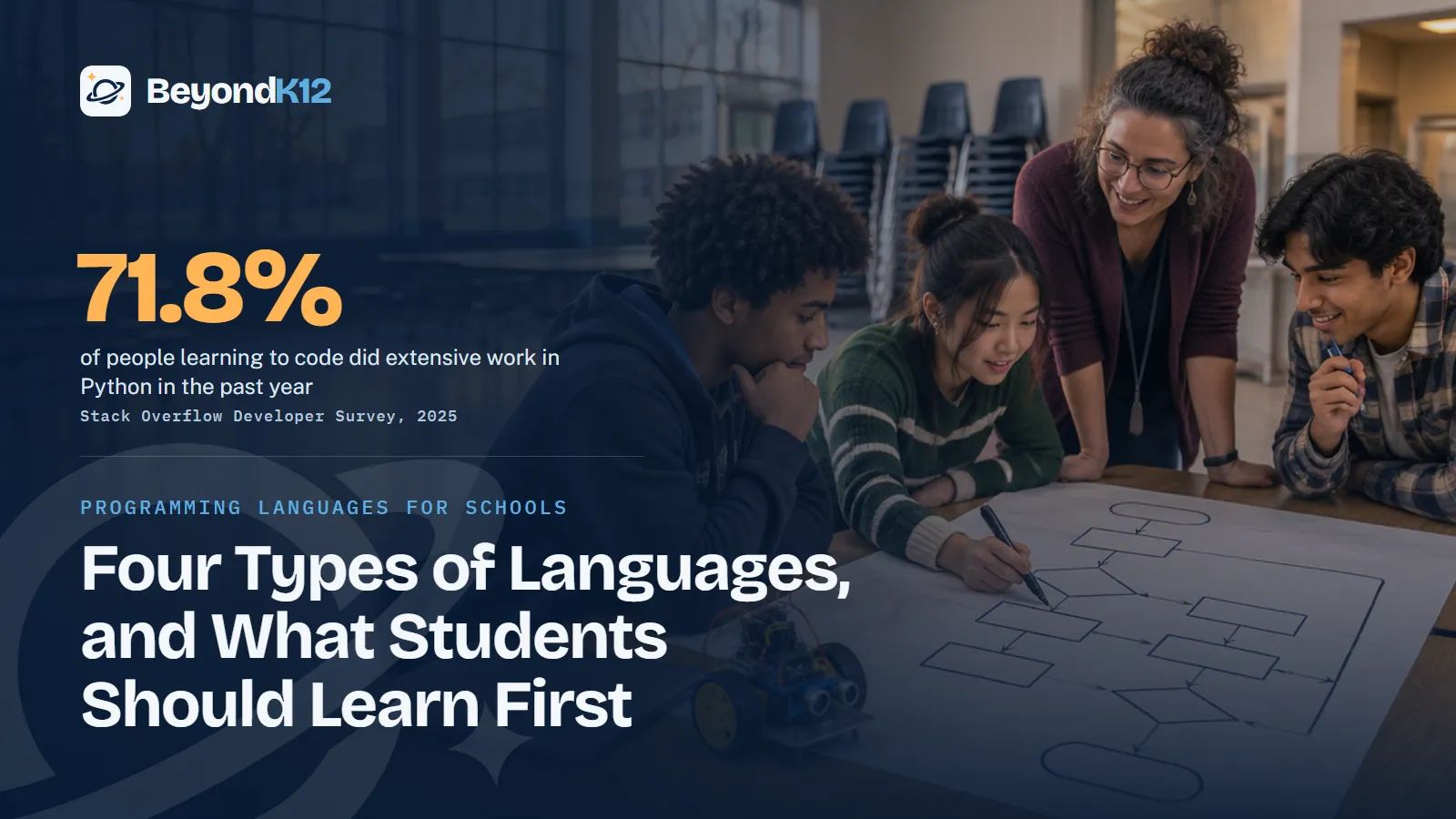
The four types of programming languages are procedural, object-oriented, functional, and scripting and markup. Each type is a different way to organize a problem, and most modern languages mix more than one.
That second point matters more than the list. A school does not need to choose a type. It needs to choose a language that teaches well at each age, then teach the habits that carry from one language to the next. Those habits now include checking code that an AI wrote.
- Programming paradigm
- A style of organizing a program, such as a list of steps, a set of objects, or a chain of functions. The four types in this guide are paradigms, plus the scripting and markup languages that shape the web. A single language can support several.
What are the 4 types of programming languages?
1. Procedural languages
A procedural program is a recipe: do this, then this, then this. Code is broken into small procedures or functions that can be tested one at a time. C, Pascal, and Fortran are the classic examples, and C still runs close to the hardware in embedded systems. Students meet this thinking first, because a stack of Scratch blocks and a short Python script both run from top to bottom.
2. Object-oriented languages
Object-oriented programming groups data and behavior into objects, such as a student record that stores a name and knows how to print a report card. Encapsulation, inheritance, and polymorphism are the core ideas. Java and C++ are the standard examples. This style suits large programs built by teams, and it is the heart of AP Computer Science A.
3. Functional languages
Functional languages treat a program as math: functions take inputs and return outputs, and data is not changed along the way. Haskell, Lisp, and Erlang are the usual examples. Fewer schools teach this style directly, but a spreadsheet formula works in a similar way. Bootstrap:Algebra, built for math classes in grades 7 to 12, teaches algebra through programming in Pyret and WeScheme.
4. Scripting and markup languages
These two travel together but do different jobs. Scripting languages such as JavaScript and PHP automate tasks, usually inside a host such as a web browser. Markup languages such as HTML and XML describe content and structure, and they contain no program logic. A student who builds a web page meets both in the same afternoon.
| Type | Core idea | Example languages | Where students meet it |
|---|---|---|---|
| Procedural | A sequence of steps and reusable procedures | C, Pascal, Fortran | Scratch stacks, first Python scripts, microcontroller projects |
| Object-oriented | Objects that hold data and behavior | Java, C++, Python | AP Computer Science A |
| Functional | Functions that return values without changing data | Haskell, Lisp, Erlang | Bootstrap:Algebra, spreadsheet formulas |
| Scripting and markup | Automating tasks and structuring content | JavaScript, PHP, HTML | Web design units, App Lab in Code.org's CS Principles |
Which languages do K-12 programs teach, and why?
We did not find a current national count of which languages U.S. classrooms use, so treat this as the common pattern and not a census. Four names come up again and again, and each earns its place for a different reason.
- Scratch: Blocks snap together, so a child can build a working program without a single typing error. The Scratch Foundation lists it for ages 8 to 13 and up, says it is free for everyone, and says 200 million kids create on it.
- Python: Short, readable syntax makes it a natural first text language, and it is also a working tool. GitHub's Octoverse 2025 report says Python powers nearly half of new AI repositories.
- JavaScript: It runs in every browser, so students can see and share results at once. Code.org's free CS Principles course teaches it in App Lab and offers a Python option for its programming units.
- Java: It is there mostly because of one exam. College Board says AP Computer Science A uses a subset of Java, and 93,217 students took that exam in 2025, according to College Board.
The first language should be chosen for how well it teaches, not for how it ranks. A sixth grader who finishes a project in blocks learns more than one who stalls on a missing semicolon. AP Computer Science Principles leaves room here: College Board's student page names no required language and says no previous coding experience is needed.
Which programming languages are most popular in 2025 and 2026?
It depends on what you measure, and the three big rankings measure different things. Stack Overflow asks developers what they used. In its 2025 survey of more than 49,000 respondents, JavaScript led all respondents at 66%, and Python rose 7 percentage points to 57.9%. Among people learning to code, Python leads by a clear margin.
Languages used by people learning to code, 2025
TIOBE ranks languages using search results that reflect engineers, courses, and vendors. Its October 2026 index puts Python first at 19.23%, well ahead of C at 11.33%.
TIOBE index ratings, October 2026
GitHub counts contributors. Its Octoverse 2025 report says TypeScript, a typed version of JavaScript, passed Python and JavaScript in August 2025 to become the most used language on the platform.
2.64M
monthly TypeScript contributors in August 2025, up 66.6% in a year, just ahead of Python at 2.6 million.
GitHub Octoverse, 2025
6
languages made up nearly 80% of new repositories: JavaScript, Python, TypeScript, Java, C++, and C#.
GitHub Octoverse, 2025
Read together, the rankings tell a school leader something steady. The names at the top barely change: Python, the JavaScript family, Java, and the C family. A program built on Scratch, Python, JavaScript, and Java is teaching the languages the field uses.
How do AI coding assistants change what a beginner should learn?
They change the job from writing every line to judging every line. Stack Overflow's 2025 survey found that 84% of developers use or plan to use AI tools, and GitHub reports that nearly 80% of new developers on its platform use Copilot in their first week. Beginners are already there: 58.2% of learners in the Stack Overflow survey use AI daily or weekly.
Trust has not kept up. In the same survey, 46% of developers said they do not trust the accuracy of AI output, 66% named answers that are almost right as their biggest frustration, and 45.2% said debugging AI-generated code takes more time. Almost right is the hardest kind of wrong to catch, and catching it takes knowledge.
There is early evidence on what this does to learning. In a January 2026 trial by Anthropic, the maker of Claude, 52 mostly junior software engineers learned a new Python library with or without an AI assistant. The AI group averaged 50% on a quiz and the hand-coding group 67%, and the widest gap was in debugging. The authors call the results preliminary, and participants who used AI to ask for explanations did better than those who handed off the work.
Our position at BeyondK12 is simple: a student who cannot read, test, and explain a program has not learned it, whoever or whatever wrote it.Ernie Delgado, BeyondK12
So the fundamentals move up in value. Variables, loops, functions, and data still need to be learned by hand first, because they are what a student uses to judge a draft. Our TechPlus AI curriculum for TK-8 is built on the same idea: every project ends with the student explaining their work.
What should a K-12 language plan look like?
- Elementary: start with blocks. Use Scratch or a similar tool to teach sequences, loops, and events. Keep typing out of the way of the thinking.
- Middle school: make the move to text. HTML gives quick visible results, and Python or JavaScript introduces real syntax. Let students compare a block program with the same program in text.
- First high school course: go broad. Use Python or JavaScript in a course such as AP Computer Science Principles, and cover data and the impact of computing along with code.
- Next course: go deep. Offer Java through AP Computer Science A for students ready for object-oriented design.
- At every stage: read, test, explain. Set a clear rule for when AI help is allowed, ask students to disclose it, and have them walk through their code out loud.
Where to start this week
Ask your computer science or technology lead one question: which language do students use at each grade, and why? If the answer is a list with no reason attached, sketch the plan above at your next team meeting. Then check whether your acceptable use policy says anything about AI help with code.
Language choices sit inside a larger decision about curriculum and staff readiness. The free AI Readiness Assessment takes five minutes and scores your school across Policy, People, Curriculum, Guardrails, and Funding, with the fixes that matter most.
Related reading: Exploring computer science: a guide for future innovators and Why computer science matters in K-12 education.
Questions school leaders ask
What are the 4 main types of programming languages?
Procedural languages such as C run step by step instructions. Object-oriented languages such as Java organize code around objects. Functional languages such as Haskell build programs from functions and avoid changing data. Scripting and markup languages such as JavaScript and HTML automate tasks and structure content.
Is HTML a programming language?
Not in the strict sense. HTML is a markup language: it describes and structures content rather than giving a computer logic to run. It belongs in this guide because students usually meet it beside JavaScript, and 66.6% of people learning to code use HTML/CSS, according to the 2025 Stack Overflow Developer Survey.
What programming language should a beginner learn first?
For young children, a block language such as Scratch, which the Scratch Foundation lists for ages 8 to 13 and up. For older beginners, Python is the common choice: 71.8% of people learning to code used it in the 2025 Stack Overflow Developer Survey.
Which language does AP Computer Science A use?
A subset of Java, according to College Board. AP Computer Science Principles has no single language named on College Board's student page, and Code.org's version teaches JavaScript in App Lab with a Python option.
Do students still need to learn programming if AI can write code?
Yes. In the 2025 Stack Overflow survey, 46% of developers said they do not trust the accuracy of AI output, and 66% named almost-right answers as their biggest frustration. Someone has to read the code, test it, and know when it is wrong.
Sources
- Stack Overflow, 2025 Developer Survey: Technology (opens in a new tab) (checked 2026-11-05)
- Stack Overflow, 2025 Developer Survey: AI (opens in a new tab) (checked 2026-11-05)
- Stack Overflow, 2025 Developer Survey press release (opens in a new tab) (checked 2026-11-05)
- TIOBE Index (October 2026) (opens in a new tab) (checked 2026-11-05)
- GitHub, Octoverse 2025: A new developer joins GitHub every second as AI leads TypeScript to #1 (opens in a new tab) (checked 2026-11-05)
- College Board, AP Computer Science A course page for students (opens in a new tab) (checked 2026-11-05)
- College Board, AP Computer Science A score distributions (opens in a new tab) (checked 2026-11-05)
- College Board, AP Computer Science Principles course page for students (opens in a new tab) (checked 2026-11-05)
- Code.org, Computer Science Principles curriculum (opens in a new tab) (checked 2026-11-05)
- Code.org, Computer Science A curriculum (opens in a new tab) (checked 2026-11-05)
- Scratch Foundation, Tools and age ranges (opens in a new tab) (checked 2026-11-05)
- Scratch Foundation, home page (opens in a new tab) (checked 2026-11-05)
- Bootstrap, Bootstrap:Algebra materials (opens in a new tab) (checked 2026-11-05)
- Anthropic, How AI assistance impacts the formation of coding skills (January 2026) (opens in a new tab) (checked 2026-11-05)

See where your school stands on AI, in five minutes
Eight questions. A score out of 24 across Policy, People, Curriculum, Guardrails, and Funding, with the three fixes that move it most. The report is yours whether or not you ever call us.