


4 ways to find the technology funding your K-12 school needs
A practical search method for K-12 technology funding: federal listings, Title II, parent groups, and foundations, with what to check in each.
Updated with current data and sources. Originally published April 8, 2014.
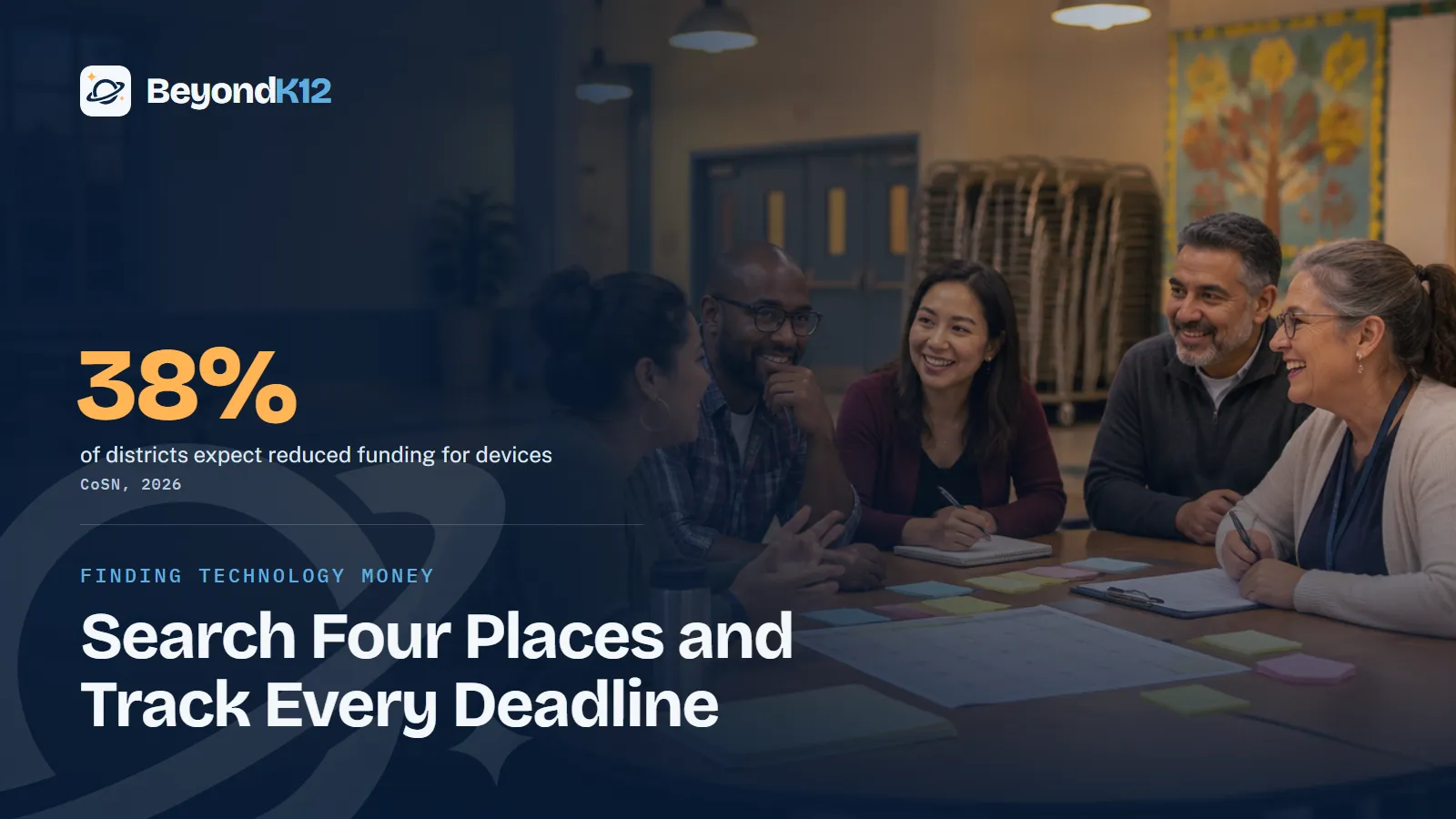
You find technology funding by searching four places in order: federal grant listings, your Title II contact, parent groups and local donors, and education foundations. No single source will cover a whole plan, so the real skill is a repeatable search that shows you quickly which money fits. Nothing here is a promise of funding, because every source sets its own rules.
In 2014 I wrote that districts grappling with state and federal shortfalls had begun looking elsewhere for technology money. That pressure has not gone away. The four sources I named then still work, but each one needs a sharper approach now.
Why look beyond your budget now?
Budget constraints have been the top challenge in 12 of the 13 years that CoSN has asked education technology leaders about implementation barriers. In CoSN's 2026 report, 38% of districts expect reduced funding for devices. The same survey shows which lines leaders see at risk as emergency funding ends.
Budget areas leaders see at risk as emergency funding ends (2026)
7 to 10
business days, on average, to process a SAM registration once all information is entered.
Grants.gov
$2.19B
in Title II-A funding in the final FY2026 bill.
Committee for Education Funding, 2026
$250 to $5,000
range of Walmart local grant amounts.
Walmart.org, FY27 guidelines
$117.15B
estimated giving by U.S. foundations to all causes in 2025.
Giving USA 2026
Way 1: how do you search federal grants?
Many schools assume federal money comes only from the Department of Education. It does not. Grants.gov is still the clearinghouse to search, and it names SAM.gov Assistance Listings as the authoritative source on federal programs. The lists are long, so set aside real time and read the terms closely.
Take USDA's Distance Learning and Telemedicine program. Its FY2026 guide allowed requests from $50,000 to $750,000 with a 15% match, aimed at rural areas, and that round closed June 30, 2026. A school that only checked the education department would never have seen it.
Do the paperwork before you need it. Grants.gov says your SAM registration must be fully processed before you can apply, and processing averages 7 to 10 business days after all information is entered. Your district may already hold a registration, so ask first.
Way 2: where do you find Title II funding?
Title II is still federal money that reaches you through state and local agencies. The search I recommended in 2014 still works: go to your state department of education's website, or search "Title II" with your state's name. Then call your district's federal programs director, because that person knows what is committed.
Know what it buys. Title II-A supports teachers and leaders. Washington's guidance, updated December 2025, lists equipment, software licenses, and classroom hardware or software as non-eligible. So use Title II for the training that makes a technology purchase work, and use another source for the purchase. Our funding guide shows how the pieces fit.
Plan for risk as well. The final FY2026 bill held Title II-A at $2.19 billion, according to the Committee for Education Funding, but a House committee bill for FY2027 would eliminate it, the Association of California School Administrators reported. That bill has not become law, and the Congressional Research Service reported in September 2026 that full-year funding had not been enacted.
Way 3: how can parent groups and local donors help?
A PTA, PTO, or other parent group can be the closest help a school has. Parent groups know how to run events, and the wider community usually wants its school to succeed. Publicity is still what moves a campaign beyond the school grounds, so give one person the job of reaching local media and local businesses.
- Local stores: Walmart's FY27 guidelines list local grants of $250 to $5,000 for K-12 public, nonprofit private, and charter schools, with November 30 as the last day to submit.
- Teacher crowdfunding: DonorsChoose is free for teachers employed full-time in U.S. public or public charter schools who work directly with students at least 75% of the time. It says teachers at over 84% of U.S. public schools have signed up.
- Fairness across schools: researchers writing in The 74 reported a gap of more than $40,000 between schools in Evanston, Illinois, before its PTA Council began pooling funds. In a district, ask how parent money affects schools that cannot raise as much.
Funding goes to the school that stays organized after the first burst of excitement is gone.Ernie Delgado, BeyondK12
Way 4: how do you find education foundations that fund technology?
Foundation money is real. Giving USA 2026 estimates that foundations gave $117.15 billion in 2025 and that education received $92.01 billion from all donors. Those totals cover far more than K-12 technology, so they tell you the money exists, not that it is meant for you.
The work is in the fit. Grants.gov points readers to Candid's database of grant makers, and Candid says partner locations offer free access to its resources. ProPublica's Nonprofit Explorer lets you search annual returns filed by tax-exempt organizations. Your local education foundation and community foundation belong on the list too.
Read the exclusions first. Pinellas Education Foundation in Florida says it provides more than $125,000 in classroom grants each year, with requests up to $1,000, and its 2026-27 FAQ also says it will not fund computers, tablets, projectors, or printers. A technology request there would fail however well it was written. For national funders and their deadlines, see our education grants guide.
| Way | Best fit | First move | Watch for |
|---|---|---|---|
| Federal listings | Larger, specific projects | Search Grants.gov and check your SAM registration | Long applications and matching requirements |
| Title II | Training that supports a purchase | Call your federal programs director | Limits on hardware and licenses, and FY2027 risk |
| Parent groups and local donors | Small items and pilots | Bring one clear request to the next meeting | Fairness across schools and eligibility rules |
| Foundations | A project that matches a funder's mission | Read the exclusions, then past awards | Small errors that disqualify an application |
How do you run the search so nothing gets missed?
Getting organized is still the key. These steps turn four sources into one process.
- Write a one-page need. Name the technology, the students it serves, the cost, and how you will know it worked. Every application starts from this page.
- Assign roles. One person searches, one writes, one owns the budget, and one handles publicity. In a small school, one person may hold two roles, but each role needs a name.
- Screen in ten minutes. Check who may apply, what is excluded, and the deadline before you read anything else. If any of the three fails, move on.
- Tailor each request. Fit your application to your needs and to the funder's goals, and follow the format exactly.
- Report and thank. Send results on time. Reporting can be part of the terms, and Pinellas says it can affect eligibility for future awards.
Where to start this week
Write your one-page need, then spend 30 minutes on one source from each of the four ways. Add what you find to a shared tracker, and name an owner for each deadline. Check every rule on the funder's own page, since terms change.
If you are not sure which need to write down, the free AI Readiness Assessment takes eight questions and scores your school out of 24 across Policy, People, Curriculum, Guardrails, and Funding. The result gives you a starting point for that page.
Related reading: Education grants: a guide to funding STEM and AI curriculum and support and What is an AI strategy in K-12 education?
Questions school leaders ask
Where do I find federal grants for school technology?
Start at Grants.gov and at SAM.gov Assistance Listings, which Grants.gov calls the authoritative source on federal programs. Search beyond the Department of Education: USDA's Distance Learning and Telemedicine program is one example. Your organization must be registered in SAM.gov before it can apply.
How do I find Title II funding in my state?
Start with your state education department's website and search for Title II, Part A plus your state name. Title II-A money flows through states to districts, so your district's federal programs director is the person to ask. It mainly supports educators, and Washington's guidance excludes hardware and software licenses.
Can a private or Catholic school use these sources?
Some of them. Walmart's local grants list nonprofit private schools as eligible, while DonorsChoose is built for public and public charter school teachers. Title funds reach private schools through district-provided equitable services, not direct payments, so answer your district's consultation invitation.
Do foundations pay for technology?
Some do, and some rule it out. Pinellas Education Foundation's 2026-27 FAQ says it will not fund computers, tablets, projectors, or printers. Read each funder's exclusions before you write a word, and use Candid's free partner locations or ProPublica's Nonprofit Explorer to research a foundation.
How much can a parent group realistically raise?
It varies by community. In Evanston, Illinois, researchers writing in The 74 reported a gap of more than $40,000 between schools before the PTA Council pooled its fundraising. Ask your parent group what it raised last year, and plan from that figure.
Sources
- CoSN, U.S. State of EdTech 2026 (opens in a new tab) (checked 2026-11-05)
- Grants.gov, Organization registration (opens in a new tab) (checked 2026-11-05)
- Grants.gov, Grant programs (opens in a new tab) (checked 2026-11-05)
- USDA Rural Utilities Service, FY2026 Distance Learning and Telemedicine application guide (opens in a new tab) (checked 2026-11-05)
- Committee for Education Funding, final FY 2026 funding table (January 2026) (opens in a new tab) (checked 2026-11-05)
- Washington OSPI, Title II, Part A allowability (December 2025) (opens in a new tab) (checked 2026-11-05)
- Association of California School Administrators, Federal report: good news, bad news on federal funding (July 2026) (opens in a new tab) (checked 2026-11-05)
- Congressional Research Service, Status of FY2027 Labor, HHS, and Education appropriations (September 2026) (opens in a new tab) (checked 2026-11-05)
- Massachusetts Department of Elementary and Secondary Education, Private school equitable services under ESSA (opens in a new tab) (checked 2026-11-05)
- The 74, Illinois district shows what can be done about PTA fundraising inequities (opens in a new tab) (checked 2026-11-05)
- DonorsChoose, For teachers (opens in a new tab) (checked 2026-11-05)
- Walmart.org, Spark Good local grants guidelines (FY27) (opens in a new tab) (checked 2026-11-05)
- Giving USA Foundation, Giving USA 2026: charitable giving rose to $617.20 billion in 2025 (opens in a new tab) (checked 2026-11-05)
- Candid, Free access to Candid near you (opens in a new tab) (checked 2026-11-05)
- ProPublica, Nonprofit Explorer (opens in a new tab) (checked 2026-11-05)
- Pinellas Education Foundation, Grant FAQs 2026-27 (opens in a new tab) (checked 2026-11-05)

See where your school stands on AI, in five minutes
Eight questions. A score out of 24 across Policy, People, Curriculum, Guardrails, and Funding, with the three fixes that move it most. The report is yours whether or not you ever call us.