


9 ways to spend your end of year funds: what use it or lose it really means
Nine ways to spend end of year school funds, with the real rules on Title I, II-A, and IV-A carryover, obligation dates, and allowable uses.
Updated with current data and sources. Originally published May 7, 2019.
Use it or lose it is true for some school money and not for other money. Most federal title funds stay available well past June 30, while local budgets, state grants, and restricted gifts can end on their own dates, so the first step is to find out which is which. Then spend on one of the nine things below, and confirm the rules with your finance office or state agency before you sign.
Don't leave money on the table. Here are eight ideas, plus a bonus idea, for programs and upgrades that benefit your school and your students, along with the rules that decide whether your money can pay for them.
- Obligated funds
- Money the school has legally committed, even if the bill has not been paid. In federal programs, the date of the obligation, not the date of the check, is usually what decides whether a cost falls inside the funding period.
What does use it or lose it actually mean?
It depends on the source. Your state or district fiscal year often ends June 30, and a local budget line may truly vanish that day. Federal title money works differently. Wisconsin's education department tells districts they do not have to spend all Title I-A funds by June 30, and it describes a 27-month window: funds awarded July 1, 2022, were available until September 30, 2024. Arkansas describes the same structure as 15 months plus a one-year carryover period, and federal law provides the extra year.
By that count, funds awarded July 1, 2026, would run through September 30, 2028, if your state follows the same calendar. Ask first. Your state may set earlier internal deadlines, and carrying money forward can affect your next application.
27
months of availability for Title I-A funds in Wisconsin's guidance, including the Tydings period.
Wisconsin DPI
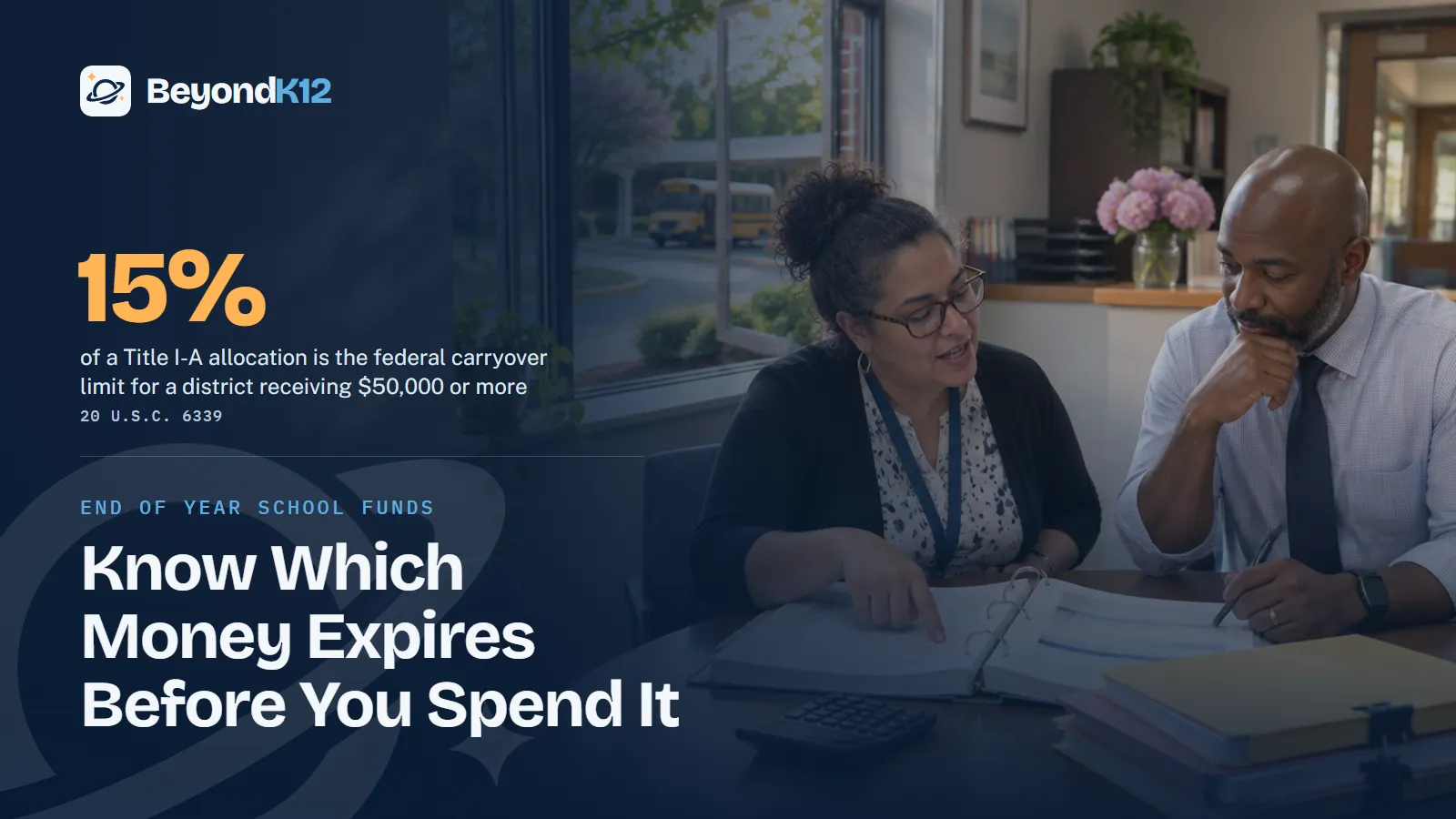
15%
federal Title I-A carryover limit for a district receiving $50,000 or more.
20 U.S.C. 6339
3 years
how often a state may waive that limit for a district.
20 U.S.C. 6339
100%
carryover listed for Title II-A and Title IV-A in New York.
New York State Education Department
Federal percentages that shape end of year spending
What are the exact carryover rules by fund?
| Source | Carryover rule | What to confirm |
|---|---|---|
| Title I-A | 15% limit if the allocation is $50,000 or more; no limit below that | Whether you need a waiver this year, since states may grant one only once every three years |
| Title II-A | New York lists 100%; the section 1127 limit is a Title I rule | Your state's rule and your approved plan |
| Title IV-A | New York lists 100%, and districts must still meet the prior year's spending requirements | The 20% floors and the 15% technology infrastructure cap |
| Other federal programs | Varies: Arkansas limits REAP-RLIS carryover to 5% | The rule for each grant |
| Private school equitable services | Must be obligated in the fiscal year received, by the district | Your district's timeline and how it handles unused amounts |
| State, local, and donor funds | Set by state law, board policy, or the gift agreement | Your finance office, your board, and the donor's terms |
When does money count as committed?
Federal rules in 34 CFR 76.707 spell it out, and they catch people every year:
- Equipment, curriculum, and other property: the date of a binding written commitment to acquire it.
- Contractors and vendors: the date of a binding written commitment for the service or work.
- Your own employees: when the services are performed.
- Travel: when the travel is taken, not when you register.
- Rentals and utilities: when you use the property or receive the service.
A July conference paid for in May may fall in a different period than you expect. Before you prepay a multi-year license, ask your finance office whether the term can run past the fund's end date. An obligation date does not rescue a purchase the program never allowed.
Nine ways to spend your end of year funds
Fund matches below are starting points, not approvals.
1. Teacher training
Is there ever enough training for your teachers? Today that includes AI, along with presentation and classroom tools. Title II-A is the usual home, but New Jersey bars "stand alone, discreet" sessions that do not connect to a larger plan, so tie it to one.
2. Technology courses for students
The future of work looks very different, and courses need to keep pace. CEO Challenge and CEO Marketing give middle and high school students entrepreneurship tools. Title II-A is not for direct student instruction, according to New Jersey, so look at Title IV-A or local funds.
3. Custom technology lessons
Maybe a truck unloaded a device for every student, and months later you are not getting the value you expected. Often the missing piece is quality content that connects the technology to your curriculum. Pay for projects that fit your grade levels and your needs assessment.
4. IT upgrades and support
Is your wireless failing in parts of the building? E-Rate Category Two is the program built for internal connections. USAC sets budgets for the FY2026-2030 cycle at $201.57 per student, with a $30,175 floor, and it has its own application process, so it is not a June fix. Wisconsin says broadband, building hardware, and routers are not allowable under Title IV-A.
5. In-class coaching and mentoring
Often a couple of teachers need more than a workshop. Coaching in the classroom is the answer, and New Jersey lists instructional coach salaries, stipends, and contractor fees as allowable Title II-A uses in public schools.
6. New Chromebook, laptop, or iPad carts
Buy devices last, not first, and watch the limits. Title IV-A caps technology infrastructure at 15%, and Wisconsin applies that cap to the amount a district codes to effective use of technology, so $5,000 in that category allows $750. New Jersey lists general computers as unallowable under Title II-A. Local funds may be the cleaner route.
7. A new technology curriculum for your computer teacher
If your computer teacher is building every lesson alone, that is a lot of hours. TechPlus AI is our TK-8 digital literacy and AI literacy curriculum, and every project ends with the student explaining their work. Schools often look to Title IV-A for digital literacy, within their plan and their state's rules.
8. Specialized training for your computer teacher
Calling yourself a computer teacher does not make you a complete computer teacher. Specialized training gives them tools, strategies, and confidence. Travel counts when it is taken, so a summer trip needs a fund that is open in the summer.
9. Bonus idea: spend a meeting, not money
The ninth way costs nothing. A district with a Title IV-A allocation of $30,000 or more has to do a needs assessment once every three years, and a good one tells you what to buy next spring. Start with the free AI Readiness Assessment and bring the results to your budget meeting.
The goal is not to empty the account, it is to buy something your teachers will still be using next June.Ernie Delgado, BeyondK12
How should a private or Catholic school approach this?
A private school does not hold title money. The public district provides equitable services after consultation, and federal law says those funds "shall be obligated in the fiscal year for which the funds are received." A public agency keeps control of the funds and title to materials, equipment, and property bought with them. A Chromebook bought this way is not your school's asset.
So get on your district's calendar in the fall, not in May, and ask how they handle amounts left over. Your own budget follows your board's policy and your donors' terms. Our funding guide explains where the money lives.
How do you spend well before the deadline?
- List every source and its end date. Ask your finance office for the balance, the last day to obligate, and the last day to pay. Do this by March, not June.
- Sort by urgency. Money that truly expires goes first. Money that can carry over can wait for a better plan, within your limits.
- Match the need to the rule. Check each idea against your approved plan and your state's guidance. Get the answer in writing from your finance office or state agency.
- Follow procurement. The federal micro-purchase threshold rose to $15,000 and the simplified acquisition threshold to $350,000 on October 1, 2025, but Texas tells districts to keep following the old limits until local procedures are updated. Your state may be stricter.
- Sign before the date and keep the file. Keep the quote, approval, agreement, and proof of delivery in one place.
Where to start this week
Ask your business manager one question: which of our balances truly expire this year, and on what date? Nothing here is a promise of funding, and rules change, so treat your finance office and state agency as the final word.
Then take the free AI Readiness Assessment, which scores your school in five minutes, including Funding, and gives you a list to spend against.
Related reading: Education grants: a guide to funding STEM and AI curriculum and support and Implementing an AI strategy in K-12 education: a roadmap for future-ready schools.
Questions school leaders ask
Do unspent Title funds really disappear on June 30?
Usually not. Wisconsin's education department tells districts they do not have to spend all funds by June 30, and federal funds generally carry a 27-month period of availability. Carryover limits and state rules still apply, so confirm your dates with your finance office or state agency.
How much Title I money can a district carry over?
No more than 15% of its allocation under federal law, if it receives $50,000 or more. A state may waive the limit once every three years if the request is reasonable and necessary. Funds received through reallocation are excluded from the cap.
Is there a carryover limit on Title II-A and Title IV-A?
New York's published table lists 100% carryover for both, and the federal 15% limit in section 1127 is a Title I rule. States can add conditions, and New York says a district must still meet the previous year's Title IV-A spending requirements. Check your state's table before you plan around it.
Does a purchase order count as spending the money?
It can count as an obligation. Under 34 CFR 76.707, property, contractor services, and other work are obligated on the date of a binding written commitment. Employee services and travel are different: they count when performed or taken. Ask your finance office what your state requires as proof.
Can a private or Catholic school spend Title funds at year end?
Not directly. The district provides equitable services after consulting with private school officials. Federal law says these funds must be obligated in the fiscal year received, and a public agency keeps control of the funds and title to what they buy. Contact your district's federal programs office early.
Can we buy Chromebooks with Title funds?
Sometimes, and only within limits. Title IV-A caps technology infrastructure at 15%, and Wisconsin applies that to the amount coded to effective use of technology. New Jersey lists general computers as unallowable under Title II-A. Local funds are often simpler, so ask your finance office first.
Sources
- U.S. Code, 20 U.S.C. 6339, Carryover and waiver (ESEA section 1127) (opens in a new tab) (checked 2026-11-05)
- U.S. Code, 20 U.S.C. 1225, Availability of appropriations (Tydings amendment) (opens in a new tab) (checked 2026-11-05)
- Code of Federal Regulations, 34 CFR 76.707, When obligations are made (opens in a new tab) (checked 2026-11-05)
- U.S. Code, 20 U.S.C. 7881, Participation by private school children and teachers (ESEA section 8501) (opens in a new tab) (checked 2026-11-05)
- U.S. Code, 20 U.S.C. 7116, Local educational agency applications (Title IV-A) (opens in a new tab) (checked 2026-11-05)
- U.S. Code, 20 U.S.C. 7119, Activities to support the effective use of technology (Title IV-A) (opens in a new tab) (checked 2026-11-05)
- Wisconsin Department of Public Instruction, Title I-A carryover and period of availability (opens in a new tab) (checked 2026-11-05)
- Wisconsin Department of Public Instruction, Title IV-A frequently asked questions (September 2025) (opens in a new tab) (checked 2026-11-05)
- New York State Education Department, Carryover limits for selected ESSA programs (opens in a new tab) (checked 2026-11-05)
- Arkansas Department of Education, Carryover (opens in a new tab) (checked 2026-11-05)
- New Jersey Department of Education, Uses of Title II, Part A funds (opens in a new tab) (checked 2026-11-05)
- USAC, E-Rate Category Two budgets (opens in a new tab) (checked 2026-11-05)
- Texas Education Agency, Federal grant threshold changes update (November 2025) (opens in a new tab) (checked 2026-11-05)

See where your school stands on AI, in five minutes
Eight questions. A score out of 24 across Policy, People, Curriculum, Guardrails, and Funding, with the three fixes that move it most. The report is yours whether or not you ever call us.