


How a hasty technology purchase won't benefit your K-12 school, and how to buy well
Why rushed K-12 technology purchases fail, and a buying discipline for leaders: needs first, total cost of ownership, pilots, privacy review, AI tools.
Updated with current data and sources. Originally published March 25, 2014.
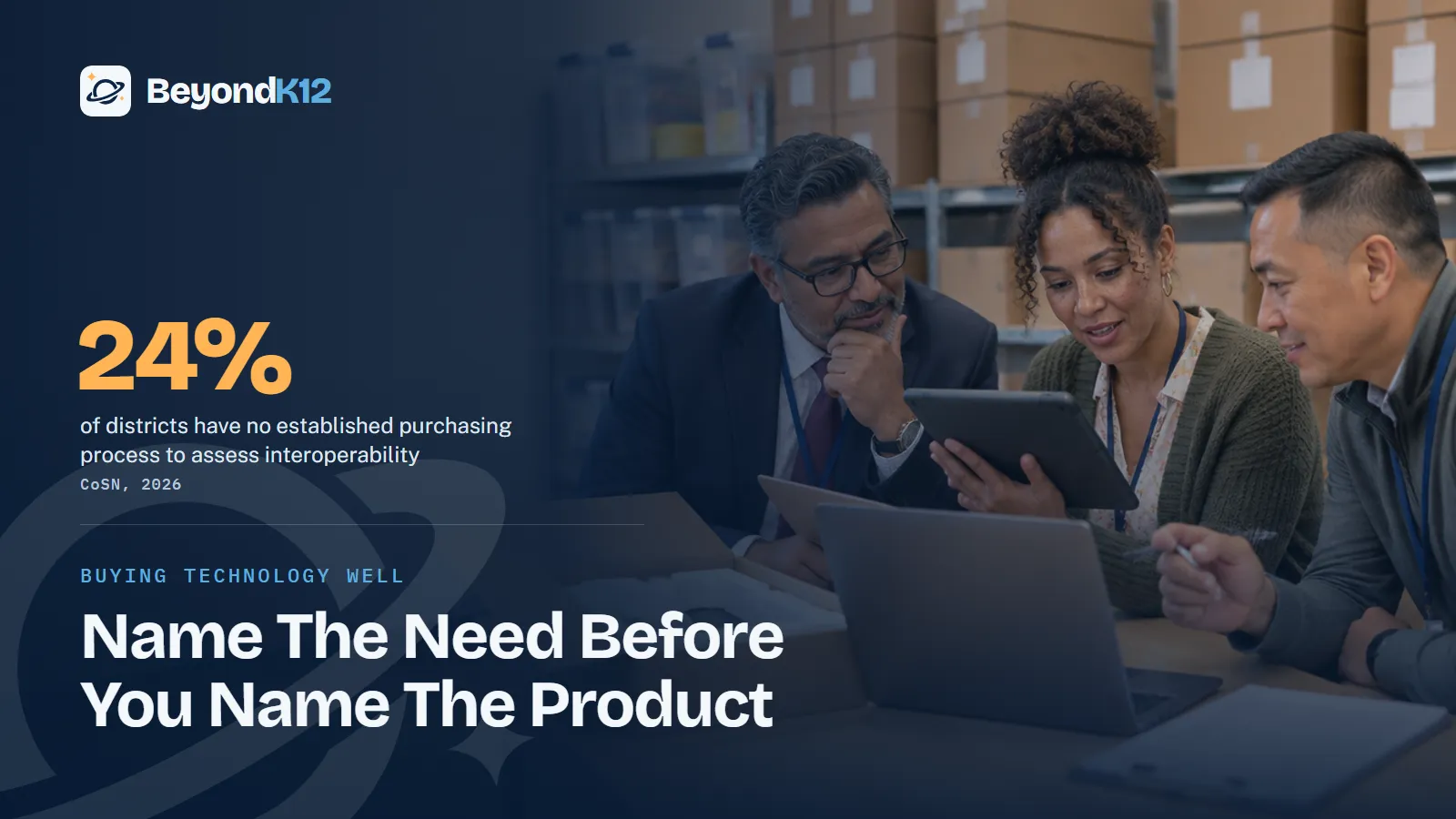
A hasty technology purchase hurts a school because the product arrives before anyone has named the need, priced the full cost, trained the staff, or checked the vendor. The fix is a buying discipline with five parts: needs first, total cost of ownership, a short pilot, a vendor privacy review, and extra care with AI tools.
Technology in education changes faster than many schools can keep up with, and that makes it tempting to dive in. I said so in 2014, when the temptation was laptops and tablets. The advice holds: taking time to learn the market will pay off.
Why do rushed technology purchases go wrong?
Look at people and process before you blame the product. In CoSN's 2026 survey, 24% of respondents said their districts have no established purchasing process to assess interoperability. One leader told CoSN about cases where a supervisor or director "purchased a technology and did not do any research." CoSN warns that this ad hoc approach can lead to costly and delayed implementation and can put district data at risk.
The learning curve is still the first problem. If administrators and teachers do not understand how to use a tool, it will not get used. In the same survey, 58% of districts said they are understaffed for supporting the technology used for teaching and learning, and leaders ranked a lack of relevant training as their third-biggest challenge. Budget for professional development in the same request as the purchase.
2,982
distinct edtech tools accessed by the average district in a year.
LearnPlatform by Instructure, 2025
58%
of districts are understaffed for instructional technology support.
CoSN, 2026
54%
of respondents are unfamiliar with the Five Quality Indicator framework.
CoSN, 2026
11%
of districts have formal procurement policies requiring digital content accessibility.
CoSN, 2026
What can leaders learn from the Los Angeles iPad program?
I pointed to Los Angeles in 2014, and the story finished badly. LAist, then KPCC, reported in September 2015 on what it called the district's failed $1.3 billion program to equip every student with an iPad. The Pearson software was not ready when the iPads went out, and teachers complained of missing math problems. The district later reached a settlement of about $6.4 million.
Mark Warschauer of the University of California, Irvine, said at the time that the district came out of it looking worst because it did not think through the best use of the iPads and the software. That is the whole argument for slowing down. No program works everywhere, but you can learn which ones worked before you sign.
Buy the answer to a problem you can name, not the product everyone is talking about.Ernie Delgado, BeyondK12
How do you put the need ahead of the product?
Write the problem down before you open a catalog. Kris Astle of SMART Technologies put it plainly in EdTech Magazine: start with the problem, not the technology, and set success measures first. Trends make this hard. In 2014 the trend was tablets, and I warned against overlooking keyboards. Today the trend is AI. In either case, ask what will still be useful after the excitement fades.
There is real pressure to hurry. A CDW manager wrote in EdTech Magazine in May 2026 that devices cost more, lead times are stretching, and some manufacturers have raised prices after a purchase order was issued. That is a reason to start your review earlier, not a reason to skip it.
What does total cost of ownership include?
The sticker price is the easiest number to compare and the least complete. EdTech Magazine's 2026 guide says to follow each option through your refresh cycle and compare cost per device, per year. IDC's Matthew Leger recommends modeling at least three years and no more than five.
| Cost area | What to count | Question to ask |
|---|---|---|
| Acquisition | Devices, accessories, cases, spares, freight, financing | What do we need beyond the unit price? |
| Software and management | Applications, device management, security, identity, support licenses | What renews every year, and at what price? |
| Deployment and operations | Imaging, configuration, asset tagging, inventory, network capacity, staff labor | Who does this work, and what stops while they do? |
| Repair and downtime | Coverage, deductibles, parts, loaners, shipping, lost instructional time | What happens to the student while a device is out? |
| Retirement | Collection, data sanitization, recycling, less any residual value | Who wipes the data, and who pays for it? |
Staff time is among the most omitted categories, Leger told EdTech Magazine. Track one representative month of device work, price that labor, and project it across the year. Then check how long the product will be supported, because a device with a short update window is a cheap device for a short time. See 3 things to consider before upgrading your K-12 school's technology for the dates to confirm.
How do you run a pilot that gives you an answer?
- Set the question. Name the outcome you want to improve and the measure that will count as success, before anyone logs in.
- Pick a mixed group. Include willing teachers, a skeptic or two, and a school leader. Doubters surface problems you need to hear.
- Keep it short. Three to six months is typically long enough, IXL's Robin Munsell told EdTech Magazine. A full school year can cost you momentum.
- Collect both kinds of evidence. Use a baseline, midpoint, and final survey, along with usage data, classroom visits, and teacher interviews.
- Decide on your rule. Buy, keep testing, or stop. Separate problems with the product from problems with your rollout.
You do not have to build this alone. The EdTech Quality Indicators Guide, released in 2026 by a group that includes CoSN, ISTE, and Digital Promise, includes a vendor screening checklist and a pilot navigator, according to EdTech Magazine.
What should a vendor privacy review cover?
A vendor's security problem becomes your families' problem. The Texas attorney general alleges in a lawsuit that a hacker used a subcontractor's account in December 2024 to reach PowerSchool data, exposing information on more than 880,000 Texas school-aged children and teachers. Yet CoSN found that vendor requirements are uneven.
What districts require vendors to show
The five labels are the Five EdTech Quality Indicators, and the chart shows the share of districts requiring vendors to provide that information. Close the inclusive gap in particular. CoSN notes the federal accessibility deadline moved to April 2027 for school districts serving large communities and 2028 for smaller ones.
Federal privacy rules moved too. Companies covered by the amended COPPA rule generally had until April 22, 2026, to comply, though the FTC left its proposed ed tech and school provisions out of the final rule. K-12 Dive reports that districts can consent in place of parents only when data is used solely for educational, not commercial, purposes. Two tools help: the Department of Education's model terms of service checklist and the National Data Privacy Agreement from the Student Data Privacy Consortium.
What is different about buying AI tools?
AI raises the stakes on every step above. In CoSN's 2026 survey, 62% of technology leaders were very concerned about AI's potential impact on student data privacy. CoSN also found 79% of districts report AI guidelines, but Gallup found only 18% of teachers have formal AI guidance from administrators, so a tool can reach classrooms ahead of the people expected to use it well.
Plan for the vendor to fail. Government Technology reported that AllHere, the company behind a Los Angeles Unified chatbot, went bankrupt in 2024. Miami-Dade's three-year contract with the company ended after two years, and an administrator there said the system lost contact with over 3,000 users. Ask what happens to your data and your families if the company disappears.
Federal guidance from July 2025 says AI initiatives should be educator-led, ethical, accessible, and transparent, THE Journal reported. Our guide to human in the loop AI shows how to put that into practice. If you need the policy first, the 90-Day AI Readiness Accelerator includes templates your board can adopt.
Where to start this week
Pick the next technology purchase on your list and write one page: the need, the total cost for three years, the pilot, and the person who owns the vendor review. If you cannot fill that page, you are not ready to buy.
Then take the free AI Readiness Assessment. It takes eight questions, scores your school out of 24 across Policy, People, Curriculum, Guardrails, and Funding, and shows you what to fix first.
Related reading: The role of AI ethics and human judgment in protecting student data in schools and Top 3 markers to audit your school's AI readiness in one hour.
Questions school leaders ask
How long should an edtech pilot run?
Three to six months is typically long enough to use and assess a platform, according to an IXL executive quoted by EdTech Magazine. A pilot that runs a full school year can lose momentum. Set your success measures before it starts.
What belongs in total cost of ownership for school technology?
EdTech Magazine's 2026 guide lists five areas: acquisition, software and management, deployment and operations, repair and downtime, and retirement. Compare options per device, per year. Staff time is among the costs districts most often leave out, according to IDC's Matthew Leger.
What should a vendor privacy review cover?
What data the product collects, how it is used, who else receives it, how it is protected, and what happens to it when the contract ends. The U.S. Department of Education's model terms of service checklist and the National Data Privacy Agreement are good starting points. Have your counsel review the final agreement.
Do AI tools need a different review?
They need the same review plus more. Confirm your AI policy allows the use, name the person who reviews the output, ask how student data is handled, and plan for the vendor failing. Federal guidance from July 2025 says AI initiatives should be educator-led, ethical, accessible, and transparent.
Should we buy now because device prices are rising?
Early buying can make sense, but not skipping steps. A CDW manager wrote in EdTech Magazine in May 2026 that devices cost more and lead times are stretching. Start your review sooner rather than shortening it.
Sources
- EdSurge, report on school IT officials' worries about AI adoption and cybersecurity (June 2026) (opens in a new tab) (checked 2026-11-05)
- CoSN, U.S. State of EdTech 2026 (opens in a new tab) (checked 2026-11-05)
- eSchool News, LearnPlatform by Instructure EdTech Top 40 findings (July 2025) (opens in a new tab) (checked 2026-11-05)
- LAist (KPCC), LAUSD board to vote on $6.4 million settlement proposal with Apple over iPad software (September 2015) (opens in a new tab) (checked 2026-11-05)
- Government Technology, AI company collected $1.6M from Miami-Dade schools before bankruptcy (2026) (opens in a new tab) (checked 2026-11-05)
- EdTech Magazine, The real cost of a student device: a total cost of ownership guide (October 2026) (opens in a new tab) (checked 2026-11-05)
- EdTech Magazine, How to run a successful K-12 ed tech pilot program (August 2026) (opens in a new tab) (checked 2026-11-05)
- EdTech Magazine, New ed tech procurement guide simplifies purchasing (August 2026) (opens in a new tab) (checked 2026-11-05)
- EdTech Magazine, How the artificial intelligence boom is disrupting K-12 device buying (May 2026) (opens in a new tab) (checked 2026-11-05)
- CAST, EdTech Quality Collaborative launches new guide (July 2026) (opens in a new tab) (checked 2026-11-05)
- SETDA, K-12 EdTech Quality Action Toolkit (March 2026) (opens in a new tab) (checked 2026-11-05)
- Office of the Texas Attorney General, Attorney General Paxton sues over PowerSchool data breach (2025) (opens in a new tab) (checked 2026-11-05)
- Federal Trade Commission, Children's Online Privacy Protection Rule (Federal Register, April 2025) (opens in a new tab) (checked 2026-11-05)
- K-12 Dive, reporting on the updated COPPA rule (2025) (opens in a new tab) (checked 2026-11-05)
- U.S. Department of Education, Protecting student privacy while using online educational services: model terms of service (opens in a new tab) (checked 2026-11-05)
- Access 4 Learning, National Data Privacy Agreement v2 usage guidance (April 2025) (opens in a new tab) (checked 2026-11-05)
- U.S. Department of Education guidance on AI and federal grant funds (July 2025, via THE Journal) (opens in a new tab) (checked 2026-11-05)
- Gallup and Walton Family Foundation, teachers receive no formal guidance on AI (May 2026) (opens in a new tab) (checked 2026-11-05)

See where your school stands on AI, in five minutes
Eight questions. A score out of 24 across Policy, People, Curriculum, Guardrails, and Funding, with the three fixes that move it most. The report is yours whether or not you ever call us.