


8 reasons K-12 schools should use mobile technology in their curriculum, and where the evidence stops
Eight reasons K-12 schools use mobile technology in the curriculum, updated for 2026: what the evidence supports, where it falls short, what to do next.
Updated with current data and sources. Originally published March 20, 2014.
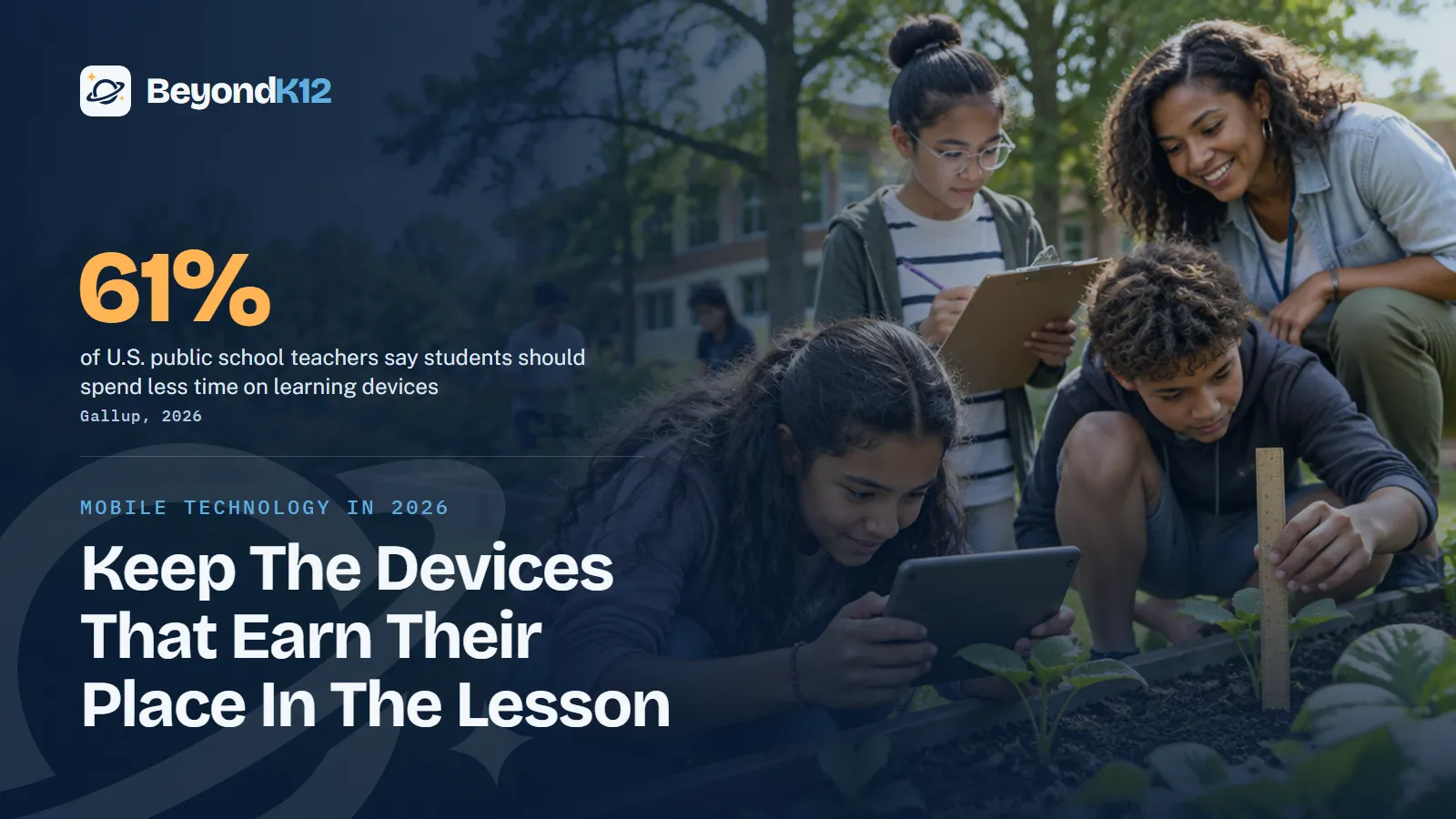
K-12 schools should still use mobile technology in the curriculum, but for specific jobs and not by default. In 2026 the evidence backs devices for access, digital skills, and shared work, and it does not back more screen time for its own sake.
What does the evidence say about mobile technology in 2026?
Devices are now part of the room. In a May 2026 Walton Family Foundation and Gallup survey of 2,101 public school teachers, 96% said their students use learning devices in class. CoSN's 2026 district survey shows how far 1:1 has reached, even in the youngest grades.
Districts with 1:1 devices already in place, by grade band
Teachers are not sure the amount is right. Most see value, few feel strongly about it, and a majority want less.
59%
of teachers agree digital tools help students learn effectively. Only 10% strongly agree.
Walton Family Foundation and Gallup, 2026
61%
of teachers say students should spend less time on devices. 6% say more.
Gallup, 2026
52%
of teachers say devices do as much harm as good.
Walton Family Foundation and Gallup, 2026
53%
of educators say 1-to-1 computing has had a positive impact on student learning.
EdWeek Research Center, 2025
International data points the same way. Across OECD countries in PISA 2022, students who spent up to an hour a day on devices for learning at school scored 14 points higher in math than students who spent no time. Students distracted by classmates' devices in at least some math lessons scored 15 points lower. Those are associations, not proof of cause.
The eight reasons, updated for 2026
1. Mobile technology can build complex problem solving, if someone teaches it
Analytical thinking remains the top core skill in the World Economic Forum's Future of Jobs Report 2025. A device alone does not build it. U.S. eighth graders averaged 482 in computer and information literacy in 2023, down from 519 in 2018, according to NCES.
2. It helps students acquire skills critical to their future
This reason has grown stronger. Employers surveyed worldwide by the World Economic Forum expect 39% of workers' core skills to change by 2030, and technological literacy is among the three fastest-growing skills. That now includes AI: 54% of U.S. teens have used chatbots for schoolwork, according to Pew Research Center.
3. It gives teachers multimedia resources, which now need vetting
Access is no longer the problem. Districts accessed an average of 2,982 distinct ed-tech tools in 2024-25, according to Instructure's EdTech Top 40. Only 37% of teachers told Gallup that classroom tools are adequately reviewed all or most of the time.
4. It uses tools students already know, with one big change
Pew Research Center reports that 97% of U.S. teens use the internet daily. Comfort is not skill, as reason 1 shows, and the classroom tool is rarely the student's own phone. Among public schools with 1-to-1 programs, 89% make laptops available and 27% make tablets available, according to NCES.
5. It collects and organizes student work
Digital portfolios and cloud drives still beat paper folders for showing growth over time. The cost has moved to security. Slightly over half of schools or districts reported a cybersecurity incident in the last year, according to a Center for Internet Security report covered by K-12 Dive, and cybersecurity is the top priority in CoSN's 2026 survey.
6. It makes collaboration easier
Shared documents let a group work in one file, in class or with a classroom far away. The benefit is practical and easy to see. The studies cited here measure device time and test scores, not teamwork, so treat this as a working advantage rather than a measured learning gain.
7. It creates learning before, during, and after class
Learning after class needs a device and a connection at home. Among 1-to-1 schools, NCES found 46% let students take devices home on school days and weekends, and 37% do not let them go home. CoSN found 22% of districts do not know whether students have devices outside school. The FCC also ended E-Rate support for lending hotspots in September 2025, according to the American Library Association.
8. It offers many ways to differentiate learning
This is the strongest reason on the list. Teachers who doubt devices in general still value them for students with specific needs. Read-aloud tools, captions, and extension work reach students a single paper handout cannot.
Teachers who say devices are very or somewhat important for these students
| Reason | Status in 2026 | What it depends on |
|---|---|---|
| 1. Problem solving | Conditional | Direct teaching, not device access |
| 2. Future skills | Strong | Digital and AI literacy in the curriculum |
| 3. Rich resources | Changed | A review process for new tools |
| 4. Familiar tools | Changed | School devices, not personal phones |
| 5. Organized work | Holds | School accounts and strong security |
| 6. Collaboration | Practical | Tasks where each student's part shows |
| 7. Learning after class | Conditional | Knowing who has a device and a connection |
| 8. Differentiation | Strong | Matching tools to named student needs |
Buy the device for the lesson, and close the lid when the lesson does not need it.Ernie Delgado, BeyondK12
Where does the evidence not support mobile technology?
Personal phones in class. BYOD once eased strained budgets. Now 58% of districts ban personal devices during school and 33% limit them to instructional purposes, according to CoSN. The research on bans is mixed. A national study of lockable pouches (NBER, 2026) found they cut phone use, with average test score effects consistently close to zero. A Florida study (NBER, 2025) found significant gains in the second year of a ban.
More device time as a goal. In the EdWeek Research Center's 2025 survey, off-task use of laptops or tablets ranked above cellphones as a source of student distraction, at 38%. In Gallup's 2026 survey, 50% of high school teachers called devices a major or moderate distraction, compared with 18% of elementary teachers.
The youngest grades, in some states. Iowa capped digital instruction at 60 minutes a day in kindergarten through fifth grade, with exceptions for special education, assessments, and computer science, according to Stateline. Utah directed its state board to develop rules restricting screen time in kindergarten through third grade and prohibiting one-device-per-student ratios in elementary school.
How should a school decide where devices belong?
- Name the job. For each grade, list the tasks a device does better than paper. If nobody can name the job, close the lid.
- Plan device-free time on purpose. CoSN found 43% of districts limit screen time through instructional design. It needs no new law.
- Give teachers a say and a view. Only 29% of teachers have ever been asked to weigh in on a new tool, and teachers with substantial oversight are less than half as likely to call devices a distraction (20% versus 52%), according to Walton Family Foundation and Gallup.
- Teach the skills directly. Our TechPlus AI curriculum ends every project with the student explaining the work, which shows what the student understands.
- Keep phones and learning devices separate. Write one rule for personal phones and a different plan for school devices, so a phone decision does not turn into a verdict on all technology.
Where to start this week
Pick one grade and ask its teachers two questions: which lessons need a device, and which ones would be better without it. Their answers will tell you more than another purchase order.
Devices are also where AI reaches your students. The free AI Readiness Assessment takes eight questions and scores your school across Policy, People, Curriculum, Guardrails, and Funding, so you can see what to fix first.
Related reading: Why every student needs a technology class in their curriculum today and Digital literacy in K-12 education: what future-ready students need by grade 8.
Questions school leaders ask
Should K-12 schools still use mobile technology in 2026?
Yes, for specific jobs. NCES reports that 88% of public schools had a 1-to-1 program in 2024-25, so the working question is which lessons need a device. Access for students with specific needs and real digital skills are the strongest reasons.
Does mobile technology improve learning?
The evidence is mixed. In PISA 2022, students across OECD countries who spent up to an hour a day on devices for learning at school scored 14 points higher in math than students who spent no time, an association rather than proof of cause. In the 2026 Gallup survey, 59% of teachers agreed digital tools help students learn effectively, and only 10% strongly agreed.
Do school phone bans raise test scores?
The two main studies differ. A national study of lockable pouches (NBER, 2026) found average effects on test scores consistently close to zero, while a study of Florida student data (NBER, 2025) found significant gains in the second year of a ban. Treat phone rules as an attention and climate decision.
Is BYOD still a good way to save money?
It is much less common as a classroom plan. CoSN's 2026 survey found 58% of districts ban personal devices during school and 33% limit them to instructional purposes. School-issued devices are the norm, and at least 40 states and the District of Columbia now require districts to ban or restrict cellphones, according to Education Week.
Which students benefit most from devices?
Teachers point to students with specific needs. In the 2026 Gallup survey, 77% called devices very or somewhat important for English learners, 76% for students with an IEP or 504 plan, 72% for students needing enrichment, and 71% for students needing extra support.
Sources
- NCES, More than half of public school leaders say cell phones hurt academic performance (February 2025) (opens in a new tab) (checked 2026-11-05)
- CoSN, U.S. State of EdTech 2026 (May 2026) (opens in a new tab) (checked 2026-11-05)
- Gallup, Screens ubiquitous in classrooms; teachers split on efficacy (September 2026) (opens in a new tab) (checked 2026-11-05)
- Walton Family Foundation and Gallup, Teaching for Tomorrow: Screen Wise press release (September 2026) (opens in a new tab) (checked 2026-11-05)
- Education Week, Which states ban or restrict cellphones in schools? (updated October 2026) (opens in a new tab) (checked 2026-11-05)
- Education Week, Chromebooks or cellphones: which are the bigger classroom distraction? (May 2025) (opens in a new tab) (checked 2026-11-05)
- Stateline, States move to limit classroom screen time (July 2026) (opens in a new tab) (checked 2026-11-05)
- NCES, U.S. eighth graders' scores decline on international assessment of computer and information literacy (November 2024) (opens in a new tab) (checked 2026-11-05)
- World Economic Forum, Future of Jobs Report 2025 (January 2025) (opens in a new tab) (checked 2026-11-05)
- OECD, PISA 2022 Results, Volume II (December 2023, copy hosted by the Czech School Inspectorate) (opens in a new tab) (checked 2026-11-05)
- Pew Research Center, Teens, Social Media and AI Chatbots 2025 (December 2025) (opens in a new tab) (checked 2026-11-05)
- Pew Research Center, How teens use and view AI (February 2026) (opens in a new tab) (checked 2026-11-05)
- ClassLink News, Despite push to pare back ed tech, report finds districts' inventories are still growing (July 2025, on Instructure's EdTech Top 40) (opens in a new tab) (checked 2026-11-05)
- K-12 Dive, Cybersecurity incidents hit over 50% of schools and districts in past year (October 2026) (opens in a new tab) (checked 2026-11-05)
- American Library Association, FAQ on the FCC's reversal of E-Rate's hotspot lending program (2025) (opens in a new tab) (checked 2026-11-05)
- NBER Working Paper 35132, The effects of school phone bans: national evidence from lockable pouches (April 2026, revised September 2026) (opens in a new tab) (checked 2026-11-05)
- NBER Working Paper 34388, The impact of cellphone bans in schools on student outcomes: evidence from Florida (October 2025) (opens in a new tab) (checked 2026-11-05)

See where your school stands on AI, in five minutes
Eight questions. A score out of 24 across Policy, People, Curriculum, Guardrails, and Funding, with the three fixes that move it most. The report is yours whether or not you ever call us.