


5 signs your K-12 students are ready for a high-tech classroom in 2026
Five signs K-12 students are ready for a high-tech classroom in 2026: a readiness check on self-control, honest AI use, and real digital skills.
Updated with current data and sources. Originally published March 18, 2014.
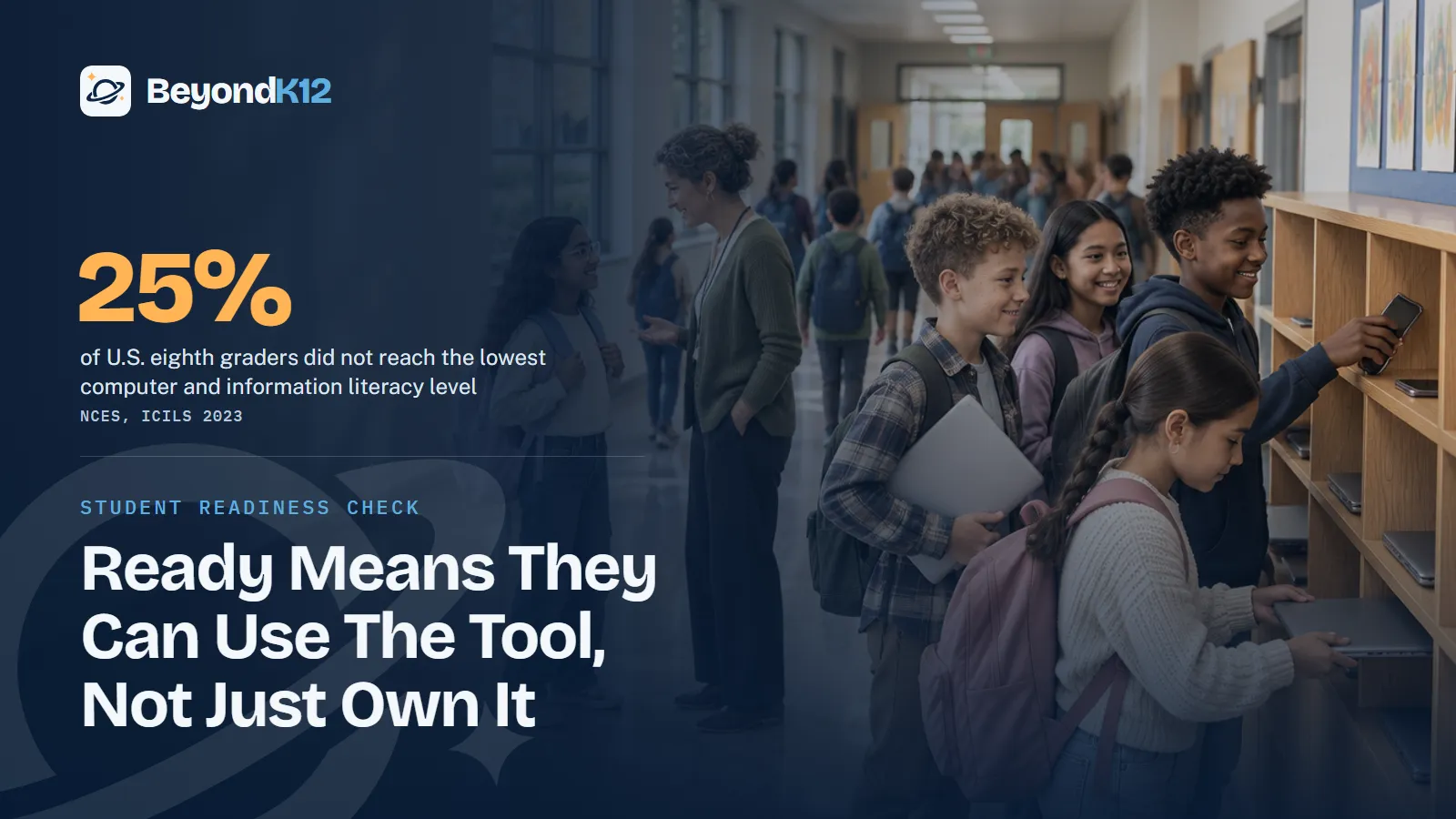
Your students are ready for a high-tech classroom when they can use a device for learning, stay on task, and explain their work, not when they simply own one. Five signs, checked in your own classrooms, will tell you where they stand.
Why is owning a device not the same as being ready?
Time on a device does not produce skill. In the 2023 International Computer and Information Literacy Study, U.S. eighth graders averaged 482, down from 519 in 2018, according to NCES. About 25% did not reach the lowest proficiency level. NCES raised direct questions about the idea of the digital native, because many students struggled with tasks such as judging whether online information is credible.
So I would turn the old list around. Each sign below started as something students did with technology. Each one is now something you can watch for and test.
What are the five signs in 2026?
1. Students can put a personal device away
In 2014 the sign was students bringing devices from home. Now the sign is what they do with them when the rule says no. In a RAND survey of middle and high school students collected in December 2025, 56% reported trying at least one tactic to get around cell phone rules. Even where phones were not allowed at all, half reported checking them in class at least once a day. The range is wide: about 20% of seventh graders in the strictest schools, compared with about 80% of high school seniors.
2. Students communicate through school channels with care
Students once asked for teachers' Twitter handles and Facebook pages. Today 77% of districts ban social media on school devices, according to CoSN, so school email and the learning platform are the real test. Do not assume students learn this in class. ICILS found 78% of U.S. eighth graders learned to manage privacy settings outside school rather than at school, and 73% learned to spot scam messages that way, according to NCES.
3. Students can explain the digital help they used
Teachers used to notice homework that looked polished: typed, laid out, full of images. Polish now proves little. Pew Research Center found 64% of U.S. teens use AI chatbots and 54% have used them for schoolwork. The sign of readiness is a student who can say what they made, which tools helped, and what they would change. That is why every project in our TechPlus AI curriculum ends with the student explaining the work.
4. Students stay on task after the novelty fades
Bored students do light up when technology appears. Excitement is a good start, and it is not readiness. One-third of educators told the EdWeek Research Center in 2025 that students using devices for learning are typically off task more than a quarter of the time. Visit a class six weeks after a rollout, when the device is ordinary, and see what students do with it.
5. Students can do real digital work, in class and at home
Asking to turn in homework online once signaled readiness. Now check the basics: can a student find a saved file, search well, judge a source, and share work without coaching? Then check home access. Among 1-to-1 schools, NCES found 46% let students take devices home on school days and weekends, and that drops to 23% for elementary schools. CoSN found 22% of districts do not know whether their students have devices outside school.
| Sign | Still developing | Ready |
|---|---|---|
| Device self-control | The phone comes out whenever an adult looks away | The phone stays away without reminders |
| School communication | Messages are careless or go through the wrong channel | Students write clearly and know where to ask for help |
| Explaining digital help | The student cannot say how the work was done | The student names the tools and explains the choices |
| Staying on task | Attention drops once the novelty wears off | Work continues in week six as it did in week one |
| Real digital work | The student needs help finding, saving, or sharing | The student finishes the task alone, at school and at home |
A student who can close the laptop and explain the work is more ready than one who can do anything on it.Ernie Delgado, BeyondK12
Does readiness look different by grade?
Yes, and the pattern may surprise you. Much of the public debate centers on the youngest students, yet the Walton Family Foundation and Gallup survey found device problems concentrated in the upper grades. Older students are more independent, and they use that independence.
Teachers who say students often find workarounds on devices
Oversight moves the other way: 51% of elementary teachers report a lot of oversight of student device use, compared with 44% in middle school and 28% in high school, according to Gallup. Early grades bring a different question. CoSN found 16% of districts do not plan individual device assignments for K-2, and Iowa, Utah, and Tennessee passed laws on device use in the elementary grades in 2026, according to Stateline. Check your state's rules before you read readiness as a reason to add devices.
Are your teachers as ready as your students?
I asked this in 2014, and it matters more now. Only 42% of teachers say they have a lot of oversight of what students do on devices during instruction, and only 29% have ever been asked to weigh in on a new tool, according to Walton Family Foundation and Gallup. Teachers with substantial oversight were far less likely to call devices a major or moderate distraction: 20%, compared with 52% of those with little or none.
If students pass this check and teachers feel left out, start with the adults. Our teacher professional development covers classroom technology and AI.
How can you run this readiness check in two weeks?
- Pick three classrooms. Choose one early grade, one middle grade, and one upper grade, so you see the differences by age.
- Visit on an ordinary day. Use the table above during a routine lesson, not a showcase. Note how students behave when no one is reminding them.
- Give one short task. Ask students to find a credible source, save it, and share it with the teacher. Time how long it takes and how much help they need.
- Ask students to explain a recent assignment. Two minutes each, out loud. Listen for what they did themselves and which tools helped.
- Survey families on home access. Ask which devices and connections students can use for homework. It is a simple step that fills the gap many districts have.
Where to start this week
Walk one classroom on an ordinary day with the table above and write down what you see. How do your students measure up? How prepared are your teachers to act on the answer?
Student readiness now includes AI. The free AI Readiness Assessment asks eight questions and scores your school across Policy, People, Curriculum, Guardrails, and Funding, so you can see where the adults stand too.
Related reading: Digital literacy in K-12 education: what future-ready students need by grade 8 and Digital citizenship: teaching responsible online behavior by grade band.
Questions school leaders ask
How do I know if my students are ready for a high-tech classroom?
Watch what they do, not what they own. Ready students can put a personal device away when asked, use school channels with care, explain any digital help they used, stay on task after the novelty fades, and complete basic digital tasks without coaching.
Are today's students digital natives?
Not in the way the phrase suggests. NCES reported that U.S. eighth graders averaged 482 in computer and information literacy in 2023, down from 519 in 2018, and 25% did not reach the lowest proficiency level. Daily use does not mean a student can judge a source or stay safe online.
Are elementary students ready for devices?
Often, with close supervision. In the 2026 Gallup survey, 51% of elementary teachers reported a lot of oversight of student device use, compared with 28% of high school teachers. Check your state first: Iowa, Utah, and Tennessee passed laws on device use in the elementary grades in 2026, according to Stateline.
How does AI change student readiness?
It changes what you look for in homework. Pew Research Center found 54% of U.S. teens have used AI chatbots for schoolwork. Polished work no longer shows understanding, so ask the student to explain how the work was done and what tools helped.
What if students are ready and teachers are not?
Fix that first. Walton Family Foundation and Gallup found only 42% of teachers report a lot of oversight of what students do on devices during instruction, and only 29% have ever been asked to weigh in on a new tool. Give teachers a voice and training before adding more technology.
Sources
- NCES, U.S. eighth graders' scores decline on international assessment of computer and information literacy (November 2024) (opens in a new tab) (checked 2026-11-05)
- NCES, More than half of public school leaders say cell phones hurt academic performance (February 2025) (opens in a new tab) (checked 2026-11-05)
- RAND, Stricter cell phone policies associated with reductions in student phone use (May 2026) (opens in a new tab) (checked 2026-11-05)
- Walton Family Foundation and Gallup, Teaching for Tomorrow: Screen Wise press release (September 2026) (opens in a new tab) (checked 2026-11-05)
- Gallup, Screens ubiquitous in classrooms; teachers split on efficacy (September 2026) (opens in a new tab) (checked 2026-11-05)
- Pew Research Center, How teens use and view AI (February 2026) (opens in a new tab) (checked 2026-11-05)
- CoSN, U.S. State of EdTech 2026 (May 2026) (opens in a new tab) (checked 2026-11-05)
- Education Week, Chromebooks or cellphones: which are the bigger classroom distraction? (May 2025) (opens in a new tab) (checked 2026-11-05)
- Stateline, States move to limit classroom screen time (July 2026) (opens in a new tab) (checked 2026-11-05)

See where your school stands on AI, in five minutes
Eight questions. A score out of 24 across Policy, People, Curriculum, Guardrails, and Funding, with the three fixes that move it most. The report is yours whether or not you ever call us.