


Should you use Snapchat in your classroom? No, and here is what to do instead
Should you use Snapchat in your classroom in 2026? No. Snapchat's age rule, COPPA, disappearing messages, state phone laws, and what to use instead.
Updated with current data and sources. Originally published June 7, 2016.
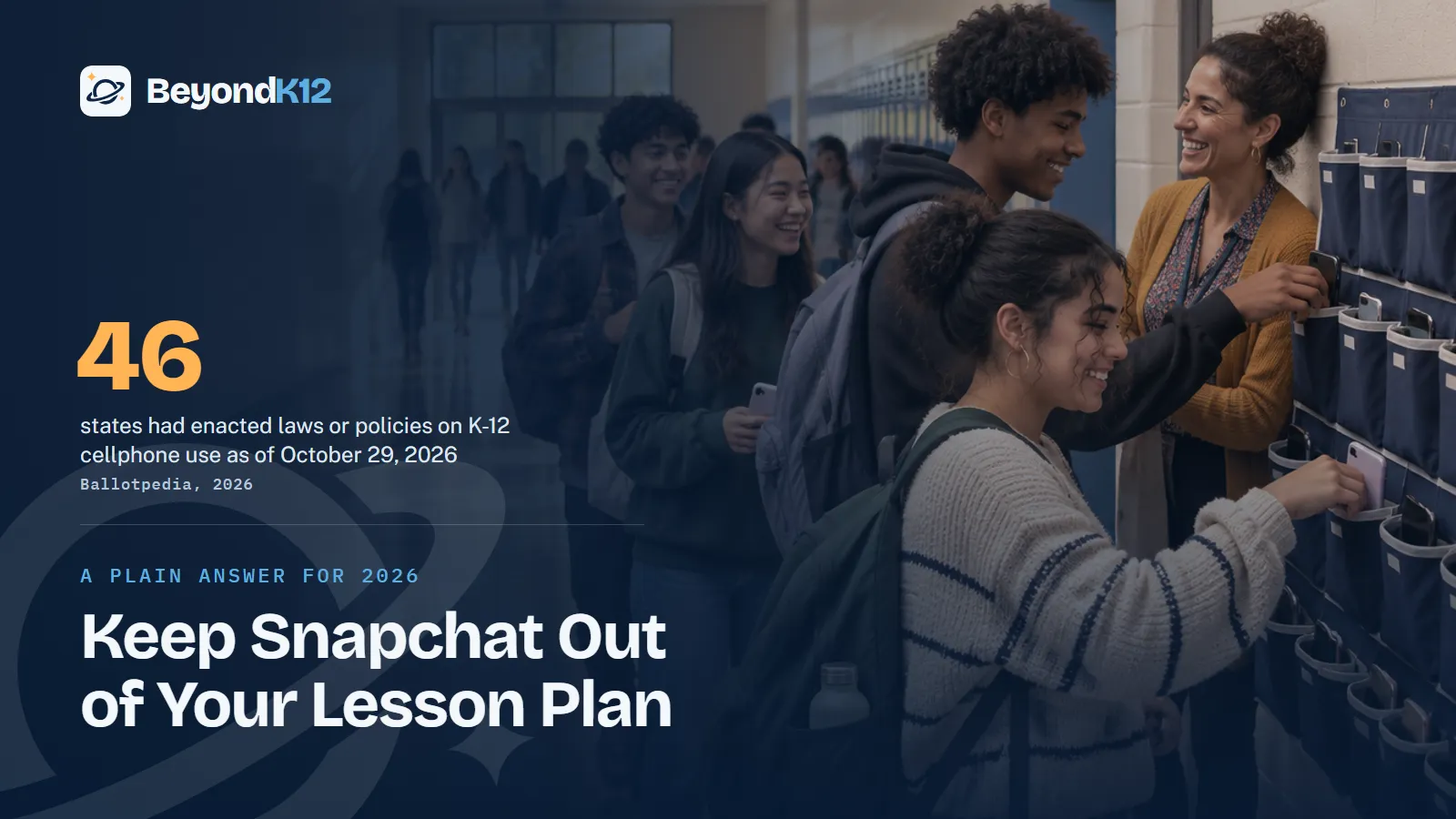
No. Snapchat should not be a classroom tool in 2026: its own terms set a minimum age of 13, its messages are designed to delete, and Ballotpedia counts 46 states with laws or policies on K-12 cellphone use.
When I wrote about this in 2016, the argument for trying Snapchat was connection. Students love social media, and if they are already on it, they may reach out to you there before they reach out the way you prefer. That instinct was right. Keep the instinct and change the tool.
How many students are actually on Snapchat?
Most of the teens in your building, and some children below the age limit. In Pew Research Center's fall 2025 survey of 1,458 U.S. teens ages 13 to 17, 55% said they use Snapchat and 46% said they visit it every day. Twelve percent said they use it almost constantly.
How U.S. teens use Snapchat
Common Sense Media tracked the phones of 203 U.S. 11- to 17-year-olds for its 2023 report. The numbers show why a phone app and a school day do not sit well together.
31%
of 11- to 12-year-olds in the study used Snapchat, although its minimum age is 13.
Common Sense Media, 2023
237
notifications on a typical day at the median, and about a quarter arrived during the school day.
Common Sense Media, 2023
43 min
of phone use during school hours at the median, among the 97% of participants who used their phones then.
Common Sense Media, 2023
57%
of teens on Snapchat say they message people daily on the app.
Pew Research Center, 2026
Common Sense also found that Snapchat and Discord ranked highest in the number of notifications sent to participants on a typical day. A teacher who adds a class account to that stream is competing with it.
What does Snapchat's age rule mean for a school?
It means a teacher cannot assign it to a student under 13. Snap's Terms of Service, effective September 21, 2026, say you must be 13 or older, depending on where you live, and that its services are not directed to children under 13. If Snap learns a user is under the minimum age, it says it will lock or delete the account.
COPPA points the same way. The FTC says a school may consent for parents only when an operator collects information for the use and benefit of the school and for no other commercial purpose. A consumer social app with no school agreement does not fit that test.
Read the content terms too. For public content, such as a public Story, Snap's terms give Snap and others an unrestricted, worldwide, irrevocable, and perpetual license, and that covers the name, image, likeness, and voice of anyone featured. Student work and student faces do not belong under that license.
Meet students where they are in your conversations, and keep your teaching where the school can see it.Ernie Delgado, BeyondK12
Why do disappearing messages matter in a school?
Because a school needs a record. Snapchat's own support page says "Delete is our default," and most messages are automatically deleted once viewed or expired. Chats are deleted by default 24 hours after everyone has viewed them, or 31 days after being sent, whichever is sooner.
That is a fair feature for friends. It is the wrong one for an adult and a student. If a family asks what a teacher said to their child, the answer should never depend on a screenshot.
Pew's 2026 report adds the student view. Roughly three-quarters of teen users of each platform see harassment and bullying there as a problem for people their age. Roughly three in ten Snapchat users have experienced at least one of three types of harassment Pew asked about, compared with about one in five on Instagram or TikTok. Most teens on the platform also report a mostly positive experience, and 44% say it helps their friendships. Both things are true, and neither makes it a classroom tool.
What do state phone laws mean for a Snapchat lesson?
In many schools, the phone that runs Snapchat is no longer available. As of October 29, 2026, Ballotpedia counted 46 states with laws or policies on K-12 classroom or school cellphone use.
State rules on K-12 cellphones, October 2026
Do not assume a private school sits outside this. Kansas's 2026 bell-to-bell ban applies to public and nonpublic accredited schools, according to Ballotpedia. In CoSN's 2026 survey, 58% of districts reported complete bans on personal devices during the school day or instructional periods.
What should teachers do instead of Snapchat?
Keep the goals from 2016 and move them to tools the school controls. Microsoft shut down the standalone Flip app in 2024, and Flip video recording now sits inside Teams assignments.
| What you wanted Snapchat to do | What to use now | Why it works better |
|---|---|---|
| Send reminders about permission slips | Learning management system announcements and school-approved family messaging | Families see it, and the school keeps it |
| Explain a hard problem in a short video | A short recording posted in your class site or assignment tool | Students can replay it for the whole unit |
| Pose a cliffhanger for tomorrow | A class stream post or a question on the board | No phone required |
| Have students record their thinking | Video in assignments, such as Flip recording in Teams | The work stays inside the class |
| Share field trip moments | A class-only blog with teacher approval | Permission and moderation come first |
| Connect with students | Open questions in class, office hours, and the class stream | The relationship stays visible and professional |
How do you put this in writing?
A short policy beats a long debate. These four steps fit on one page.
- Name the approved channels. List the tools staff may use to reach students and families. Everything else is off the list.
- Ban private adult-student messaging on consumer apps. Apply it to every social app, not only Snapchat, and to coaches and club advisers too.
- Check your state's phone law. Find out what it requires, who it covers, and when it takes effect. Then align your handbook with it.
- Teach about the app. Students need to talk about streaks, notifications, and screenshots. Common Sense offers a digital citizenship lesson on design tricks for grades 9 to 12, and Snap publishes an Educator's Guide to Snapchat. Use Snap's guide to understand your students, not as a reason to adopt the app.
Where to start this week
Ask your students how they use Snapchat, and listen. They will have ideas, as I said in 2016. Then make sure every reminder a teacher sends this week goes through a channel the school can see.
If your staff need help with digital citizenship or with the tools that replace it, our professional development works with teachers on both.
Social media rules, phone rules, and AI rules are one conversation now. The free AI Readiness Assessment asks eight questions and scores you out of 24 across Policy, People, Curriculum, Guardrails, and Funding.
Related reading: Digital citizenship in education: building responsible online behavior school-wide and Media literacy in K-12 education: how to build a program that sticks.
Questions school leaders ask
Should teachers use Snapchat with students?
No. Snapchat's terms set a minimum age of 13, and Snap says most messages are automatically deleted once viewed or expired. That gives a school no record of what an adult and a student said to each other. Use a channel the school can see.
How old do you have to be to use Snapchat?
At least 13, or older depending on where you live, according to Snap's Terms of Service effective September 21, 2026. Snap says its services are not directed to children under 13 and that it will delete an account if it learns the user is below the minimum age.
Does the answer change for high school students over 13?
No. The age rule is only one reason. Disappearing messages, state phone laws, and district bans on social media still apply. In CoSN's 2026 survey, 77% of districts said they ban social media access on school-issued devices.
Is it illegal for students to have phones at school?
It depends on your state. Ballotpedia counts 46 states with laws or policies on K-12 cellphone use as of October 29, 2026, and 37 of them ban or limit phones in classrooms. Kansas's 2026 ban also applies to accredited nonpublic schools, so private school leaders should check their state's law.
What should a school use instead of Snapchat?
Use your learning management system for reminders and questions, school-approved messaging for families, and assignment tools for short video. Microsoft's Flip video recording now lives inside Teams assignments. The test is simple: the school can see it, keep it, and turn it off.
Sources
- Snap Inc., Terms of Service (effective September 21, 2026) (opens in a new tab) (checked 2026-11-05)
- Snapchat Support, When does Snapchat delete Snaps and Chats? (opens in a new tab) (checked 2026-11-05)
- Snap Values, tools and resources for educators (August 2024) (opens in a new tab) (checked 2026-11-05)
- Pew Research Center, Teens, social media and AI chatbots 2025 (December 2025) (opens in a new tab) (checked 2026-11-05)
- Pew Research Center, Teens' experiences on TikTok, Instagram and Snapchat (April 2026) (opens in a new tab) (checked 2026-11-05)
- Common Sense Media, Constant Companion: a week in the life of a young person's smartphone use (2023) (opens in a new tab) (checked 2026-11-05)
- Federal Trade Commission, Complying with COPPA: frequently asked questions (opens in a new tab) (checked 2026-11-05)
- Ballotpedia, State policies on cellphone use in K-12 public schools (October 2026) (opens in a new tab) (checked 2026-11-05)
- Ballotpedia News, Kansas becomes thirty-third state to enact a K-12 cellphone ban (March 2026) (opens in a new tab) (checked 2026-11-05)
- K-12 Dive, most districts now have 1:1 device programs, on CoSN's 2026 State of Ed Tech report (2026) (opens in a new tab) (checked 2026-11-05)
- WHYY, Pa. attorney general sues Snapchat for its addictiveness and disappearing messages (August 2026) (opens in a new tab) (checked 2026-11-05)
- KNOE, Attorney General Griffin sues Snap, Inc. (June 2026) (opens in a new tab) (checked 2026-11-05)
- Microsoft Support, Flip video recording for assignments in Microsoft Teams (opens in a new tab) (checked 2026-11-05)
- Windows Central, Microsoft shuts down the standalone Flip app (2024) (opens in a new tab) (checked 2026-11-05)
- Common Sense Media, Constant Companion research summary and educator resources (2023) (opens in a new tab) (checked 2026-11-05)

See where your school stands on AI, in five minutes
Eight questions. A score out of 24 across Policy, People, Curriculum, Guardrails, and Funding, with the three fixes that move it most. The report is yours whether or not you ever call us.