


The key traits of an exceptional coding teacher
The traits of an exceptional coding teacher, the evidence behind each, the CS teacher shortage, interview questions, and a first-year PD plan.
Updated with current data and sources. Originally published April 5, 2024.
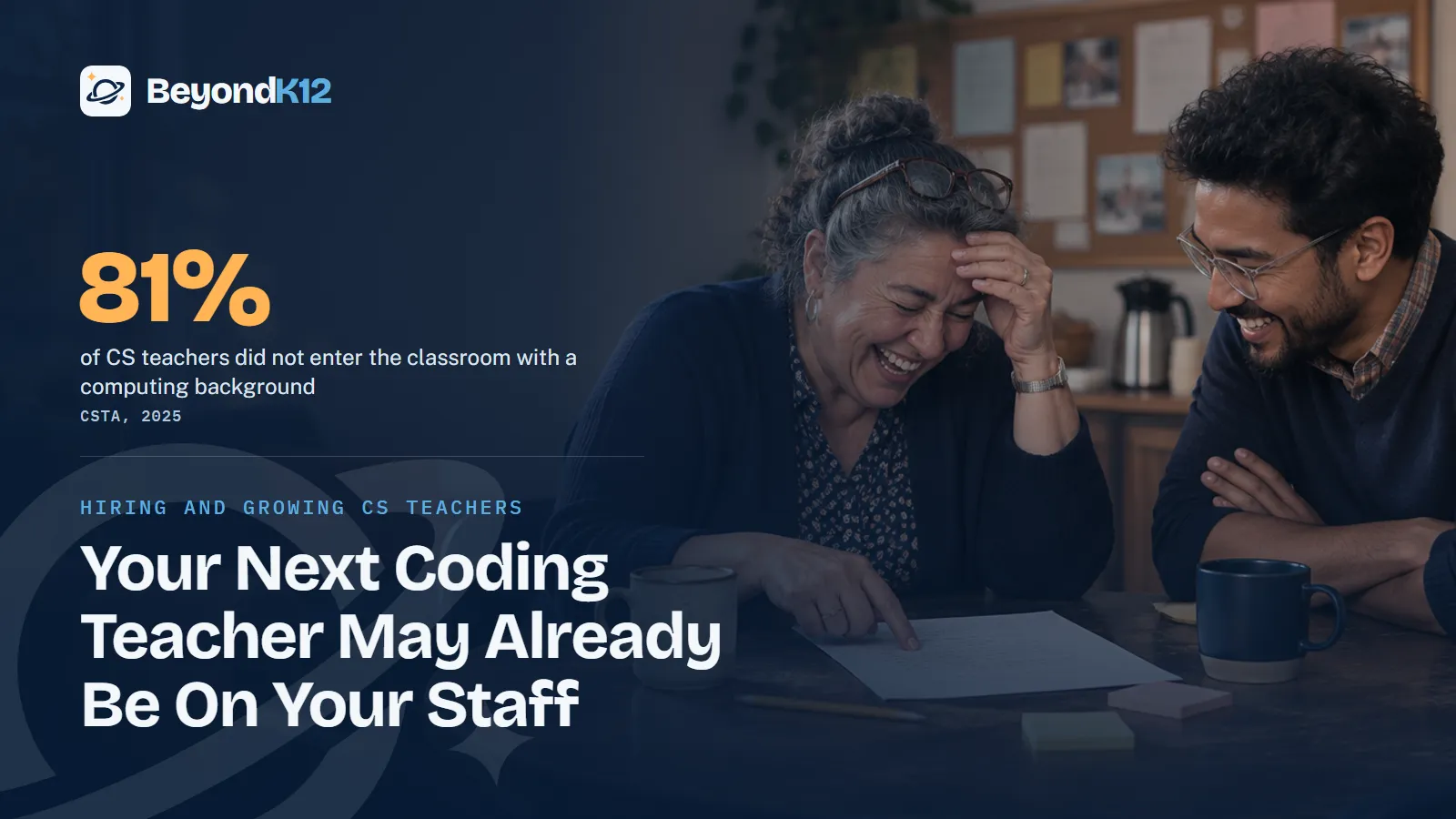
An exceptional coding teacher explains hard ideas plainly, stays patient with broken code, and keeps learning, and those traits count for more than a computer science degree. That is good news for a principal: in CSTA's 2025 survey, 81% of computer science teachers came to the classroom without a computing background, so your best candidate may already teach down the hall.
What traits make an exceptional coding teacher?
The traits in the first version of this post still hold. What has changed is the evidence, which now shows which ones to screen for and which ones you can train. There is also one new trait on the list.
Technical skill that keeps growing
Subject knowledge matters, and it is what teachers ask for most: 48% told CSTA in 2025 that deepening their CS knowledge is their greatest learning need. A credential is a weak stand-in for it, though. A 2025 study of North Carolina high schools found that graduate degrees and CS-related licenses were not reliable predictors of Advanced Placement results, while general teaching experience and prior CS teaching experience were linked to higher exam participation and scores. It covers one state and one course type, so read it as a caution, not a rule.
Real enthusiasm for the subject
Enthusiasm in this job shows up as recruiting. CSTA found that 96% of CS teachers enjoy teaching it, 65% actively recruit students, and 54% do targeted outreach to underrepresented students. Ask who the candidate has talked into trying something hard.
Clear communication
This trait rests on practitioner judgment more than on studies. The teacher who can explain a loop to a sixth grader without jargon, and then listen to what the student heard, will outperform the expert who cannot. You will not learn this from a resume, so watch them teach.
Patience and adaptability
Beginners get stuck constantly, and every class holds a wide range. This is also where teachers feel least ready: in CSTA's survey, 58% felt confident teaching students with disabilities, 41% felt confident teaching multilingual learners, and 33% said their curriculum lacks enough options for differentiation.
Problem solving in public
CS teachers at every grade level told CSTA that computational thinking is their top classroom priority, ahead of programming. The best ones model it. They debug out loud, say "I do not know yet," and let students watch a wrong guess get corrected.
A habit of learning
The field moves faster than any course can. CSTA found that 96% of CS teachers took part in professional development last year, yet only 17% could do so as often as they needed. Look for someone who has taught themselves something recently without being told to.
Empathy, and a room where everyone belongs
Belonging is measurable. In a 2016 study of high school students by Master, Cheryan, and Meltzoff, 35.4% of girls expressed interest in a CS course when its classroom looked non-stereotypical, compared with 13.3% when it was full of video games and science fiction. Boys did not care either way. An empathetic teacher thinks about who feels invited before the first lesson.
New since 2024: judgment about AI
CSTA found that 81% of CS teachers believe AI belongs in foundational CS and 70% already teach it, but only 42% feel equipped to. In a 2024 TeachAI and CSTA survey, 88% said they need more resources and training to teach with and about AI. Your teacher does not need to be an AI expert. They need a clear answer for what happens when a student submits code they cannot explain.
How short is the supply of coding teachers?
Short, and access has stopped growing. Code.org's 2025 report shows 60% of public high schools offering foundational CS, the same as a year earlier, and Education Week reports that 6.1% of eligible students enrolled in 2024-25. Code.org says schools with fewer than 500 students have the hardest time offering and sustaining these courses, which describes many Catholic, independent, and charter schools.
The people doing this work look less like software engineers and more like your current staff. CSTA's survey drew 2,882 teachers, 84% of them CSTA members, so it leans toward the more connected part of the field. Even so, the picture is stark.
Who teaches computer science
Certification has not kept up either. The state numbers below are the newest national count we could verify, and they are several years old. Code.org's 2025 state pages track certification policy, so check yours, along with your accreditor's expectations, before you decide what to require.
19
states had an independent CS teacher certification as of 2020.
Education Week, 2023
42
states let teachers add CS to an existing license as of 2020.
Education Week, 2023
1%
of North Carolina CS teachers were certified specifically in CS. Most were business or math teachers.
Education Week, 2023
8 of 48
Wyoming districts had a qualified CS teacher in 2018, which led the state to build micro-credentials.
American Institutes for Research, 2024
Can a willing generalist become a strong coding teacher?
Yes, and it is already the normal route. CSTA found that almost three-quarters of CS teachers have more than ten years in the classroom, while 41% have under five years teaching CS. They were good teachers first. The 2025 North Carolina study reached the same place, concluding that veteran teachers can staff new CS courses and that broad certification mandates may slow expansion without clear benefit.
Hire the teacher who can stay patient with a broken loop. You can teach the loop.Ernie Delgado, BeyondK12
- Find the willing one. Look for the math, science, or business teacher who tinkers, or the colleague others ask for help. CSTA found that 85% of CS teachers chose this assignment, and that choice is worth more than a reluctant placement.
- Start narrow. One grade, one course, and a tested curriculum with lesson guides. Nobody learns to teach coding while also writing the course.
- Give real time. CSTA recommends stipends, substitute coverage, or release time so teachers can attend PD without personal cost. Fewer preps in year one is the cheapest version.
- End the isolation. Half of CS teachers have no CS colleague at their school. Assign a mentor outside the building, such as a CS teacher at a neighboring school, and cover the cost of joining a local CSTA chapter.
- Back them on the schedule. In CSTA's survey, 46% of CS teachers said it is hard to prioritize their classes against tested subjects. Only you can fix that one.
What should you ask in a coding teacher interview?
Ask for performance, not biography. These questions work for an experienced CS teacher and for a generalist you are thinking of growing. Give the candidate the short program in advance if they are new to code, and judge how they think.
| Ask | Trait | A strong answer |
|---|---|---|
| Teach me what a variable is, as if I were eleven. | Clear communication | Uses a concrete picture, checks what you understood, and adjusts |
| Here is a short program with a bug. Talk me through finding it. | Problem solving | Thinks out loud, tests one idea at a time, and is calm when wrong |
| Tell me about a student who stayed stuck. What did you change? | Patience and adaptability | Names a specific student and a change in the teaching, not in the student |
| What have you taught yourself in the last year, and how? | Habit of learning | Gives a real example, including what was hard about it |
| How would you get a student who says "coding is not for me" to try your class? | Empathy and enthusiasm | Talks about the projects, the room, and who gets invited |
| A student turns in working code that an AI wrote. What do you do? | Judgment about AI | Asks the student to explain it, and has a clear disclosure rule |
| What do you do when you do not know the answer? | Technical honesty | Says so, then shows students how to find out |
What does a first-year professional development plan include?
It includes more time and more people than most schools provide. CSTA found that 39% of CS teachers had under 11 hours of PD in a year, while 25% had 41 hours or more. The mix matters as much as the total: most training is solo or one-off, and CSTA says that fragmented pattern has worsened since 2022.
How CS teachers actually get their training
The same report ties sustained options such as coaching and learning communities to higher satisfaction and commitment to teaching CS. A simple year looks like this:
- Summer: the teacher works through the first unit as a student, then plans it with a coach.
- Fall: a coach observes or co-teaches early lessons, and the two meet on a set schedule.
- Winter: add AI content and a written rule on disclosure, and visit another school's CS classroom.
- Spring: students present their work, the teacher reviews what to change, and you decide on any license or micro-credential route.
If you need outside help, our teacher professional development is planned by the hour, on campus or online, on your units and your devices, and it can include coaching visits.
Where to start this week
Make a short list of three teachers who explain well and enjoy a puzzle, and have a conversation with each before you write a job posting. Then look at your calendar and decide what you would take off their plate.
Staffing is one piece of a larger readiness question. The free AI Readiness Assessment takes five minutes and scores your school across Policy, People, Curriculum, Guardrails, and Funding, with the three fixes that matter most.
Related reading: Professional development for educators in the era of human and AI collaboration: what works in 2025-2026 and Why computer science matters in K-12 education.
Questions school leaders ask
What makes a good coding teacher?
Clear explanation, patience with error, real enthusiasm, visible problem solving, empathy, a habit of learning, and now sound judgment about AI. Subject knowledge matters too, and it is the most trainable item on the list: 48% of CS teachers told CSTA in its 2025 survey that deepening their CS knowledge is their greatest learning need.
Does a coding teacher need a computer science degree?
No. In CSTA's 2025 survey, 81% of CS teachers entered the classroom without a CS or technical background. A 2025 study of North Carolina high schools found that graduate degrees and CS-related licenses were not reliable predictors of Advanced Placement results, while teaching experience was linked to higher participation and scores.
Is there a shortage of computer science teachers?
Yes, and the pipeline is thin. The American Institutes for Research reports that just 82 of more than 150,000 teachers newly certified in 2020 were certified in computer science, citing U.S. Department of Education data. Code.org's 2025 report shows 60% of public high schools offering foundational CS, with small schools having the hardest time sustaining it.
Do states require computer science teacher certification?
It varies. Education Week reported that as of 2020, 19 states had an independent CS certification, 42 let teachers add CS to an existing license, and 24 had alternative pathways. That is the newest national count we could verify, so confirm the current rule with your state agency and your accreditor.
How much professional development does a new coding teacher need?
More than most get. CSTA's 2025 survey found that 39% of CS teachers had under 11 hours of PD in a year and 25% had 41 hours or more. Plan for sustained coaching across the year rather than a single workshop, and protect the time on the calendar.
Sources
- CSTA and AiiCE, The 2025 Computer Science Teacher Landscape (December 2025) (opens in a new tab) (checked 2026-11-05)
- CSTA and AiiCE, 2025 CS Teacher Landscape dashboard (opens in a new tab) (checked 2026-11-05)
- CSTA, The 2025 CS Teacher Landscape: insights into a profession facing isolation, AI uncertainty, and exhaustion (opens in a new tab) (checked 2026-11-05)
- Code.org and CSforALL, 2025 State of AI + CS Education (December 2025, full report copy) (opens in a new tab) (checked 2026-11-05)
- Code.org, State of AI and Computer Science Education report page (opens in a new tab) (checked 2026-11-05)
- Education Week, How to get more students into computer science classes in the age of AI (December 2025) (opens in a new tab) (checked 2026-11-05)
- Education Week, States are calling for more computer science classes. Now they need the teachers (October 2023) (opens in a new tab) (checked 2026-11-05)
- American Institutes for Research, Three ways to meet the growing demand for K-12 computer science educators (2024) (opens in a new tab) (checked 2026-11-05)
- Duke Center for Child and Family Policy, summary of Bruno, Who teaches high school computer science and does it matter? (2025) (opens in a new tab) (checked 2026-11-05)
- TeachAI and CSTA, guidance on computer science education in an age of AI (July 2024) (opens in a new tab) (checked 2026-11-05)
- Harvard Kennedy School Gender Action Portal, summary of Master, Cheryan, and Meltzoff, Computing whether she belongs (2016) (opens in a new tab) (checked 2026-11-05)

See where your school stands on AI, in five minutes
Eight questions. A score out of 24 across Policy, People, Curriculum, Guardrails, and Funding, with the three fixes that move it most. The report is yours whether or not you ever call us.