


Schools of the future or schools of today? What 2016 promised and what to do now
In 2016 I imagined learning pods plus Finnish curiosity. What arrived by 2026, what teachers say now, and what a school should do next.
Updated with current data and sources. Originally published January 21, 2016.
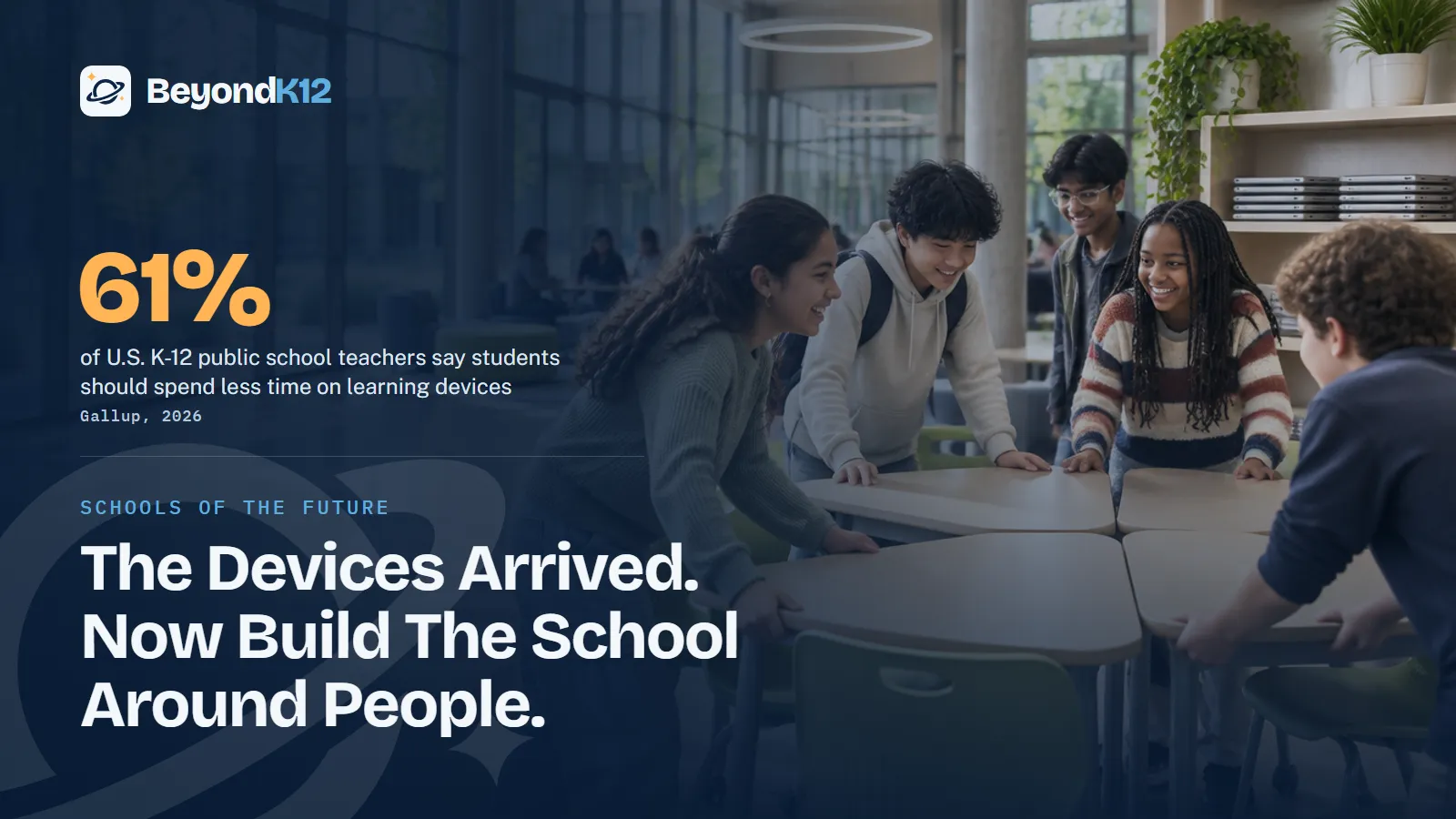
The schools of the future turned out to be the schools of today, with learning devices in nearly every classroom. The promise from 2016 that still matters is the part a device cannot deliver alone: students who work together, stay curious, and have a teacher running the room.
Often we hear that our education system needs reform. But what does reform look like? In January 2016 I threw that question out to my professional learning network and asked what schools could be if we were not held to boundaries. Here is what we imagined, what arrived, and what I would do now.
What did we imagine for the schools of the future in 2016?
For the Trekkies out there, we naturally thought of the Vulcan School of Learning pods. Every student has multiple screens and information at their fingertips. The system asks questions and moves on based on the answers. It takes personalized learning to a new level.
Something is missing from that kind of learning: collaboration. The pod is isolated. As we know, Spock struggled with human emotion, and emotion is essential to our children's understanding.
So we tried to do the Vulcans one better. Imagine movable desks or pods loaded with the needed technology and connected to the world. Students learn the background information in their pods, tied to students in other classrooms or around the world. They self-assess, then move out of their pods to collaborate with the rest of the class.
The teacher orchestrates all of this, providing timelines, checking understanding, and regrouping students as needed. Informal formative assessment is constant. Learning is at the forefront, not assessment.
What actually arrived by 2026?
The pods arrived, though not as furniture. In May 2026, 96% of U.S. K-12 public school teachers told Gallup and the Walton Family Foundation that their students use learning devices in class. Teachers do not call that a finished job: 61% say students should spend less time on devices, 33% say about the same, and 6% say more.
Teachers who say students should spend less time on devices
Their view is mixed rather than hostile. In the same study, 59% agree the digital tools they use help students learn more effectively, but only 10% strongly agree. About half (52%) say devices do equal amounts of harm and good.
Then came AI, the closest thing yet to a system that asks questions and moves on based on the answers. RAND found that the share of middle school, high school, and college students using AI for homework rose from 48% to 62% between May and December 2025. The worry I had about the pod now has numbers attached to it.
Half
of high school students agree that using AI in class makes them feel less connected to their teacher.
Center for Democracy and Technology, 2025
67%
of middle school, high school, and college students said using AI for schoolwork harmed critical thinking.
RAND, 2026
42%
of teachers report a lot of oversight of what students do on devices during instruction.
Gallup, 2026
29%
of teachers say they have ever been asked to weigh in on a new classroom tool.
Walton Family Foundation and Gallup, 2026
Working with others, communicating, understanding, and exercising emotional intelligence are necessary to child development and education. None of that happens by itself inside a pod. It has to be designed in.
A pod can teach a fact, but it takes a room full of people to teach a child to work with others.Ernie Delgado, BeyondK12
What can schools still learn from Finland?
In 2016 I turned to schools that are not so galactic. I said then that comparing Finland to America is not comparing apples to apples, but that we can still learn from how they educate. Both halves of that remain true.
In Finland, comprehensive school starts in the year a child turns 7, after a compulsory pre-primary year at age 6, according to Eurydice. There are no mandatory national standardized tests for pupils in basic education, and children have less homework than in many other countries, according to the Finland Promotion Board.
Finland is also no longer the automatic example. It scored 469 in math on PISA 2025, above the OECD average of 463, according to the University of Jyvaskyla, and the OECD says the latest results extended two decades of relatively steady drops. I look at the practices worth borrowing from Finland in a separate post.
What interested me was the learning environment. Taking testing out of the center makes room for students to learn and enjoy it without the stress of a test. I think about the informal learning I do when I seek out knowledge just out of curiosity, traveling down the rabbit hole to satisfy my need to know. If we could cultivate that in our schools, students might be more excited to go to school.
Where should the money and the time go now?
In 2016 I called for moving money from testing our students to educating them. Brookings put state testing regimens at about $1.7 billion a year, a quarter of 1 percent of total K-12 spending, Education Week reported in 2012. My position has not moved: spend first on what a student learns, then on how we measure it.
The shopping list has changed. I wanted stronger wifi, better tools, and training for teachers on those tools. Teachers are now asking for something more specific, and in Gallup's 2026 study a daily cap on device time is not at the top of their list.
What teachers strongly support
They also want to know that a tool earned its place. In the Walton Family Foundation and Gallup study, 92% of teachers support clear quality standards before adoption, while only 37% say classroom tools are adequately reviewed all or most of the time. Control matters too: 67% of teachers with a lot of oversight agree digital tools help students learn more effectively, compared with 49% of those with little to no oversight.
| What we imagined in 2016 | What the data shows in 2026 | What to do now |
|---|---|---|
| A personal pod for every student | 96% of teachers report devices in class; 61% want less time on them (Gallup) | Use devices for background learning, not the whole period |
| Students leave the pod to collaborate | Half of high school students agree AI in class makes them feel less connected to their teacher (CDT) | End every unit with group work and a spoken explanation |
| The teacher orchestrates | 42% of teachers report a lot of oversight of device use (Gallup) | Give teachers classroom monitoring tools and a voice in adoption |
| Constant informal assessment | 67% of students said AI for schoolwork harmed critical thinking (RAND) | Check understanding in conversation, not only in software |
| Less testing, more curiosity | Finland has no mandatory national tests in basic education and still scored above the OECD average | Protect time for inquiry and cut the local tests that change nothing |
How can a real school build the mashup today?
It is possible to have a mashup of Vulcan and Finnish schools today, not just in the future. Here is how I would do it, one unit at a time.
- Redesign one unit. Let students learn the background alone on a device and self-assess. Set a clear point in the unit when the screens close.
- Move students out of the pod. Finish with group work that needs every member. In our TechPlus AI curriculum, every project ends with the student explaining their work, which is the part a pod cannot do for them.
- Give the teacher the controls. Provide classroom monitoring tools, then ask teachers which tools deserve to stay.
- Audit the assessments you control. List every test your school chooses to give. Keep the ones that change what a teacher does next.
- Put the time and money into people. Move what you save into teacher training and into the print and hands-on materials teachers are asking for.
Where to start this week
Pick one unit and mark the moment students leave the pod. With a little innovation and restructuring, our students could learn like Vulcans and still learn from each other.
If you want to see where your school stands on the people and policy behind that, the free AI Readiness Assessment scores you across Policy, People, Curriculum, Guardrails, and Funding in eight questions.
Related reading: Human-centered AI and the future of personalized learning in schools and Hybrid intelligence in schools: why AI alone will not save education.
Questions school leaders ask
What will schools of the future look like?
Much like the best schools of today, with technology used for a clear purpose. Devices are already common: 96% of U.S. K-12 public school teachers told Gallup in 2026 that their students use learning devices in class. The design question is how much of a unit happens alone on a screen and how much happens with other people.
Should schools cut classroom screen time?
Teachers lean that way, but they want better management more than a hard cap. In Gallup's 2026 survey, 61% said students should spend less time on devices, yet only 34% strongly support a daily time maximum. More teachers strongly support investing in print or hands-on materials (58%) and stronger filtering or monitoring (54%).
Is Finland still a good model for U.S. schools?
It is a useful example, not a formula. Finland has no mandatory national standardized tests for pupils in basic education, according to the Finland Promotion Board, and it still scored above the OECD average on PISA 2025. The OECD also reports two decades of relatively steady drops in its scores, so borrow practices rather than rankings.
How much do states spend on standardized testing?
Brookings estimated about $1.7 billion a year across state testing regimens, or a quarter of 1 percent of total K-12 spending, according to Education Week's 2012 report on the study.
How does AI change the personalized learning idea?
It makes the pod far more capable and the isolation risk more real. RAND found that AI use for homework rose from 48% to 62% of middle school, high school, and college students between May and December 2025. Keep the human part in the design: group work, teacher check-ins, and students explaining their work out loud.
Sources
- Gallup, Screens ubiquitous in classrooms; teachers split on efficacy (September 2026) (opens in a new tab) (checked 2026-11-05)
- Walton Family Foundation and Gallup, Teaching for Tomorrow: Screen Wise press release (September 2026) (opens in a new tab) (checked 2026-11-05)
- Center for Democracy and Technology, survey research on AI in K-12 schools (October 2025) (opens in a new tab) (checked 2026-11-05)
- RAND, Student use of AI for homework rises as concerns grow about critical thinking skills (March 2026) (opens in a new tab) (checked 2026-11-05)
- Pew Research Center, How teens use and view AI (February 2026) (opens in a new tab) (checked 2026-11-05)
- University of Jyvaskyla, PISA 2025: students in Finland still perform well above OECD average in science (September 2026) (opens in a new tab) (checked 2026-11-05)
- OECD, PISA 2025 Results (Volume I): Finland country note (September 2026) (opens in a new tab) (checked 2026-11-05)
- Eurydice, Finland: organisation of the education system and of its structure (opens in a new tab) (checked 2026-11-05)
- Eurydice, Finland: compulsory education extended until the age of 18 (July 2021) (opens in a new tab) (checked 2026-11-05)
- Finland Promotion Board, Education in Finland (opens in a new tab) (checked 2026-11-05)
- Education Week, Standardized testing costs states $1.7 billion a year, study says (November 2012) (opens in a new tab) (checked 2026-11-05)

See where your school stands on AI, in five minutes
Eight questions. A score out of 24 across Policy, People, Curriculum, Guardrails, and Funding, with the three fixes that move it most. The report is yours whether or not you ever call us.