


Hybrid intelligence in schools: why AI alone will not save education
Hybrid intelligence pairs AI with teachers. What 2025 and 2026 studies say about AI tutoring, where AI alone failed, and how leaders design for both.
Updated with current data and sources. Originally published October 20, 2025.
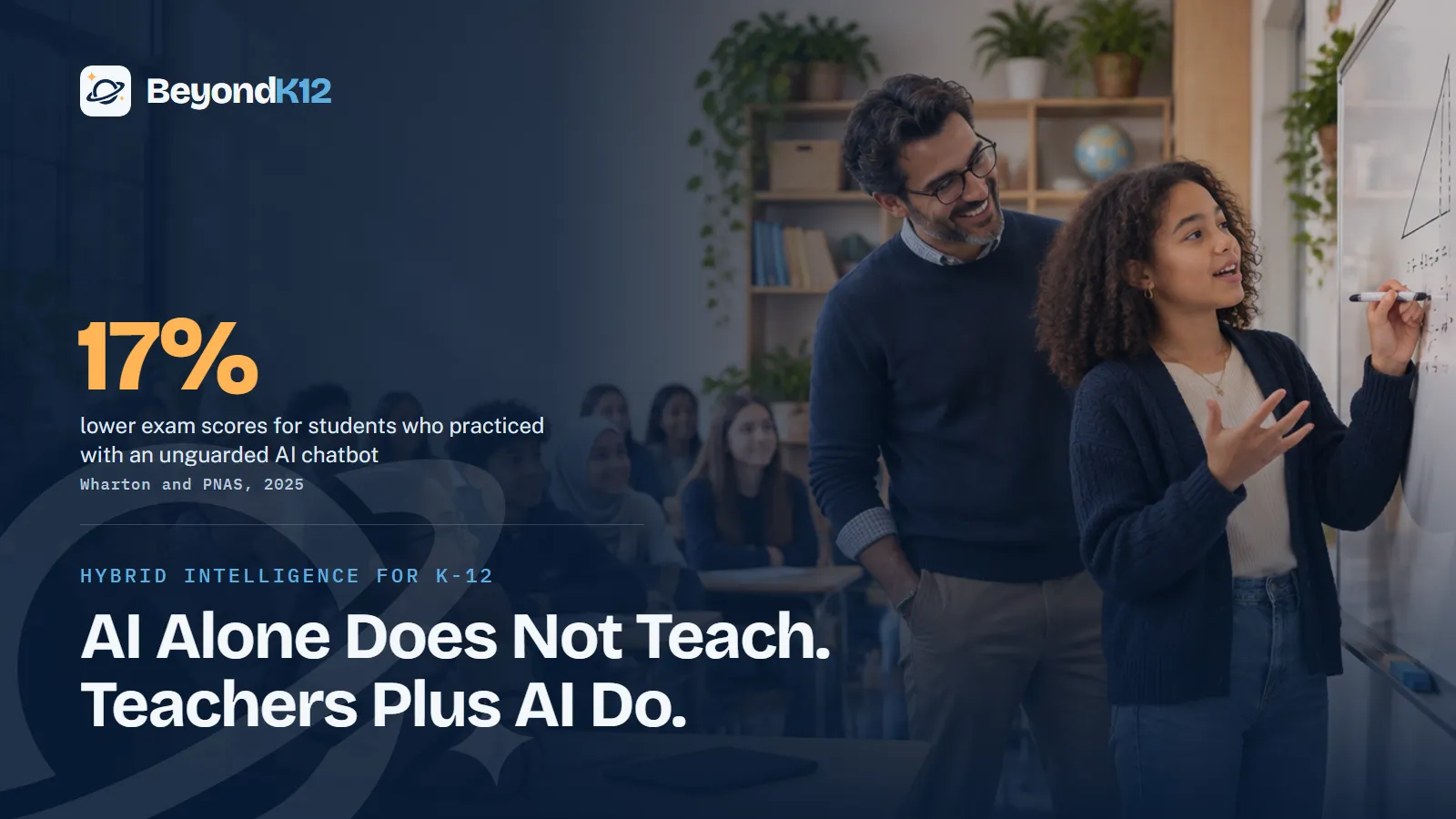
AI alone will not save education, and the best research of 2025 and 2026 says so plainly: students who practiced with an unguarded chatbot did worse on the exam, while students whose AI tutor was built around a teacher's judgment learned more in less time. The model that works is hybrid intelligence, where the AI does the pattern work and a teacher owns the instruction, the judgment, and the relationship.
Schools are adopting AI faster than they are designing for it. Six in ten public school teachers used AI for their work in 2024-25, according to Gallup, and CoSN reports that 79% of districts now have official AI guidelines, up from 57% a year earlier. Yet only 18% of teachers told Gallup in 2026 that administrators had given them formal guidance on how AI should be used. This guide is for the leader who has to close that gap.
- Hybrid intelligence
- A way of running a school where AI and people each do what they do best. The AI drafts, gives practice feedback, flags patterns, and personalizes materials. The teacher explains, decides what a pattern means, motivates, and knows the child. Neither works as well alone.
What the evidence says about AI tutoring
The clearest finding of the last two years is that design matters more than the model. The same technology can raise or lower learning depending on who shaped how it is used.
In a field experiment with about 1,000 high school math students in Turkey, Wharton's Hamsa Bastani and colleagues gave one group a ChatGPT-style assistant during practice, a second group a version with teacher-informed guardrails that offered hints instead of answers, and a third group no AI. The unguarded group scored 48% higher on practice problems and then 17% lower on the exam than students with no AI at all. The guardrailed tutor group scored 127% higher in practice and about the same as the control group on the exam. The AI that handed out answers became a crutch; the AI that behaved like a teacher did no harm (Knowledge at Wharton, PNAS 2025).
When educators design the AI around good pedagogy, the gains can be large. At Harvard, 194 physics students each worked through one topic with an AI tutor built on the course's own active learning principles and another topic in the active learning class. The AI sessions produced median learning gains more than double the in-class gains, in a median 49 minutes against 60, with higher engagement ratings (4.1 versus 3.6 on a five-point scale). The tutor was written to withhold answers, break problems into steps, and give targeted feedback, and the authors note the study covered first exposure to new concepts, not synthesis or long-term retention (Scientific Reports, June 2025).
2x
median learning gain for Harvard physics students using an AI tutor built on the course's own pedagogy, compared with the active learning class.
Kestin et al., Scientific Reports, 2025
+9 pts
gain in student mastery when lower-rated human tutors had an AI copilot suggesting moves in real time (4 points across all tutors).
Stanford National Student Support Accelerator, 2024
0.3 SD
learning gain in six weeks for Nigerian students in a teacher-supported after-school AI tutoring program, close to two years of typical schooling.
World Bank, 2025
17%
lower exam scores for high school students who practiced with an unguarded chatbot, compared with no AI at all.
Bastani et al., PNAS, via Knowledge at Wharton, 2025
Notice what the three positive studies share. Stanford's Tutor CoPilot trial put the AI next to a human tutor, not in place of one: across more than 700 tutors and 1,000 students, children were 4 percentage points more likely to master the topic, 9 points when their tutor was lower-rated, at about $20 per tutor per year. The World Bank program ran its AI sessions with teacher support and credited that support for a result that outperformed 80% of the education interventions in its comparison database. The Harvard tutor was written by the instructors who taught the class. In every case a teacher decided what the AI was for. That is hybrid intelligence.
What the evidence says about teachers
Teachers are the other half of the equation. Gallup found that 32% of teachers use AI at least weekly, and those weekly users estimate they save 5.9 hours a week, about six weeks over a school year. Majorities say AI improves the quality of their work, from 57% for grading and feedback to 74% for administrative tasks. The Education Week Research Center saw the same surge: 61% of teachers used AI in 2025, up from 32% in 2024.
The same teachers are not naive about students. In Gallup's 2025 survey, 57% expected weekly student AI use to decrease independent thinking and 52% expected it to decrease critical thinking, as reported by The 74. An NPR/Ipsos poll in June 2026 found 54% of teachers saying AI makes critical thinking harder to learn and 55% calling it mostly a shortcut. The Center for Democracy and Technology found seven in ten teachers worried that AI weakens the skills students need, and half of high school students saying AI use in class makes them feel less connected to their teacher.
What educators fear AI alone does to student skills
Read those numbers together and the picture is coherent. Teachers see the dividend in their own work and the risk in students' unsupervised use. Hybrid intelligence is built around that asymmetry: give the adults the time savings, and put an adult between the student and the machine.
Where AI-only approaches have failed or stalled
None of these was a failure of what the model could do. Each was a failure to put a person in charge of what the model was for. CoSN's 2026 survey of 607 district technology leaders found only 5% very concerned about AI replacing teachers, while 52% worried about the lack of teacher training to integrate it. The people closest to the technology have concluded that the risk is not the AI. It is AI without the teacher.
Teacher guidance on AI in 2026
The guidance gap is where a leader can act first. In Gallup's 2026 survey, 69% of teachers had no guidance on using AI for one-on-one instruction or tutoring and 58% had none for grading and feedback, the two uses with the highest stakes for a child. Teachers in higher-need schools were less likely to receive guidance than those in higher-income schools, so the schools with the most to gain are the most likely to be improvising.
AI can make a good teacher faster. It cannot make a school good without one.Ernie Delgado, BeyondK12
How to divide the work between AI and people
The table below is the hybrid intelligence design on one page, built from the studies above and from the U.S. Department of Education's July 2025 guidance, which asks that federally funded AI use be educator-led, ethical, accessible, and transparent, and names hybrid models that pair human tutors with AI platforms as an allowable use of funds (THE Journal). Utah has since barred AI from grading students or making essential decisions about them on its own (Education Week, June 2026).
| Learning task | What the AI does | What the teacher does | What the evidence says |
|---|---|---|---|
| Practice and homework help | Gives hints, checks steps, never the final answer | Sets the guardrails and reviews the error patterns | Guardrailed tutor matched control; unguarded chatbot cut exam scores 17% (Wharton and PNAS, 2025) |
| High-impact tutoring | Suggests the next move to the human tutor in real time | Delivers the tutoring and the relationship | +4 points mastery overall, +9 for lower-rated tutors (Stanford, 2024) |
| First exposure to a new concept | Scaffolds steps and gives immediate feedback | Writes the pedagogy into the tool and teaches synthesis | Gains more than double, for new concepts (Scientific Reports, 2025) |
| Intervention and catch-up | Tutors after school at scale | Runs the sessions and keeps students attending | About 0.3 SD in six weeks with teacher support (World Bank, 2025) |
| Grading and feedback | Drafts comments against the rubric | Decides the grade and signs the feedback | 58% of teachers have no guidance here; Utah bars AI from grading alone (Gallup, 2026; Education Week, 2026) |
| Student well-being | Nothing on its own | Notices, talks, refers | 42% of students or a friend have used AI as a companion; 1 in 10 teachers are trained to respond (CDT, 2025) |
That last row matters more than it looks. Pew found that 12% of teens have used a chatbot for emotional support or advice. No school tool should be the adult in that conversation, and no teacher should be left outside the one in ten who were trained for it.
How to design human-plus-AI learning in five steps
- Name the learning problem before the tool. Formative assessment fatigue in middle school math, reading intervention for the bottom quartile, writing feedback that arrives before the next draft. A tool chosen for a named problem can be measured against it; a tool chosen for a demo cannot.
- Buy or build for guardrails, not answers. Ask every vendor to show how the tool withholds final answers, how a teacher sets its limits, and what the student sees when it does not know. The Wharton study is the reference point: guardrails did no harm, and their absence cost 17 points on the exam.
- Put a teacher in the loop by design. Every AI use gets a named reviewer, written into the acceptable use policy before the tool is turned on. Grading, placement, discipline, and well-being stay human. Our 90-Day AI Readiness Accelerator gives a leadership team the policy templates and pilot plan to do this in one semester.
- Train the adults and bank the dividend. Half of teachers had at least one AI professional development session in 2025, according to the Education Week Research Center, which means half had none. Train on prompting, on reading an AI draft for flaws, and on what to do when a student's AI use raises a concern.
- Measure learning, not usage. Logins and minutes are vendor metrics. Hold the pilot to the measure you named in step one, collect student work, and ask teachers what they could do that they could not do before. If the answer is nothing, stop.
What students should learn from all of this
Hybrid intelligence is not only an adult arrangement. Pew found that 10% of teens do all or most of their schoolwork with chatbot help and that 59% say AI cheating happens at least somewhat often at their school. The students who will thrive learn to use AI, question it, disclose it, and then explain their own thinking without it. That is the design principle behind our TechPlus AI curriculum for TK-8: every project ends with the student explaining what they made, which tools helped, and what they would change. It is the one assessment AI cannot take for them.
Where to start this week
You do not need a new budget line to start. Pick one learning problem, one low-risk AI use with a named reviewer, and one measure of learning. Write the review requirement into your acceptable use policy and tell families what the AI does and who checks it.
If you want to know how far your school is from a working hybrid model, the free AI Readiness Assessment takes five minutes. Eight questions give you a score out of 24 across Policy, People, Curriculum, Guardrails, and Funding, with the three fixes that move it most. The report is yours whether or not you ever call us.
Related reading: Why school leaders must consider human in the loop AI for future-ready strategies and Teaching responsible AI use and human decision making in the classroom: routines, assignments, and assessment.
Questions school leaders ask
What is hybrid intelligence in education?
Hybrid intelligence is a way of running a school where AI and people each do what they do best. The AI drafts, gives practice feedback, flags patterns, and personalizes materials. The teacher explains new ideas, decides what a pattern means, motivates the student, and owns the relationship. The 2025 research shows that the same AI can raise or lower learning depending on whether a teacher shaped how it is used.
Does AI tutoring actually work?
It can, when it is designed around teaching rather than answers. Harvard physics students using an AI tutor built on the course's own pedagogy showed median learning gains more than double those of the active learning class, in less time (Scientific Reports, 2025). A teacher-supported AI tutoring program in Nigeria produced about 0.3 standard deviations of learning in six weeks (World Bank, 2025). But students given an unguarded chatbot for math practice scored 17% lower on the exam than students with no AI (Wharton and PNAS, 2025).
Will AI replace teachers?
The evidence and the people closest to it say no. In CoSN's 2026 survey of 607 district technology leaders, only 5% were very concerned about AI replacing teachers, while 52% worried about the lack of teacher training to integrate it. The strongest results in the research came from AI placed next to a human tutor or teacher, not in place of one: students of human tutors using an AI copilot were 4 percentage points more likely to master the topic, 9 points for lower-rated tutors (Stanford, 2024).
What has gone wrong when schools relied on AI alone?
Los Angeles Unified launched an AI assistant called Ed in March 2024 under a $6 million commitment and shelved it by summer; the vendor went bankrupt and its founder was charged with fraud (KNX News, 2024). In the Wharton field study, unguarded chatbot access produced higher practice scores and lower exam scores, a crutch rather than a tutor. And RAND found in 2025 that more than half of students and teachers used AI for school while fewer than half of principals had any AI policy.
How should a small school start with hybrid intelligence?
Pick one learning problem, one low-risk AI use with a named teacher reviewer, and one measure of learning rather than usage. Write the review requirement into your acceptable use policy before the tool is turned on. The free AI Readiness Assessment at BeyondK12 scores your school across Policy, People, Curriculum, Guardrails, and Funding in five minutes and points to the three fixes that matter most.
Sources
- Knowledge at Wharton, Without guardrails, generative AI can harm education (Bastani et al., PNAS, 2025) (opens in a new tab) (checked 2026-11-05)
- Stanford National Student Support Accelerator, Tutor CoPilot: a human-AI approach for scaling real-time expertise (2024) (opens in a new tab) (checked 2026-11-05)
- World Bank Blogs, From chalkboards to chatbots: transforming learning in Nigeria (2025) (opens in a new tab) (checked 2026-11-05)
- Kestin et al., AI tutoring outperforms in-class active learning, Scientific Reports (June 2025), via Stanford SCALE repository (opens in a new tab) (checked 2026-11-05)
- ETC Journal, Review of Kestin et al.'s June 2025 Harvard study on AI tutoring (November 2025) (opens in a new tab) (checked 2026-11-05)
- Gallup and Walton Family Foundation, Most teachers receive no formal guidance on AI use (May 2026) (opens in a new tab) (checked 2026-11-05)
- Gallup and Walton Family Foundation, Three in 10 teachers use AI weekly, saving six weeks a year (2025) (opens in a new tab) (checked 2026-11-05)
- The 74, Survey: 60% of teachers used AI this year and saved up to 6 hours of work a week (July 2025) (opens in a new tab) (checked 2026-11-05)
- NPR/Ipsos teacher poll, Most K-12 teachers say AI's impact on education will eclipse the internet (June 2026, via WUSF) (opens in a new tab) (checked 2026-11-05)
- Center for Democracy and Technology, Hand in Hand survey research (October 2025) (opens in a new tab) (checked 2026-11-05)
- Pew Research Center, How teens use and view AI (February 2026) (opens in a new tab) (checked 2026-11-05)
- RAND, AI use in schools growing rapidly as policies lag (October 2025, via KMPH) (opens in a new tab) (checked 2026-11-05)
- GovTech, CoSN report: cybersecurity is top concern, AI guardrails needed (May 2026) (opens in a new tab) (checked 2026-11-05)
- THE Journal, CoSN: cybersecurity and data privacy remain top AI concerns in education (May 2026) (opens in a new tab) (checked 2026-11-05)
- THE Journal, ED offers guidance on the use of federal grants to support learner outcomes with AI (July 2025) (opens in a new tab) (checked 2026-11-05)
- Education Week, White House honors AI Challenge winners as tech backlash grows (June 2026) (opens in a new tab) (checked 2026-11-05)
- KNX News, Tech exec behind failed LAUSD chatbot charged with fraud (November 2024) (opens in a new tab) (checked 2026-11-05)
- Education Week Research Center, More teachers are using AI in their classrooms (January 2026) (opens in a new tab) (checked 2026-11-05)

See where your school stands on AI, in five minutes
Eight questions. A score out of 24 across Policy, People, Curriculum, Guardrails, and Funding, with the three fixes that move it most. The report is yours whether or not you ever call us.