


8 ways to connect effectively with your students, and what technology changes
Eight ways teachers build real connection with students, the 2026 evidence on belonging, and where phones and AI help or harm the relationship.
Updated with current data and sources. Originally published March 28, 2019.
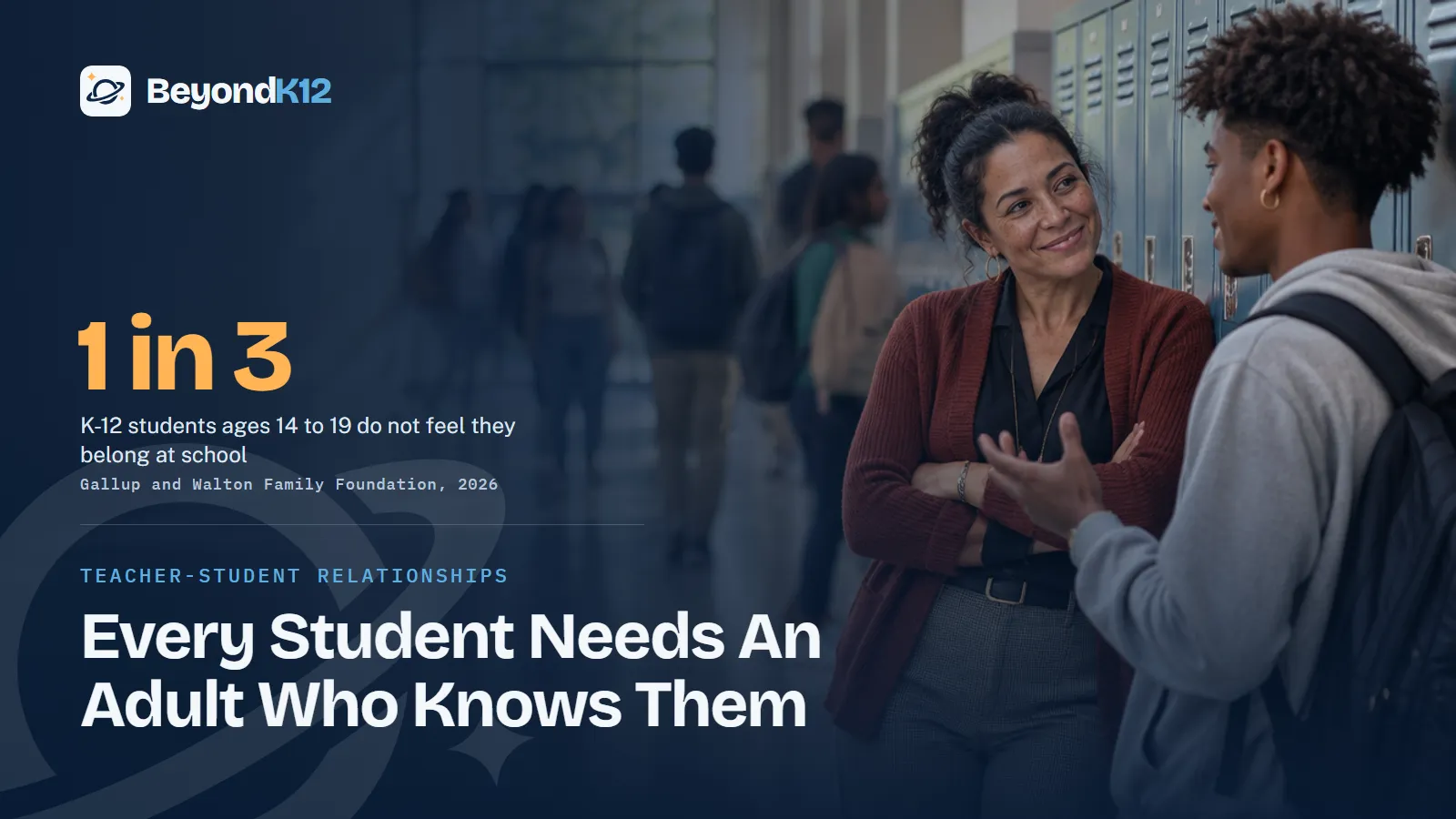
Eight habits connect teachers with students: find common ground, celebrate them, know them, be consistent, listen, communicate, check your emotions, and care. They matter more than ever, because one in three K-12 students ages 14 to 19 say they do not feel they belong at school, according to Gallup.
Why do teacher-student relationships matter so much?
The evidence is broad. A 2025 review in Psychological Bulletin pulled together 26 meta-analyses and more than 70 years of research, based on about 2.64 million prekindergarten and K-12 students. It found large links between teacher-student relationships and achievement, motivation, behavior, belonging, and well-being. The link was larger for middle and high school students. The review reports relationships between measures, not proof of cause, but the pattern is hard to ignore.
Gallup and the Walton Family Foundation's 2026 Voices of Gen Z study surveyed 1,758 K-12 students ages 14 to 19. Most report at least one adult in their corner, and a large minority do not.
What K-12 students ages 14 to 19 agree with
33%
of K-12 students ages 14 to 19 do not feel a sense of belonging at school.
Gallup, 2026
29%
report no adult at school who regularly checks in on their wellbeing.
Gallup, 2026
81% vs. 27%
feel prepared for the future: the most engaged and supported students compared with the least.
Gallup, 2026
50%
of 9th to 12th graders agree that using AI in class makes them feel less connected to their teacher.
Center for Democracy and Technology, 2025
The gap is not even. Among students who do not plan to go to college, 59% feel they belong, compared with 71% of their college-bound peers. The student who needs an adult most may be the one no one has noticed.
What are the 8 ways to connect effectively with your students?
1. Find common ground
What movies do they watch? What shows on YouTube? What games do they love? Even watching one episode of the show they all seem to be talking about gives you access to them in a new way. It takes students by surprise in a really good way.
These little connections build a bridge. When a teachable moment comes later, that bridge gives you access to their heart. Instead of walls, there is something much deeper. Students may need that from you more than you know: just 30% say they have things in common with all or most of their classmates, Gallup found.
2. Celebrate your students
Acknowledge the good things your students do in private and in front of the rest of the class. Do not be afraid to boast about them, and do this with all your students. Compliment them as a class, as individuals, and on group projects. Go out of your way to find the good in them. Gallup found 30% of students report no adult at school who recognizes their talents.
3. Know your students and ask them questions
Students will often tell you they are going to Disneyland or that they have ballet after school. Why not make a note and ask how it went? If you know they had a birthday party, simply ask, "How was your birthday?"
If you are invited to a baseball game, try to go. Email the parents, let them know their student invited you, and ask if it would be okay to attend. Your actions can say more than your words do.
4. Be consistent with your students
Set your rules and follow them. Do not show favoritism, because it creates disrespect in your classroom. Some students are testing you to see if you will really follow through. Sometimes we think being easier on them in those moments is better. I have found it only makes it worse.
The research on phones shows how much follow-through counts. In RAND's 2026 report, only 17% of students with very strict teachers reported keeping a phone in their pocket, compared with 50% of students who said their teacher was only a little strict.
5. Listen to your students
When a student is acting out, it often has more to do with something else in their life. What is their home life like? Do they have kind friends? Is someone bullying them? Is there a diagnosed or undiagnosed developmental issue? Simply asking, "You doing OK?" or "What's going on?" can begin to uncover these issues. It matters because 29% of students do not agree that they feel comfortable asking questions at school.
6. Communicate with parents and administrators
If problems escalate, do not handle them lone ranger style. Being in communication with administrators and parents is extremely important. This is a team effort. Document, document, document: keep track of dates and circumstances so you can share them clearly. It also helps keep your emotions out of the conversation.
Keep those records in your school's approved systems. A note about a child does not belong in an AI tool your school has not reviewed.
7. Check your emotions
You learn quickly that teaching is about so much more than teaching. It is about guiding these lives down a path. When a student has a discipline problem, the whole mood of the classroom is disrupted. Stay calm and keep your own emotions in check. The better you can do this, the more stable your classroom will be.
That is hard work. RAND found that managing student behavior was the most cited source of job-related stress, named by 52% of teachers. Leaders should treat a teacher's calm as something the school has to protect.
8. Care for your students
Care deeply. Care through acts of kindness, high fives, and the tone of your voice. In the hurry of the day, we forget how our actions affect students. We have an impact on them whether we see it or not.
Do not give up, no matter how tough the case is. Be firm, but always stay hopeful. You may be in their life at a time when the child is at their worst, and your actions could be what turns their life around.
Children need adults in their lives who will stick with them through the hard times.Ernie Delgado, BeyondK12
Where does technology help the relationship, and where does it hurt?
Technology is not the enemy of connection. It depends on what the tool replaces. AI that drafts a newsletter gives a teacher time back. Gallup found teachers who use AI at least weekly estimate they save 5.9 hours a week. AI that stands between a student and a teacher does the opposite.
| Technology | Where it helps | Where it hurts |
|---|---|---|
| AI for teacher prep | Drafts routine work, so a teacher has more time for students | Writes the feedback a student expected from you |
| AI used in class | Supports a task the teacher has designed and reviews | Replaces the conversation; half of students in CDT's survey feel less connected |
| Student chatbots | Answers a homework question late at night | Becomes the place students go instead of people |
| Student phones | Keeps a family in touch outside the school day | Pulls attention during class |
Two findings deserve a leader's attention. In the Center for Democracy and Technology's 2025 survey, 38% of students agreed it is easier for them to talk to AI than to their parents, and 31% said they have had personal conversations with AI on a device, tool, or software provided by their school. And phone rules alone will not bring attention back. RAND's survey of middle and high school students found that even where students are not allowed to use phones at all at school, half reported checking them during class at least once a day.
How can a school leader make connection a routine?
- Ask the students. Survey them on two plain statements: an adult at school checks in on me, and an adult at school recognizes my talents. For students ages 14 to 19, compare your results with Gallup's national 71% and 70%.
- Name an adult for every student. Go through the roster with your staff. Any student no one can speak for gets a named adult that week.
- Protect the time. Build check-ins into advisory, homeroom, or the first minutes of class, so connection does not depend on a free moment.
- Write the technology rules down. Say where AI belongs, what stays human, and how the phone policy works. Enforce it the same way in every room.
- Support the adults. Stressed teachers struggle to stay calm. Use professional development time for classroom relationships and behavior, not only new tools.
Where to start this week
Pick one student who rarely speaks up, and use way number three on Monday. Then ask your staff the harder question: is there any student here no adult can speak for?
If you want to know whether your school's approach to AI protects those relationships, take the free AI Readiness Assessment. It takes five minutes and scores you across Policy, People, Curriculum, Guardrails, and Funding.
Related reading: Human-centered AI and the future of personalized learning in schools and Hybrid intelligence in schools: why AI alone will not save education.
Questions school leaders ask
Why do teacher-student relationships matter for learning?
A 2025 review in Psychological Bulletin combined 26 meta-analyses based on about 2.64 million prekindergarten and K-12 students. It found large links between these relationships and achievement, motivation, behavior, belonging, and well-being, with a larger link for middle and high school students. The review reports relationships between measures, so it does not prove that one causes the other.
How many students feel they belong at school?
In Gallup and the Walton Family Foundation's 2026 Voices of Gen Z study, 67% of K-12 students ages 14 to 19 agree that school is a place where they belong, and 33% do not. The figure is lower for students who do not plan to attend college: 59%, compared with 71% of their college-bound peers.
Does AI hurt the relationship between teachers and students?
It can. In the Center for Democracy and Technology's 2025 survey, half of 9th to 12th grade students agreed that using AI in class makes them feel less connected to their teacher. The fix is to use AI for preparation and paperwork, and to keep feedback, conversation, and care in human hands.
Do school phone bans help teachers connect with students?
The evidence so far is about phone use, not relationships. RAND's 2026 report found that stricter policies are associated with less phone checking, though half of students in restrictive schools still reported checking during class at least once a day. The study does not prove the policy caused the change, and all findings are student self-reports.
How can a principal measure connection?
Ask students directly, in a short survey, whether an adult at school checks in on them and recognizes their talents. Gallup's national figures for ages 14 to 19, 71% and 70%, give you something to compare against. Then look at who answered no, by name if the survey allows it, and assign an adult.
Sources
- Gallup, Engaged students more confident in their post-high school future (August 2026) (opens in a new tab) (checked 2026-11-05)
- Gallup and Walton Family Foundation, 2026 Voices of Gen Z release (August 2026) (opens in a new tab) (checked 2026-11-05)
- Emslander and others, Teacher-student relationships and student outcomes, Psychological Bulletin (2025) (opens in a new tab) (checked 2026-11-05)
- Center for Democracy and Technology, Hand in Hand survey (October 2025) (opens in a new tab) (checked 2026-11-05)
- RAND, Stricter cell phone policies associated with reductions in student phone use (May 2026) (opens in a new tab) (checked 2026-11-05)
- RAND, Teachers' stress, burnout continue to outpace those of other working adults (June 2026) (opens in a new tab) (checked 2026-11-05)
- Education Week, Which states ban or restrict cellphones in schools (updated October 2026) (opens in a new tab) (checked 2026-11-05)
- Pew Research Center, How teens use and view AI (February 2026) (opens in a new tab) (checked 2026-11-05)
- Gallup and Walton Family Foundation, three in ten teachers use AI weekly, saving six weeks a year (2025) (opens in a new tab) (checked 2026-11-05)

See where your school stands on AI, in five minutes
Eight questions. A score out of 24 across Policy, People, Curriculum, Guardrails, and Funding, with the three fixes that move it most. The report is yours whether or not you ever call us.