


Top 3 tips for teaching online after COVID-19, and what the research now shows
Three online teaching tips that still hold after COVID-19, and what NAEP and the Education Scorecard show about remote learning and learning loss.
Updated with current data and sources. Originally published March 21, 2020.
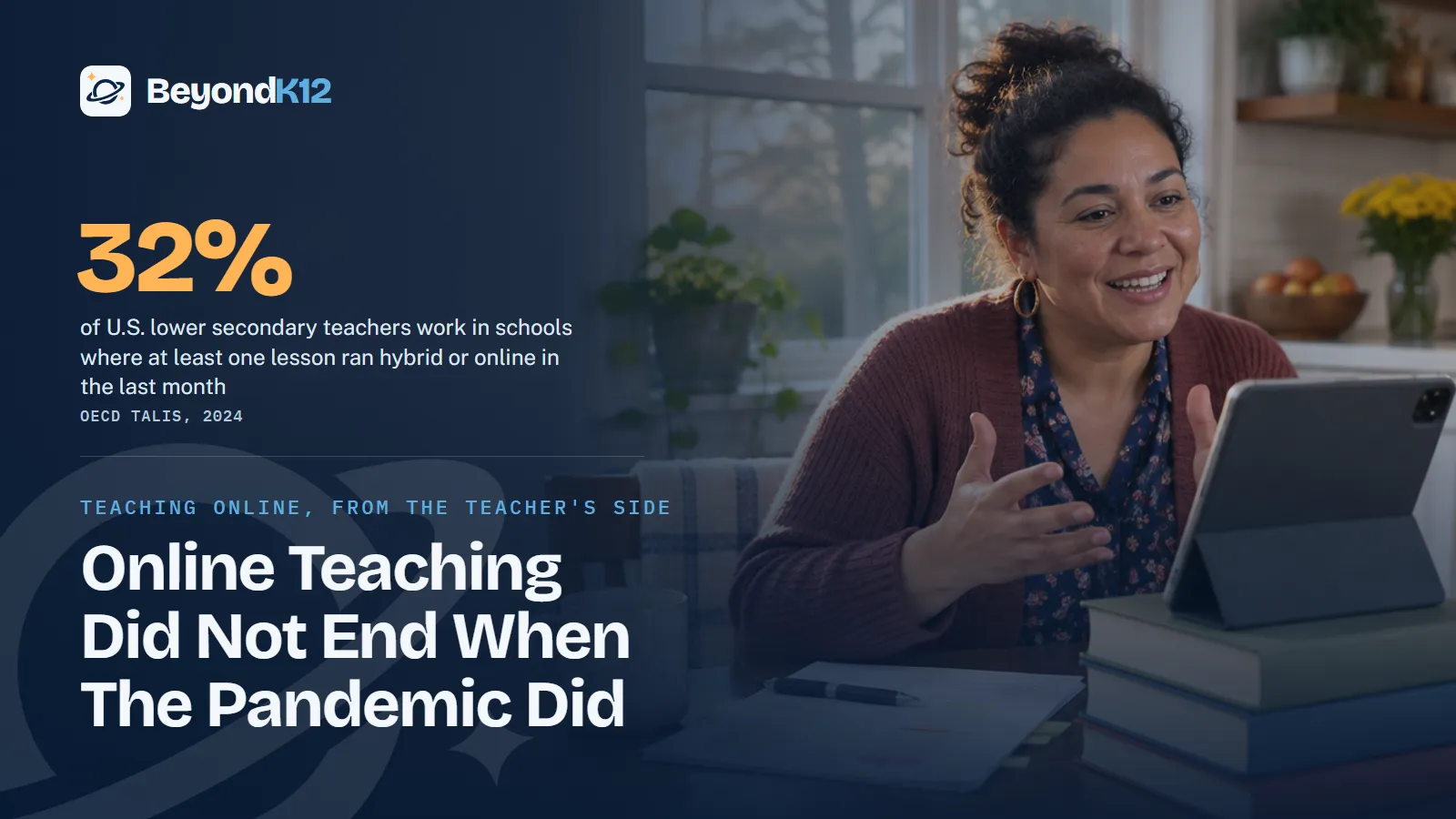
The three tips I gave teachers in March 2020 still hold: design before you post, use a few tools your school supports, and make time for students to be together. What changed is the evidence, which now shows that long stretches of remote instruction cost students the most in high-poverty schools.
When schools closed, teachers who used technology as a complement to their lessons were asked to put everything online, some with as little as 48 hours' notice. I know from experience that it takes several weeks to thoughtfully design an online course that runs a semester. It was a lot for everyone, and most teachers did their very best.
What research since 2020 shows about online teaching and learning loss
Start with the national picture. On the 2024 Nation's Report Card, fourth and eighth grade reading were both 5 points below 2019. Fourth grade math was 3 points lower and eighth grade math was 8 points lower, according to NAEP results reported by K-12 Dive. The National Assessment Governing Board noted that no state had passed its 2019 eighth grade score in either subject.
NAEP 2024 national scores compared with 2019
The damage was not spread evenly. Harvard's Center for Education Policy Research and its partners studied 2.1 million students in grades 3 to 8. Within districts that were remote for most of 2020-21, high-poverty schools lost a half-year of achievement growth, roughly twice as much as low-poverty schools in the same districts.
Half a year
of achievement growth lost by high-poverty schools in districts remote for most of 2020-21.
Harvard CEPR, 2022
23%
of students were chronically absent in 2024-25, down from the peak but above the 15% before the pandemic.
Education Scorecard, 2026
Remote time is not the whole explanation, and teachers should hear that. Chalkbeat reported in 2022 that Harvard's Thomas Kane said many districts that went back in person had bigger losses than districts that stayed remote, and that Stanford's Sean Reardon called remote learning probably a small piece of the story. The 2026 Education Scorecard, the Education Recovery Scorecard in earlier years, dates a "learning recession" to 2013. It found that the average yearly loss in reading from 2017 to 2019 was just as large as the loss during the pandemic itself, from 2019 to 2022.
Recovery is real but uneven. The Scorecard reports that math rebounded right after the pandemic and that 2025 brought the first signs of a turnaround in reading. The highest-poverty districts are still about half a grade equivalent behind their 2019 level, and the lowest-poverty districts about a tenth of a grade.
My reading as an educator: emergency remote instruction at scale was hard on the students with the least support at home. That is a reason to plan better, not a reason to stop teaching online.
Tip 1: Start with the ADDIE model
ADDIE is a popular instructional design model: Analysis, Design, Development, Implementation, and Evaluation. It tells you where to begin when a lesson has to move online. In a rush you will jump to the middle three phases, so here is what matters in each.
| Phase | What to do for an online lesson |
|---|---|
| Analysis | Decide what students must learn this week, and what they can reach from home. |
| Design | You know your students. Turn direct instruction into short videos or audio, and plan for the ones who drift off task. |
| Development | Put content in your school's learning management system. Cut clicks and downloads, and link words rather than pasting long addresses. |
| Implementation | Test every link, check that the flow makes sense, and open a Q&A space so students can see each other's questions. |
| Evaluation | Ask students what confused them. If several ask the same thing, change the content. |
My advice on video has not changed: no more than two minutes per grade level, so a sixth grade video stays under 12 minutes. Break videos up by topic so students can skip around and watch again. Good material from YouTube, Vimeo, and Khan Academy is fine to use. Enlist help in the development phase, because this is where the hours go.
Tip 2: Use a few tools your school already supports
This is not the time to go rogue. Use your school's learning management system, because students already know where to look and someone can help when it breaks. I still reach for four kinds of tools.
- Discussion around slides or video. Pose a prompt and let students answer by voice, video, or text. Schools that used Flip should check what their current platform offers in its place.
- Shared documents. Google Docs and similar tools let you see who is doing what, and the version history shows how the work developed. Students can comment, suggest changes, and work in groups.
- Video conferencing. Use the platform your school licenses for check-ins and for the direct instruction that needs to be live.
- A daily welcome. Greet students each morning the way you would at the door. A short post or video in your school's platform does the job, and your messages stay in a channel the school can see.
Tip 3: Provide opportunities for socialization
One of the big reasons kids go to school is to be with other kids their age. That is part of child development, and it does not stop when the building closes. Treat it as part of the schedule rather than an extra.
Open a video room for "recess" where students play simple games together. Run a virtual PE room where students take turns leading a short interval workout. Set up a coffee corner where students can drop in with a drink and talk. Publish the times on a shared calendar in your learning management system, with an adult in the room.
Plan the lesson first, pick the tool second, and never forget there is a kid on the other side of the screen.Ernie Delgado, BeyondK12
How to get ready before the next remote day
- Build one remote lesson now. Take a unit you already teach and run it through ADDIE while nothing is on fire.
- Teach students the routine in person. Have them log in, find the Q&A space, and submit work in class, so the first remote day is not their first try.
- Plan review for short closures. NWEA researchers note that attendance on remote days is likely to be lower, so they suggest review rather than new material.
- Write a no-internet version. Keep a paper or offline task ready for students who cannot connect.
- Ask for feedback. After each remote day, ask students what worked, then fix the top problem.
Where to start this week
Pick one unit and build the remote version with a colleague. If your whole staff needs the same practice, our teacher professional development is built around the lessons teachers are about to teach. School leaders can pair this post with the plan for the building in our continuity guide.
Be kind to one another while you do it. If your leadership team also wants to know where it stands on technology and AI, the free AI Readiness Assessment takes five minutes and scores your school across Policy, People, Curriculum, Guardrails, and Funding.
Related reading: Professional development for educators in the era of human and AI collaboration: what works in 2025-2026 and Digital citizenship in education: building responsible online behavior school-wide.
Questions school leaders ask
Did online learning cause learning loss?
It was part of the cause, not all of it. Harvard CEPR and its partners found that high-poverty schools in districts that stayed remote for most of 2020-21 lost a half-year of achievement growth. Stanford's Sean Reardon has called remote learning probably a small piece of the story, and the Education Scorecard dates the decline in achievement to 2013.
Have students caught up from the pandemic?
Not nationally. On NAEP 2024, scores at grades 4 and 8 were below 2019 in reading and math. The 2026 Education Scorecard reports a math rebound and the first signs of a turnaround in reading in 2025, but the highest-poverty districts are still about half a grade equivalent behind their 2019 level.
How long should an instructional video be?
My rule of thumb is no more than two minutes per grade level, so 12 minutes for sixth grade. Break videos up by topic so students can skip around and watch again the part they need.
What should a teacher do on a one-day remote day?
Review, practice, and check in. NWEA researchers suggest focusing on review rather than new material because attendance is likely to be lower. Keep the routine familiar, and post everything in the same place students use every day.
Should teachers use social media to reach students?
Use the channels your school manages and can see, such as the learning management system and school accounts. A personal app is hard to supervise and hard to support when something goes wrong. If you want something new, ask your technology lead before you introduce it to students.
Sources
- National Assessment Governing Board, NAEP 2024 press release (January 2025) (opens in a new tab) (checked 2026-11-05)
- The Nation's Report Card, 2024 NAEP reading results (opens in a new tab) (checked 2026-11-05)
- The Nation's Report Card, 2024 NAEP mathematics results (opens in a new tab) (checked 2026-11-05)
- K-12 Dive, 2024 NAEP reading and math scores drop from pre-pandemic levels (January 2025) (opens in a new tab) (checked 2026-11-05)
- Education Scorecard, From Learning Recession to Learning Recovery (May 2026) (opens in a new tab) (checked 2026-11-05)
- Education Scorecard, press release (May 2026) (opens in a new tab) (checked 2026-11-05)
- Harvard Center for Education Policy Research, new study highlights impact of remote learning (May 2022) (opens in a new tab) (checked 2026-11-05)
- Chalkbeat, remote learning not primary driver of academic losses (October 2022) (opens in a new tab) (checked 2026-11-05)
- OECD, Results from TALIS 2024 country note: United States (October 2025) (opens in a new tab) (checked 2026-11-05)
- NWEA, What do we know about remote learning snow days? (February 2026) (opens in a new tab) (checked 2026-11-05)
- Microsoft Q&A, old Flipgrid videos (community answer on the Flip retirement) (opens in a new tab) (checked 2026-11-05)
- Silicon Republic, Google hangs up on Hangouts, asks users to switch to Chat (2022) (opens in a new tab) (checked 2026-11-05)

See where your school stands on AI, in five minutes
Eight questions. A score out of 24 across Policy, People, Curriculum, Guardrails, and Funding, with the three fixes that move it most. The report is yours whether or not you ever call us.