


3 key attributes of a well-connected teacher: confidence, competence, and content
A device in every hand is not the answer. The 3 C's of a well-connected teacher, confidence, competence, and content, with current evidence for leaders.
Updated with current data and sources. Originally published November 16, 2015.
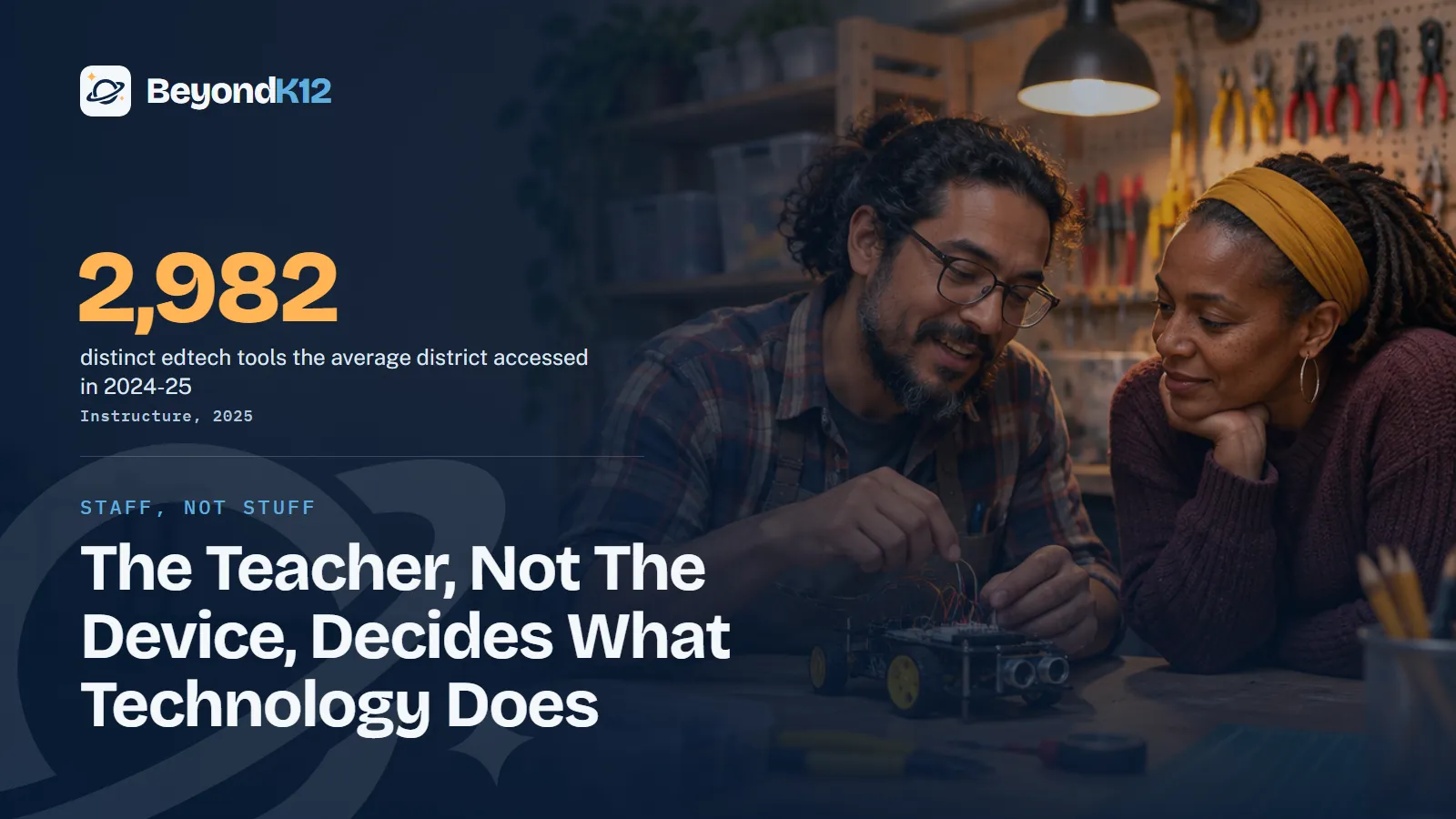
What does it take to be great with technology in the classroom? A device in the hands of every student is not the answer: it takes a teacher with confidence, competence, and content, the skills we call "the 3 C's."
In 2015 I wrote that those skills were probably not covered in teacher preparation programs. By well connected, I mean a teacher connected to the tools, to colleagues who can show how they work, and to lessons with a clear reason for using them. When I wrote this in 2015, I argued that a technology plan should put teachers and the 3 C's at the center. Eleven years and one AI wave later, the evidence points the same way.
- The 3 C's for teacher technology productivity
- Confidence comes from professional development. Competence comes from modeling and best practices. Content comes from lesson development.
Why do teachers matter more than devices?
When you consider all of the variables in technology integration, the greatest variance usually involves the teaching staff. We surveyed and assessed the skills of thousands of teachers, and when I wrote this in 2015 our data showed a very consistent distribution.
Teacher technology skills in our assessments
That spread was greater than what we saw in student skills or infrastructure readiness. Half of a typical staff sat in the middle, and a quarter sat below it. Yet most technology plans focused on infrastructure and device acquisition. Even plans centered on students and digital curriculum lacked enough focus on teachers and the skills they need.
The stuff has only multiplied. Instructure's EdTech Top 40 found that districts accessed an average of 2,982 distinct edtech tools in 2024-25, and that educators accessed 50 tools a year. That report measures engagement, not effectiveness. It tells you how much a teacher is asked to sort through.
Invest in staff before stuff, because a tool only does what the teacher knows how to ask of it.Ernie Delgado, BeyondK12
Confidence: why does professional development come first?
Teachers will not use what they are unsure of. The clearest current example is AI. In the OECD's TALIS 2024 survey, 70% of U.S. lower secondary teachers who had not used AI in their teaching in the prior 12 months said they lacked the knowledge and skills to teach with it. Only 27% said their schools lacked the infrastructure. The gap was skills more than hardware.
U.S. lower secondary teachers overall name their needs clearly. Skills for using AI in teaching and learning topped their list of high professional learning needs at 22%, and technical skills for digital resources and tools came in third at 10%.
Confidence also tracks with control. Gallup found that 67% of teachers with a lot of oversight of student devices agree digital tools help students learn, compared with 49% of those with little or none. Only 42% report a lot of oversight. Training on how to manage devices in the room is confidence work, not only tool training.
Competence: how do teachers learn what good looks like?
Competence comes from seeing it done. Gallup's 2025 study for the Walton Family Foundation found that teachers name observing others' teaching as their most valuable development activity (43%). Just one in three report having the opportunity to observe their peers.
Gallup's 2026 Screen Wise study shows what that looks like for technology. Teachers are about evenly divided on whether they want more guidance on learning devices: 47% would welcome it and 53% would not. So do not assume every teacher needs the same thing.
55%
of teachers who want more device guidance want clear, classroom-ready examples of best-practice use.
Gallup, Screen Wise, 2026
42%
of teachers who want more guidance prefer it from their own principal or administrator. Only 8% point to ed tech or curriculum vendors.
Gallup, Screen Wise, 2026
That second number is a message to every leader, and to companies like ours. Teachers want modeling from people who know their building. Your strongest teachers are your best technology training, if you give them the time to show others.
Content: why is lesson development the missing piece?
A tool without a lesson is a distraction with a login. In Screen Wise, among teachers whose students use learning devices, only 33% said a new tool's learning goal or instructional purpose is clear all or most of the time, and only 37% said tools are adequately reviewed that often.
How teachers see new classroom tools
Clarity matters beyond the lesson. Teacher engagement rose from 18% among teachers who say the goals of new technology are rarely or never clear to 46% among those who say they are clear all or most of the time. Input matters too: 70% of teachers who have been asked for input say digital tools help students learn more effectively, compared with 55% of those who have not.
AI raises the stakes here. In TALIS 2024, 43% of U.S. lower secondary teachers reported using AI in their work, and 70% of those teachers used it to generate lesson plans or activities. A generated plan is a draft. Deciding what it is for, and whether it fits these students, is still the teacher's job.
Where do the 3 C's matter most?
I wrote in 2015 that edtech had two camps. One believed in automation, apps, games, and adaptive software. The other believed in hands-on, project-based learning, where students use technology to solve problems. There is no denying that apps and game environments can benefit students. The workplace, though, will need thinkers, problem solvers, and creative people who have mastery over technology and can innovate with it.
Project-based work takes a more prepared teacher. That was true of DIY, STEM, coding, and the maker community in 2015, and it is truer now that AI can produce a finished-looking answer. In our TechPlus AI curriculum, every project ends with the student explaining their work, which only works when the teacher can ask the right questions. Does it require more teacher involvement? Absolutely.
| Attribute | What it looks like | What a leader can do |
|---|---|---|
| Confidence | Teachers try a new tool without waiting to be told | Offer leveled training built on what teachers say they need |
| Competence | Teachers have seen good practice in a real classroom | Cover classes so teachers can observe each other |
| Content | Every tool in a lesson has a stated learning goal | Give planning time, and ask teachers before you adopt a tool |
How can a school build the 3 C's this year?
- Find your own distribution. Survey staff skills before you plan training. Expect a wide range, and do not build one session for everyone.
- Fund staff before the next purchase. Set aside time for professional development, modeling, and lesson development when you budget for technology. It takes more time up front.
- Open classroom doors. Schedule peer observation for a small group each month and let your strongest teachers host.
- Ask for a purpose statement. Before adopting a tool, write down its learning goal in one sentence, and ask teachers to weigh in.
- Build lessons together. Give grade or subject teams time to turn one tool into one tested lesson. Connect them with their own learning networks for ideas.
Where to start this week
Pick the tool your school paid for most recently and ask three teachers what it is for. If you get three different answers, you have found your first piece of content work. An investment in staff, not stuff, is what makes this work. Our professional development can help with the training, and your own teachers should lead the modeling.
To see how ready your people are for AI specifically, take the free AI Readiness Assessment. It takes five minutes and scores your school across Policy, People, Curriculum, Guardrails, and Funding.
Related reading: Professional development for educators in the era of human and AI collaboration: what works in 2025-2026 and Why technology workshops for teachers are necessary, and what makes them stick.
Questions school leaders ask
What are the 3 C's for teacher technology productivity?
Confidence, built through professional development. Competence, built through modeling and best practices. Content, built through lesson development. Together they decide whether a device becomes a learning tool.
What does a well-connected teacher look like in 2026?
A teacher connected to the tools, to colleagues who can show how they work, and to lessons with a clear learning goal. It has less to do with the number of apps in use than with the purpose behind each one.
How do we build teacher confidence with technology?
Start with what is holding teachers back. In TALIS 2024, 70% of U.S. lower secondary teachers who had not used AI in their teaching said they lacked the knowledge and skills. Offer leveled training, then give teachers time to practice with colleagues.
Do teachers want more guidance on classroom technology?
About half do. Gallup found 47% would welcome more guidance on learning devices and 53% would not. Among those who want it, 55% want classroom-ready examples of best-practice device use, and they most often want it from their own principal or administrator (42%).
How many edtech tools does a district use?
Instructure's EdTech Top 40 reported that districts accessed an average of 2,982 distinct tools in 2024-25. The report measures engagement only, not effectiveness, so the number shows how much there is to manage and not how well it works.
Sources
- eSchool News, Instructure EdTech Top 40 coverage: districts more selective about edtech tools (July 2025) (opens in a new tab) (checked 2026-11-05)
- OECD, Results from TALIS 2024 country note: United States (October 2025) (opens in a new tab) (checked 2026-11-05)
- Walton Family Foundation and Gallup with the Joan Ganz Cooney Center, Teaching for Tomorrow: Screen Wise (September 2026) (opens in a new tab) (checked 2026-11-05)
- Gallup, Screens ubiquitous in classrooms; teachers split on efficacy (September 2026) (opens in a new tab) (checked 2026-11-05)
- Gallup and Walton Family Foundation, Teaching for Tomorrow: How supporting teachers today shapes classrooms tomorrow (2025) (opens in a new tab) (checked 2026-11-05)
- BeyondK12, 3 key attributes of a well connected teacher (original post with the assessment distribution) (opens in a new tab) (checked 2026-11-05)

See where your school stands on AI, in five minutes
Eight questions. A score out of 24 across Policy, People, Curriculum, Guardrails, and Funding, with the three fixes that move it most. The report is yours whether or not you ever call us.